Homeowner Finds the Survey Pins Confirming the Neighbor’s Fence Sits a Foot and Eight Inches Over the Line — Then the Neighbor Flatly Refuses to Move the Fence or the Shed Built Beside It
Photo credit: AI-generated image created using ChatGPT. Illustrative only.
It started the way a lot of property-line problems do: someone builds something that “looks about right,” and the person next door is left staring at a brand-new fence that doesn’t feel right. On a small, cookie-cutter lot, that feeling can turn into a gut-punch fast, because there’s not much extra space to lose.
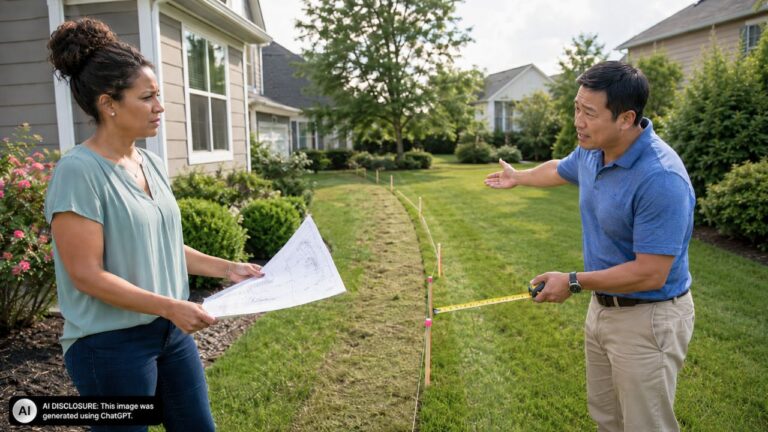
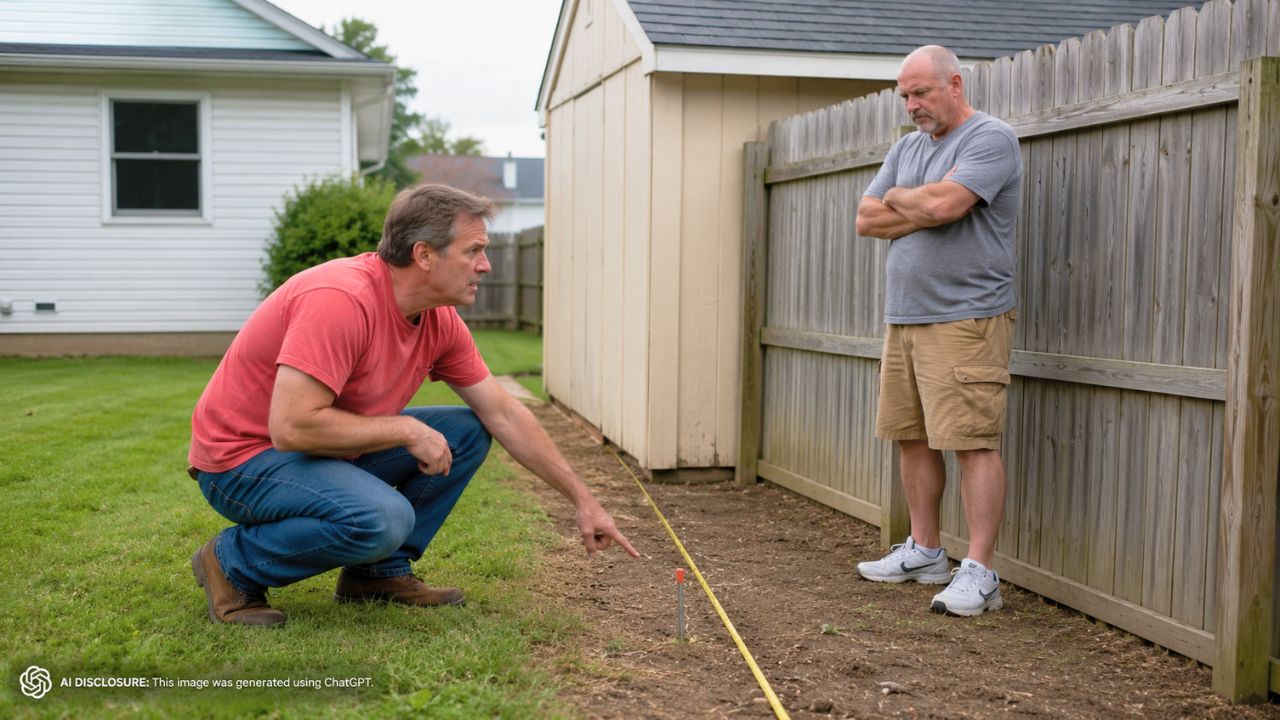
In the original post, a homeowner says they located the survey pins in the ground and realized the neighbor’s fence isn’t just close to the line—it’s 1 foot and 8 inches over it. Then the neighbor added a shed in the corner, and the homeowner says that structure is also partially on their side of the property boundary.
The pins were still there, and the numbers didn’t lie
Some homeowners never find their survey markers after moving in. They get buried, landscaped over, or forgotten until something forces the issue. Here, the homeowner says the pins were still in place, and they used a plat map that shows pin locations and lot sizes to confirm what they were seeing.
That detail matters because it’s the kind of proof people hope will end an argument quickly. If the corner markers are there and match the recorded plat, it feels like a clean, simple “here’s the line.” On tight lots—less than a quarter acre, like this one—even a foot can change how you use a side yard, where you can place your own fence, or whether you can access a corner for mowing and maintenance.
But what seems obvious on paper can get messy once the other party decides it’s not their problem.
First it was a fence—then a shed showed up beside it
A fence over the line is aggravating, but many neighbors still treat it like something that can be adjusted: move the panels, reset posts, shift a run. The homeowner says this one didn’t stop there. A shed went up in the corner of the neighbor’s yard, close to the fence line, and now that shed is partially encroaching too.
That’s when the stakes jump. A shed isn’t just a boundary marker—it’s weight on the ground, potential electrical work, a roof shedding water, and a structure that can block access. It’s also the kind of thing that starts raising bigger questions: if someone later sells the house, does that shed become a permanent argument? If a storm damages it, whose insurance gets dragged into it? If the shed needs repairs, are workers going to step onto the wrong property to do the job?
The homeowner isn’t describing a theoretical future headache. They’re looking at a physical one already sitting there.
The conversation didn’t fix it—because the answer was “no”
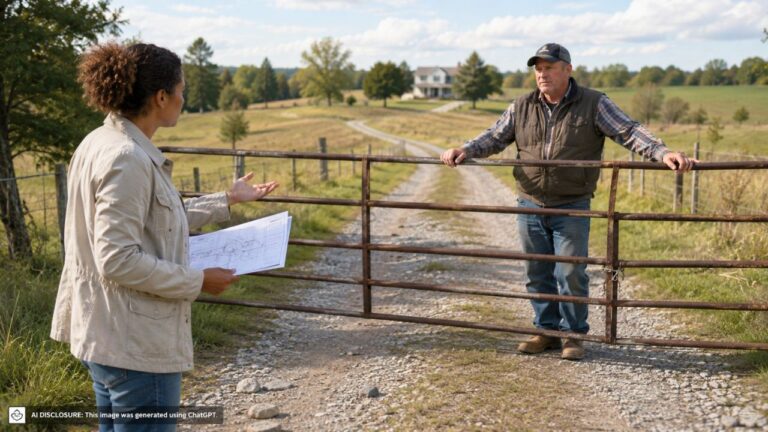
Not every neighbor dispute turns into a standoff. Sometimes a calm talk is enough to get a project corrected before it’s fully finished. The homeowner says they tried that route: they spoke to the neighbors about the fence and the shed being over the boundary.
The response was blunt. The neighbors said they’re not moving or taking down anything.
That’s the moment a lot of people recognize they’re no longer dealing with a misunderstanding or a contractor mistake. They’re dealing with someone willing to leave a known encroachment in place—and willing to bet the person next door won’t be able to force the issue.
The real pressure point: “I can’t afford an attorney”
The homeowner’s biggest worry isn’t measuring a line or finding a map. It’s money. They say they can’t afford an attorney and are trying to figure out what government entity can help, especially since their city’s code enforcement site specifically says it can’t get involved in property line disputes.
This is where a lot of homeowners get trapped. The problem looks like it should have a simple municipal fix—like a permit violation, a setback rule, or some building inspector showing up with a clipboard. But boundary lines are typically treated as private property matters, meaning a city may not want to referee who owns what, even if the structures are visible from the street.
And when the lot is small, the homeowner may feel the loss more sharply. A foot and eight inches doesn’t sound huge until you picture it running the length of a yard, or until you realize it shifts where you can place your own improvements. It can complicate future fencing, landscaping, drainage work, and even something as basic as walking a mower along the edge without bumping a fence that isn’t supposed to be there.
That’s the squeeze: the homeowner has physical proof in the ground, but no obvious public office stepping in to enforce it.
What other homeowners zero in on in disputes like this
Even without a long comment thread included, the homeowner’s questions point straight to what people tend to focus on when a fence crosses a line: documentation, escalation steps, and preventing the problem from becoming “normal.” When a neighbor refuses to move an encroaching structure, time starts to feel like an enemy because the longer something sits, the more complicated it can be to unwind socially and practically.
Homeowners in similar disputes often talk about doing everything in writing once the first conversation fails. Not to be dramatic, but because memory gets slippery fast—what was said, when it was said, whether permission was implied, and whether the property owner “didn’t mind.” When a neighbor has already taken the position that nothing is moving, the next interactions can start to look less like a chat and more like building a record.
They also tend to look at the shed differently than the fence. Fences are common and sometimes installed wrong; sheds can trigger separate questions about permits, setbacks, and whether the structure is allowed that close to a line in the first place. Even so, the homeowner has already checked their city’s code enforcement language and found a dead end on the boundary issue, which is exactly the kind of disappointing “we don’t handle that” message that leaves people feeling stuck.
A small strip of land can turn into a long-term problem
The frustrating part is how ordinary the neighborhood sounds: a standard residential subdivision, small yards, a plat map, pins where they should be. This isn’t a remote property with unclear boundaries or a decades-old fence line nobody remembers agreeing to. It’s a modern-style layout where you’d expect the edges to be easy.
But the homeowner is now staring at two structures—one long and one bulky—that they say are sitting on their land. And the neighbor’s refusal means the homeowner is left weighing bad options: live with it, spend money they don’t have, or gamble on finding some enforcement angle through setbacks or permitting that may or may not apply.
In neighborhoods like this, the real cost isn’t only the lost space. It’s the daily reminder, right at the edge of the yard, that one person can make a unilateral decision and force the other to fight just to get back what they already own.
Like Fix It Homestead’s content? Be sure to follow us.