Homeowner Notices the Neighbor Mowing Three Feet Onto Her Side of the Yard and Parking a Car Under a Tree There Too — Then Learns Staying Quiet Could Let Him Claim the Strip for Good
Photo credit: AI-generated image created using ChatGPT. Illustrative only.
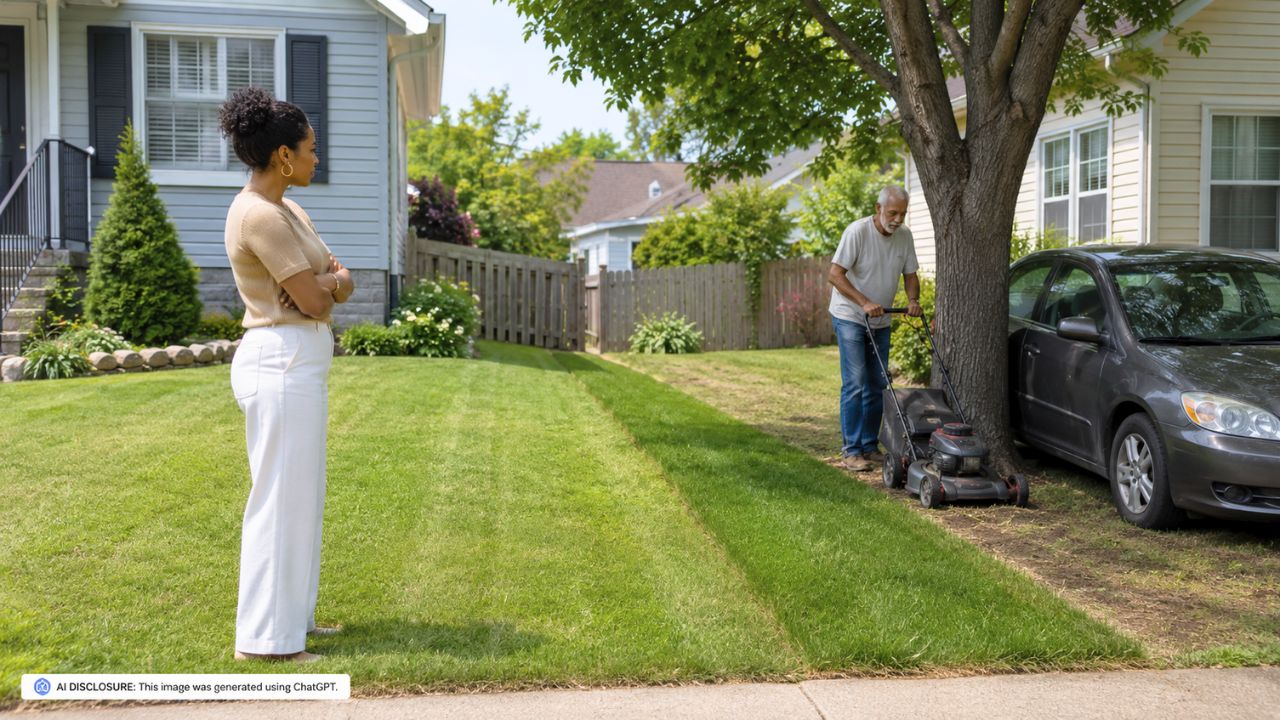
It started as one of those little things you notice from the window and try not to turn into a whole drama. A homeowner who moved in back in May began seeing the neighbor’s mower consistently drifting about three feet past what seemed like an obvious property line. Not once, not by accident—just a habit, like that strip belonged to them.
Then the second habit showed up: the neighbor’s car parked under a tree on the homeowner’s side, right in front of the home. The homeowner laid it out in the original post and asked the question that makes these boundary problems feel urgent fast: if you don’t say anything, can a neighbor eventually claim that piece of yard?
The first sign was easy to brush off
If you’ve ever bought a house and spent the first few months just trying to get your footing, this part will feel familiar. The homeowner admitted they didn’t get a survey during the purchase, but planned to get one soon. In the meantime, they went off what “seems rather obvious” when it comes to where one yard stops and the other begins.
That’s exactly where these problems love to live: in the space between “obvious” and “official.” A mower creeping a few feet over can look like someone trying to be nice, making the edge look tidy. Or it can look like someone slowly training the neighborhood to see the property line a little differently.
In a lot of neighborhoods, mowing patterns become their own unofficial map. People repeat what they see the last owner doing. They follow the “line” the grass seems to suggest. And once it’s been that way for a while, everybody starts talking about it like it’s real.
Three feet of grass turns into a claim of control
The homeowner wasn’t describing a one-time cut where the neighbor overshot the edge. They said the neighbor’s habit is to go about three feet in on their side. That’s not trimming along the border. That’s taking a stripe of lawn and treating it like part of your weekly routine.
And it wasn’t just the mower. The neighbor also had their car parked under a tree on the homeowner’s side. Parking is different from mowing because it’s visible for longer. It signals use. It signals comfort. It signals, “This is where I put my stuff.”
That’s the kind of detail that makes homeowners stop shrugging and start documenting. A car under a tree can mean drips, ruts, and dead patches from compacted soil. It can mean broken branches if the tree sheds limbs. It can mean access issues if the homeowner needs that side clear for landscaping, tree work, or even just getting equipment around the yard.
The homeowner said they planned on saying something, but they were “planning for the worst.” That’s the headspace boundary disputes create: you’re not just thinking about the lawn, you’re thinking about escalation.
The missing survey made everything feel shakier
The most stressful part of this story is also the most common: they bought the home without a survey. That doesn’t mean they did anything wrong. Plenty of purchases close without one, especially if the lender doesn’t require it and the property lines seem straightforward.
But once a neighbor starts acting like the edge of your yard is negotiable, “straightforward” stops feeling like a safe bet. The homeowner said a survey was coming soon, which is usually the first real step when someone is worried about a strip being treated like shared space.
Without that paperwork, everything becomes a conversation about vibes. Where the tree sits. Where the yard “looks like” it ends. Where the last owner may have mowed. Even the word “obvious” can get thrown back at you—because what’s obvious to one person is “not how it’s always been” to another.
That uncertainty is also why people worry about a neighbor eventually claiming land. The homeowner’s question wasn’t just about etiquette. It was about whether silence could be used against them later.
Parking under the tree raised the stakes
The car parked under a tree on the homeowner’s side is the detail that makes this feel less like a landscaping misunderstanding and more like a boundary test. Mowing can be framed as accidental. Parking is deliberate. You don’t absentmindedly store a vehicle on someone else’s land and keep doing it.
It also creates a day-to-day pressure point. Does the homeowner ask them to move it every time? Do they wait until the survey comes in? If they say nothing, does it become normal enough that the neighbor starts treating that tree and the ground beneath it like their personal shade spot?
And there’s the practical side: if a branch drops and dents that car, whose tree is it? If the ground gets torn up, who fixes it? If the homeowner wants to prune the tree or put in a fence, will the neighbor act blindsided because they’ve been “using that spot”?
Even when nobody is threatening lawsuits, the everyday mess can be expensive. Lawn damage, tree work, and fencing projects don’t get cheaper just because a neighbor got comfortable.
Most reactions pushed proof first, then a calm boundary talk
The homeowner didn’t paste in the replies, but this kind of post tends to pull the same practical drumbeat from experienced homeowners: get the property line verified, then address it clearly. People who’ve lived through boundary disputes usually don’t recommend starting with accusations. They recommend starting with facts.
A survey gives the homeowner something solid to stand on, especially if the neighbor tries to argue that the line is somewhere else. It also helps the homeowner plan what comes next—whether that’s subtle markers, landscaping changes, or a fence—without guessing where to put anything.
Another common reaction in these scenarios is documentation. Not in a dramatic way, just enough to establish a timeline: when the mowing started, how far over it goes, how often the car is there. That’s not about “winning.” It’s about not being the person who realizes two years later they can’t remember when it began.
And when it comes time to talk, most seasoned homeowners push for a calm, direct approach. Something along the lines of: once the line is confirmed, “Hey, I’m going to be maintaining my side from here on out, and I need you to keep mowing and parking on your side.” Clear, simple, not an invitation to debate history.
Quiet can feel polite, but it can also rewrite the map
The homeowner’s worry—could staying quiet let the neighbor claim that strip—gets to the heart of why these small property issues blow up. Because it’s rarely just about grass. It’s about what happens when repeated use becomes a story: “That’s basically my yard,” or “We’ve always done it that way.”
They moved in May. They’re still new enough that the neighborhood routines aren’t set in stone. That can work in their favor if they act early, but it can also make them feel like the outsider who’s “making a big deal” over a few feet of lawn.
The hard part is that three feet is not nothing. It’s room for a fence line to shift visually. It’s room for a garden bed, a shed corner, a row of shrubs, a path. It’s room for a future argument that doesn’t start with grass at all.
For now, the homeowner seems to be in that tense waiting period—planning a survey, planning a conversation, and hoping the neighbor takes it like a normal boundary reset instead of a personal attack. The longer the mower keeps crossing and the car keeps parking under that tree, the more “normal” it feels to everyone watching. And that’s exactly why they don’t want to let it slide.
Like Fix It Homestead’s content? Be sure to follow us.