Homeowner Pays to Landscape a Shared Alley for Her Tenanted Neighbors — Then Their Own Demand for a Survey Backfires and Reveals Their Shed and Fence Sit on Her Property Instead
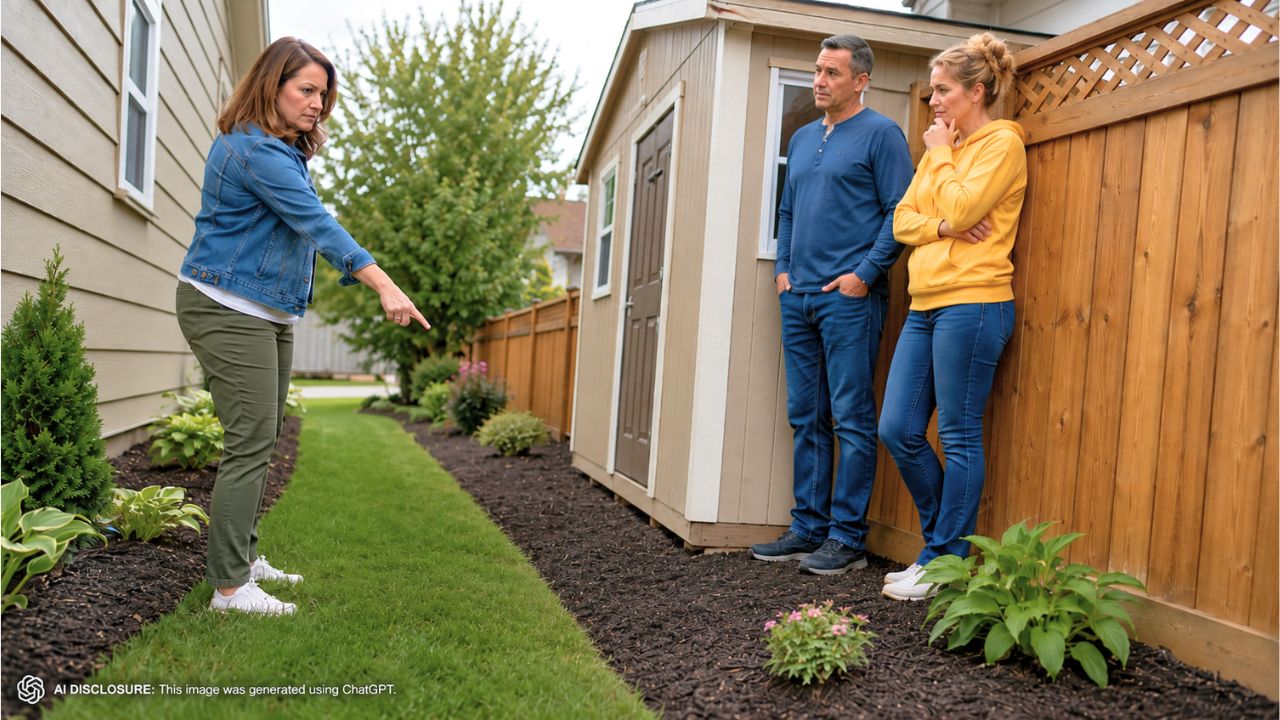
Photo credit: AI-generated image created using ChatGPT. Illustrative only.
It started like one of those neighborly upgrades that’s supposed to make everybody’s life easier. An Ontario homeowner hired out landscaping for her backyard and decided to include the narrow alley between her house and the rental next door, even though the neighboring property is owned by landlords and occupied by tenants. She says she spoke directly with the owners first, and at the beginning, it was all friendly verbal agreements.
Then the conversation shifted from “nice improvements” to “who gets to use what.” In the original post, the homeowner explains that the neighbor-owners began insisting they had access rights through that alley to reach their property. She disagreed, checked both deeds, and says there were no easements granting access. The moment she pushed back, the tone changed—and the landlords demanded she pay for a survey.
A simple landscaping job turned into a property-line standoff
The homeowner had already been spending money on the yard, and adding the alley felt like a practical choice: it’s right there, it affects drainage and appearance, and it’s the kind of shared-looking space that can become a headache if it’s left messy. She says she told the neighboring owners what she planned to do and that they initially discussed upgrades amicably.
But as soon as access came up, it became less about landscaping and more about control. The homeowner’s position was basically: “This is on my side, and there’s no legal right for you to cross it.” The neighbor-owners responded by telling her to “get a survey,” then refused to contribute to the cost.
That’s a familiar trap for homeowners: you get pressured into proving something you didn’t start arguing about in the first place, and you’re the one paying for the paperwork just to keep the peace—or to keep the project moving without regret later.
They pushed for proof—then didn’t like what the proof showed
She went ahead and ordered the survey anyway, saying she wanted to do everything “by the book,” even though she felt resentful that the demand cost her “so much financially and emotionally.” She paused the work until the boundary was confirmed, then finished the job.
One detail adds to the tension: she didn’t explicitly tell the neighbors she’d completed the survey, though she notes the line staking would have been obvious on the ground. So there wasn’t a big sit-down moment where everyone reviewed the results together. The proof just appeared in the form of stakes and markings—and then the results.
And the results didn’t support the neighboring owners’ posture. The survey showed the fence between the two properties sits on her land. More importantly, the frame of the neighbors’ shed encroaches onto her property by about three inches.
Three inches doesn’t sound like much—until it’s a shed
On paper, three inches is tiny. In real life, it’s a structure, a foundation or skids, and a longstanding assumption that can harden into “that’s just where it is.” It’s also the kind of thing that makes a future sale messier, because encroachments can become disclosure issues and can complicate title insurance conversations or buyer negotiations.
The homeowner isn’t just annoyed about the measurement. She’s bothered by the overall dynamic: she paid to upgrade a space that benefits the rental next door, then paid for a survey she didn’t want, and now she’s staring at proof that the neighbors’ improvements weren’t even on their own side.
She also says the owners have been “very rude and unpleasant,” and that she has recordings of those interactions, including them telling her to get a survey. That matters because it shows this wasn’t a misunderstanding between friendly neighbors—it became adversarial, and she’s already thinking in terms of documentation and defensible next steps.
The real fear is letting it sit until it becomes “the new normal”
The homeowner’s post isn’t a victory lap. It reads more like someone who got the facts and still feels powerless. She says the situation is “really playing on me,” and that even though she feels like she “holds the cards evidence wise,” she still feels small.
That emotional piece is what drives a lot of property disputes. The stress isn’t just about land; it’s about what happens next. If you do nothing, do you risk the encroachment becoming harder to deal with later? If you say something, do you trigger retaliation, harassment, or constant friction with the people living ten feet away?
She’s specifically worried about time—about leaving the shed issue unresolved so long that she “can’t undo” it. And she doesn’t want the neighbors to keep thinking they have access across her land, especially since she already checked for easements and found none.
Demand letter, shed move, survey costs: the choices all have a price
Her legal questions are straightforward and painfully relatable. First: is it worth asking them to move the shed “for the sake of 3 inches,” or will she get laughed off? Second: can she ask them to pay for the survey, or at least part of it?
Underneath those questions is the practical homeowner reality: even when you’re right, enforcing “right” costs money and energy. Moving a shed can mean coordinating with landlords who don’t live there, dealing with tenants who may not care, and possibly hiring contractors. Even if it’s only a few inches, it’s still a structure that has to be lifted, shifted, and set back down—without damage, without creating a new drainage issue, and without escalating the dispute.
She mentions wanting to send a demand letter but being nervous about repercussions. She also says she doesn’t particularly want to speak to them again. That’s another common crossroads in neighbor fights: direct conversation feels unsafe or pointless, but formal communication feels like lighting a fuse.
What people tend to push in these disputes: paperwork first, emotions later
While the post itself doesn’t include a long comment thread, the way the homeowner describes her approach is consistent with the practical playbook people usually recommend in property-line messes: verify the boundary, document everything, and be deliberate about communications.
She already did the big step that many homeowners put off for years: she got the survey and had the line staked. She also has recordings of the neighbor-owners’ statements and behavior, which shows she’s thinking about evidence if things keep going sideways.
The remaining fork in the road is escalation style. Some homeowners in similar spots choose a slow, formal route—written notice, clear deadlines, and professional language—because it reduces the risk of a heated face-to-face exchange. Others try one last calm conversation to see if the other side will quietly fix it once they realize the survey didn’t go their way.
Either way, the shed and fence now aren’t theoretical. They’re measurable. And once something is measurable, it stops being “a misunderstanding” and starts being “a thing that sits where it sits.”
The homeowner went into summer expecting a nicer yard and a smoother-looking alley. She came out of it with fresh landscaping, a big survey bill, and the uncomfortable knowledge that the neighbor’s fence and shed are partly on her land. The hardest part isn’t the three inches—it’s deciding whether to enforce them, and how to do it without turning a property line into a daily grind.
Like Fix It Homestead’s content? Be sure to follow us.