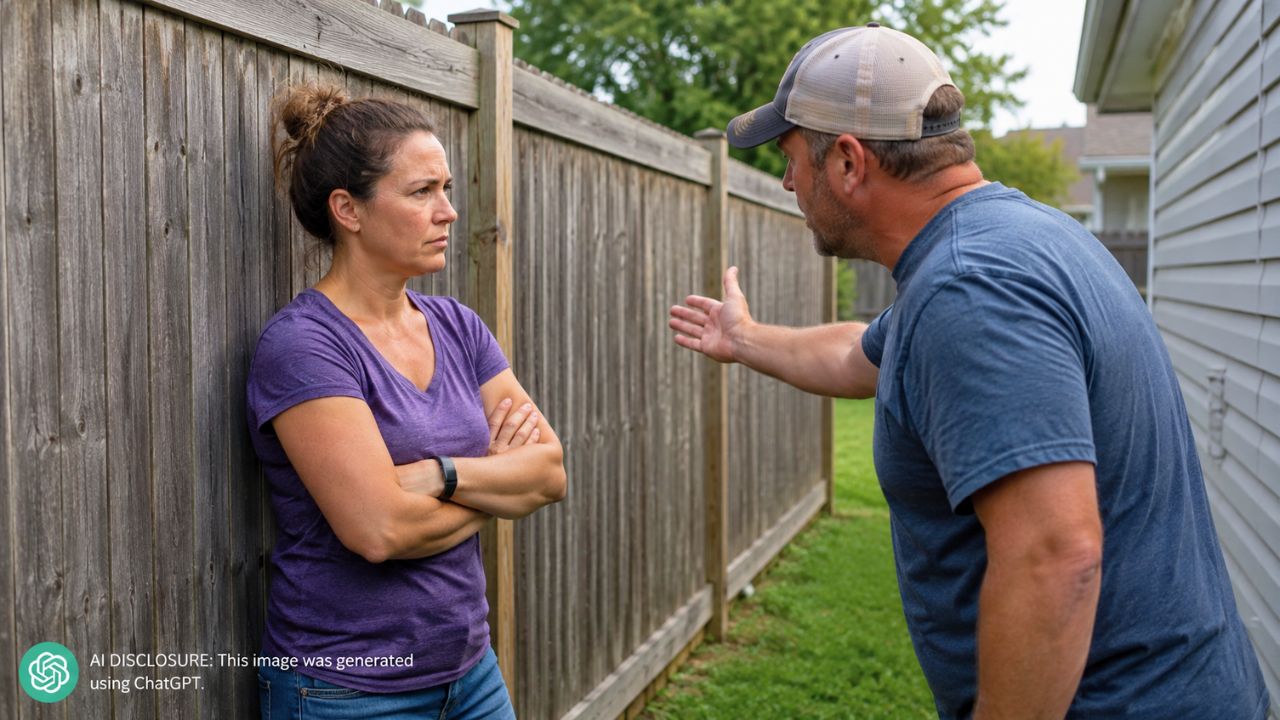
Homeowner Refuses for Years to Let a Neighbor Tie Into Her Fence to Save Money — Then the Husband Comes Over Himself, Seemingly to Intimidate a Single Woman Into Saying Yes
Photo credit: AI-generated image created using ChatGPT. Illustrative only.
When you buy a house, you expect the usual surprises: a sticky door, a mystery light switch, maybe a flowerbed that turns into a weekend project. One homeowner moved into a place with an old chain-link fence left behind by a former tenant—nothing fancy, just a quick dog run that happened to sit close to the side of the house.
But on move-in day, the neighbor showed up with a request that would turn that “whatever” fence into a years-long standoff. In the original post, the homeowner describes how the neighbor—who ran a daycare out of her home—wanted to build her own fence and “save money” by tying it into the existing one instead of paying for a full side.
The first ask came fast, and it didn’t feel casual
The fence didn’t matter to the new owner. No dog, no need. But the neighbor’s request came immediately, and it came with a very specific benefit: she wanted to skip fencing one entire side by connecting to what was already there.
That kind of shortcut can look harmless if you imagine fences like Lego pieces. In real life, property lines don’t care what’s convenient. And the homeowner said she wasn’t willing to let someone else’s enclosure effectively use her structure as a boundary.
Her bigger fear was about land itself. If the neighbor tied into the fence and treated the area between the homes as part of her fenced yard—maintaining it for years—the homeowner believed that could eventually turn into a claim over that strip of property. With the houses only about 15 feet apart, the homeowner pictured a worst-case scenario where the neighbor’s “yard” would run right up to the edge of her house, even putting her air conditioner unit on the neighbor’s side of the line.
“No” didn’t stick, even after the reason was explained
Some neighbor requests are a one-time shot: ask, get told no, move on. That isn’t how it went here. The homeowner says she explained her reasoning and made it clear the answer wasn’t going to change—“no, she cannot now or ever tie into the fence.”
Then the same question kept coming back, on and off for years. Each time, the homeowner refused.
She even brought it up with her realtor, who had already dealt with the neighbor. The realtor’s reaction was immediate and strong, because the neighbor had tried the same pitch with her as well—and had been turned down there, too.
When the husband showed up, the tone shifted
Eventually, it wasn’t just the neighbor asking. The homeowner says the husband came over to ask about tying into the fence too, and it didn’t feel friendly.
She read it as pressure—possibly an attempt to push a single woman into saying yes. Whatever the intent, the effect was clear: the request had turned into a pattern, and the boundary-pushing felt personal.
Still, she didn’t budge. The fence was on her property, and she didn’t want any part of an arrangement that might complicate access, ownership, or future resale. It wasn’t about being difficult; it was about not handing a neighbor leverage inches from her exterior wall.
Proof in hand: a property line map and a long memory
At some point, the homeowner stopped relying on common sense and started relying on paper. She did the research and got the official property line map showing exactly where the boundary ran.
That matters because fence disputes rarely stay friendly when money is involved. A shared boundary can turn into shared expectations: Who repairs it? Who controls the gate? Who gets to attach things to it? What happens when one side wants to replace it, or sell, or build an addition?
By getting documentation early, the homeowner wasn’t just preparing for an argument—she was preparing for the day the neighbor tried to treat the fence as a joint asset. The repeated asks had already shown that the neighbor didn’t see “no” as final.
The day the fencing arrived, the homeowner made her move
The turning point came when the homeowner noticed a pile of chain-link fencing in the neighbor’s backyard. Not enough to complete the full fence the neighbor would need—just enough to make the plan obvious.
To the homeowner, it looked like the neighbor intended to tie in anyway, despite years of refusals. So she acted before the posts went in on the neighbor’s schedule.
That night, she removed her own fence completely. She took it down, rolled it up, and dug up every fence post.
It was a blunt solution, but it was also clean. If there was no fence to tie into, there was no shortcut to take. The neighbor could still build a fence, but she’d have to pay for all the materials and do it entirely on her own line.
The practical fallout hit immediately—especially with the daycare
The homeowner didn’t call inspectors. She didn’t negotiate. She just erased the temptation. And the consequences showed up right away in the neighbor’s daily life.
With the fence gone, the neighbor’s yard wasn’t contained the way it had been—especially important since she watched children as part of her daycare. The homeowner says the neighbor had to come outside to watch the kids because there were suddenly more ways for them to wander off.
On top of that, the neighbor’s fencing stash wasn’t enough anymore. Without a free side to connect to, she had to order more chain-link fencing and more posts, stretching out the project and forcing her to spend what she’d hoped to avoid spending in the first place.
It’s the kind of neighbor drama that never looks dramatic on paper—just a fence—but plays out in real time with real stress when someone’s trying to run a business out of their home.
What readers latched onto: boundaries, documentation, and never sharing a fence by accident
The post reads like a warning homeowners swap at kitchen tables: if someone keeps asking for something that benefits them and binds you, don’t assume it’s harmless. Readers tend to focus on the same themes the homeowner did—property lines, long-term claims, and the danger of letting a neighbor “borrow” a boundary.
Even without a blow-by-blow comment section included here, the homeowner’s actions reflect the most common practical advice people give in these disputes: document the line, keep records, and don’t rely on verbal agreements when structures sit inches from your home.
And there was one more layer: the homeowner treated the issue like it could follow her even after she left. When she sold the house, she handed the new owner—a single man—a care package that included the property line map and a note to watch the neighbors closely. She also used the same realtor again, and that realtor filled the buyer in on the history.
The fence is gone, but the tension didn’t magically disappear. It just moved into a new phase—one where the neighbors now know, for certain, that “no” means “no,” even if they show up in person and ask again.
Like Fix It Homestead’s content? Be sure to follow us.