Homeowner Watches Snider Creek Carry Away the Backyard She’s Owned Twenty-Five Years — Then the City Says Stabilizing the Bank Is Her Own Responsibility
Photo credit: AI-generated image created using ChatGPT. Illustrative only.
Helena Montgomery didn’t buy her North Arlington house for the countertops or the school district. She bought it for the backyard—the one that held birthday parties, cookouts, and every holiday gathering that needed fresh air and extra chairs.
Now she’s watching that yard slide away into Snider Creek, one storm at a time. And when she looks for help, the message coming back from the city is basically: the creek may be the problem, but the fix is yours. The details are laid out in the source post, and the picture it paints is the kind of homeowner nightmare that doesn’t have a clean “call a contractor and move on” ending.
The backyard didn’t “flood” — it started falling away
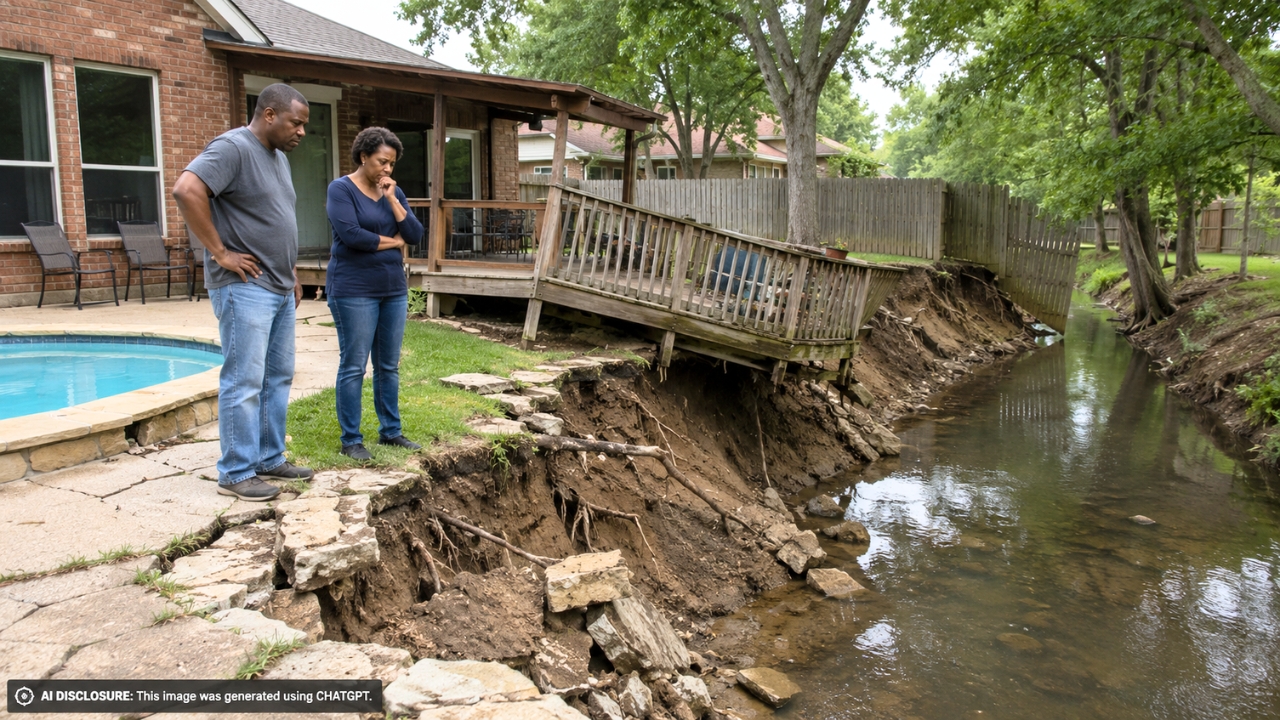
This isn’t the typical “water got too close to the patio” complaint. The Montgomerys describe their pool tilting so badly that the waterline looks higher on one side than the other. Their deck is uneven. Stonework has cracks and gaps. Calvin Montgomery says he can’t even mow parts of the yard because it feels like the ground could give way under him.
That’s the thing about creek-bank erosion: it doesn’t always announce itself with one dramatic collapse. It shows up as little changes you can rationalize—until you’re standing on ground that suddenly feels hollow, and the edge is closer than you remember.
Helena Montgomery said she used to feel proud of the house. Now she’s questioning whether she can afford to stay. That’s a brutal pivot when you’ve been in place for 25 years and the home is full of memories you can’t pack into a moving truck.
It’s not just one property — nearly 1,000 homes are dealing with it
Arlington City Council member Mauricio Galante, who represents District 1, told KERA there are close to 1,000 homeowners facing similar problems—some worse than what the Montgomerys are seeing. That number matters, because it shifts this from “one unlucky lot line” to a citywide pattern playing out behind houses where most people never see it.
Galante said Arlington is doing a good job preventing flooding, but admitted the city could do better on erosion. In other words: the city plan is focused on water getting into living rooms, not water eating the land behind the living room.
That difference sounds bureaucratic until you realize what it means on the ground. Flooding is an event. Erosion is a slow eviction notice.
When homeowners ask for help, the answer is: private creek, private problem
Arlington assistant director of public works Amy Cannon said the city is actively investing in flood mitigation, with stormwater funding supporting about $20 million per year in capital improvements through FY2031, prioritized for flood mitigation and public stormwater infrastructure.
But Cannon drew a hard line between flood mitigation and erosion control. In her statement, she said erosion is a natural process and the city does not have a program to stabilize every creek bank. Property owners, she wrote, are responsible for maintaining natural creeks on their private property and for building retaining walls or other stabilization to protect their land.
Arlington has about 112 miles of natural creeks and waterways running through it, according to a city presentation. Only 43 miles are on city-owned property. City officials say they maintain what they own—and that the rest belongs to the homeowners who happen to have a creek behind the fence.
To residents watching their yards unravel, that split feels convenient. Many of them believe development approved by the city over decades—more roads, parking lots, and buildings—has increased runoff into creeks, speeding up erosion. UT Arlington hydrologist Adnan Rajib said development has very likely contributed, describing the need for balance between building and preserving nature.
Retaining wall quotes are coming in like a second mortgage
There’s a popular suggestion that always pops up when creek banks start collapsing: build a retaining wall. The source story makes it clear why that advice lands like an insult for some of these homeowners.
Robert Blake, a resident of Prestonwood West and member of Arlington’s planning and zoning commission, said residents have received retaining wall quotes that in many cases exceeded $100,000—sometimes around half the value of the home. That’s not “tighten the belt and finance a repair.” That’s “do you keep the house or do you try to outrun the problem.”
Even Helena Montgomery said neighbors once saw estimates around $40,000 years ago. With inflation and more damage since then, she believes the number has climbed dramatically. And if you can’t afford the fix, you still own the liability: you disclose it when you sell, you watch buyers flinch, and you wonder whether you’re trapped.
Rajib also warned that isolated fixes don’t necessarily hold forever. If only one property gets armored and the neighboring stretch keeps eroding, the creek can chew around the protection and undermine it from the side. It’s the kind of project that works best as a continuous plan, not a patchwork of households spending whatever they can scrape together.
Prestonwood West watched a “lake” turn into a widening creek
In Prestonwood West, Blake said his backyard used to face Prestonwood Lake, created by damming a creek that feeds into Village Creek. Residents saw ducks and geese. People used rowboats and canoes. It wasn’t just scenery—it was a feature that shaped property values and how the neighborhood felt.
Then sediment built up. Blake said residents didn’t realize dredging was needed or that it was the HOA’s responsibility. In 2018, dangerous flooding hit, and the city breached the dam by removing ground from one side to let the water flow around it, according to residents and Galante.
Today, Blake describes it as a widening creek consuming backyards of 31 homes on either side. Fences hang in midair where the soil used to be. Stormwater has eroded underneath the dam. The ground is literally disappearing, which is a special kind of distress when your property line is also your safety line.
The neighborhood HOA sued in 2020, arguing the dam wouldn’t have needed to be breached if the city properly managed waterways, and that Arlington should pay to fix stormwater erosion damage after the breach. The city sought dismissal, arguing the court lacked jurisdiction and that the city has immunity. The suit was dismissed in 2021, residents appealed, and the appeal is still moving through the courts.
The “comment section” energy: document everything, because the bills are real
When homeowners hear “it’s on you,” the next move is rarely polite acceptance. It’s paperwork. It’s photos after every storm. It’s calling the city to get an evaluation on record. It’s gathering bids, even when the bids are terrifying, because you need hard numbers to prove this isn’t cosmetic.
And you can see that instinct all over this story. Galante says he’s visited more than three dozen homes and often goes with city staff to see erosion firsthand. That detail matters: residents aren’t just venting. They’re pushing for a paper trail and for city staff to stand at the edge of the problem and witness what a collapsing bank looks like up close.
Blake’s push for a possible utility-bill fee to fund repairs, Galante’s interest in grants, bonds, and even low- or no-interest loans—those are all “how do we turn private despair into a public project” ideas. Irving, the story notes, has obtained $35.6 million from the Texas Water Development Board for a creek project there, and residents want Arlington to chase similar outside money instead of leaving households to negotiate alone with gravity.
Cannon said city staff will evaluate whether there’s a public drainage issue or a threat to public infrastructure. But she also made it plain that an eroding creek bank on private property, by itself, doesn’t make stabilization a city responsibility. So homeowners are left trying to prove not only that damage is happening, but that it’s severe enough—or close enough to roads, bridges, or other infrastructure—to become everybody’s issue.
For the Montgomerys, the stress isn’t theoretical. Calvin Montgomery worries that when they eventually sell, they’ll have to disclose the erosion and that it could make the home harder to sell—or make it too expensive to move away. Helena Montgomery said she simply wants the city to do something.
And that’s where this sits: a backyard that used to hold family gatherings, now marked by cracks, tilt, and soft ground; a creek that doesn’t care about property lines; and a city telling residents that unless the damage threatens public infrastructure, the fix belongs to the homeowner watching their land wash away.
Like Fix It Homestead’s content? Be sure to follow us.