New Homeowner Breaks Ground on Family Land Owned for Generations — Then Digging Severs an AT&T Line With No Recorded Easement Anywhere
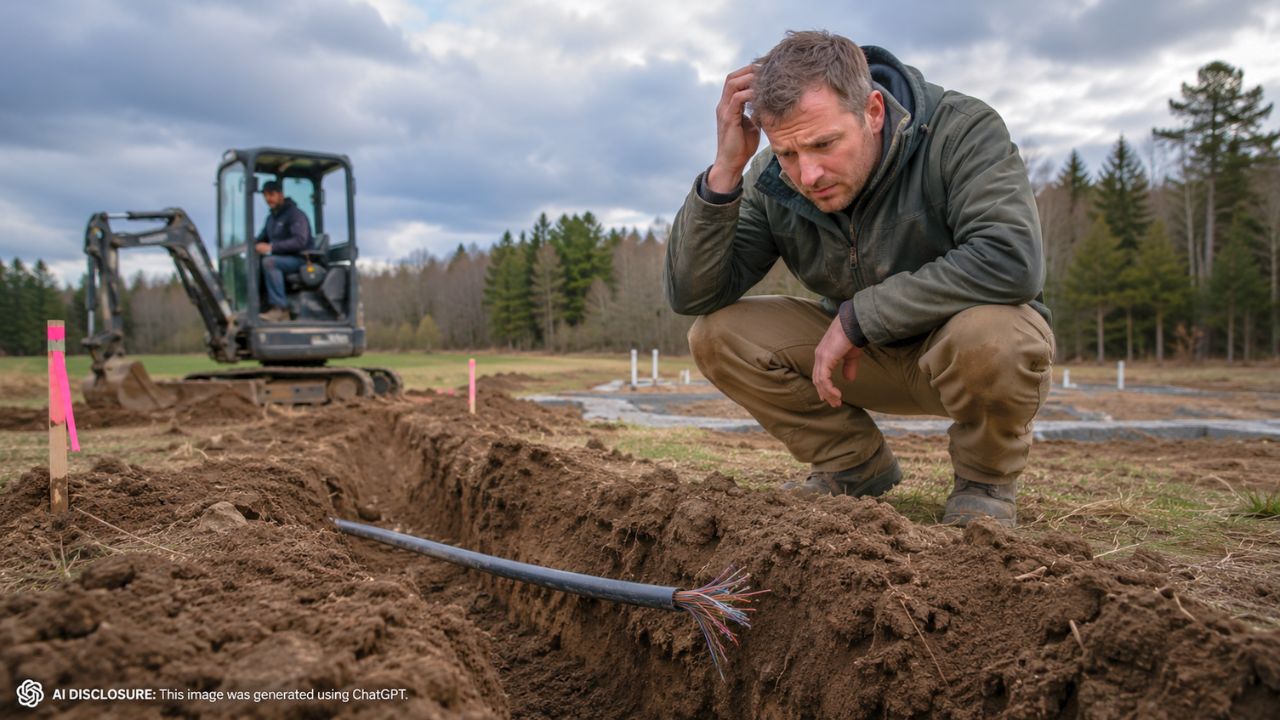
Photo credit: AI-generated image created using ChatGPT. Illustrative only.
The first couple hours of a new build are usually loud, messy, and satisfying—dirt moving, stakes turning into a real footprint. For one Ohio family, that excitement lasted right up until the excavator bucket hit something it wasn’t supposed to: a “mystery cable” buried in ground that had been in their family for nearly a century.
In the original post, the homeowner said their builder did what everyone tells you to do: call 811 before digging. The locate came back with no utilities noted. Then the cable got severed anyway—and within a couple hours, AT&T techs arrived, already tracking down what went wrong.
It was supposed to be clean dirt and a basement hole
This wasn’t a suburban infill lot with a spaghetti bowl of lines. The homeowner described the property as longtime pasture and crop land, bought by their great grandpa almost 100 years ago. In their mind, it was the safest kind of ground to dig: open land, no old foundations, no prior houses, no obvious utility corridors.
That’s why the no-marks result from 811 mattered. When contractors schedule an excavator, there’s a whole chain of planning that assumes the locate results are reliable: basement location, spoil piles, equipment staging, and the calendar that keeps a build on track.
Instead, they hit an unmarked cable almost immediately. The line was cut, and that’s when the build day went from “big milestone” to “stop everything and figure this out.”
AT&T showed up fast—and said the line was old
The response time told its own story. The homeowner said AT&T technicians arrived a couple hours after the line was severed, which makes sense if it was actively carrying service somewhere. At that point, the mystery cable wasn’t a mystery anymore.
According to what the homeowner was told on site, the line was first installed in the 1940s and upgraded in the 1980s. That detail raised a new problem: if it’s been there that long, why wasn’t it found in the locate process, and why can’t anyone point to recorded paperwork allowing it to cross the property?
Old infrastructure can live a long life underground. But when it’s sitting right where a new basement is going, “it’s been there forever” stops being comforting and starts sounding expensive.
The missing paperwork became the real fight
After the initial scramble, the homeowner’s attention turned to documentation. They said they couldn’t find any legal easement recorded anywhere that would give AT&T the right to run that line across the land. And if you’re building a house, this isn’t a theoretical question—you need to know whether a utility can demand access, force a route, or block construction.
AT&T sent an engineer out a couple days later. The homeowner said the engineer spoke with the builder and offered to “be nice and move the line around our house.” On the surface, that sounds like the best outcome: relocate the cable, keep the project moving, and avoid a long fight.
But the homeowner kept asking for the legal basis—proof of an easement—and said the answer stayed vague: the engineer reportedly told them AT&T’s legal team was working on it. Days passed, and the homeowner’s suspicion grew. If the documents were real and easy to pull, why weren’t they already in hand?
Now the builder is staring at blame, fines, and delays
The engineer also mentioned that the builder or excavator would “probably be fined,” according to the homeowner. That’s when the stress shifts from “unexpected obstacle” to “somebody’s about to get billed,” and everyone starts watching their own back.
From the homeowner’s perspective, the logic felt backwards. If 811 reported no utilities, and if there’s no recorded easement, how can there be a fine? And if the company can’t prove it has the right to be there, shouldn’t the homeowner be the one with leverage—especially if the discovery delays the build and adds costs?
That’s the pressure point: a new house build is basically a long line of scheduled trades, inspections, deliveries, and financing deadlines. A buried line in the wrong spot can trigger real-world consequences fast—change orders, rescheduling fees, idle equipment time, and the kind of delay that makes every other part of the project wobble.
People zeroed in on proof: maps, records, and who called 811
Even without a pile of comments included in the source material, the homeowner’s questions reflect the same practical instinct most property owners have in these moments: don’t argue from vibes—argue from paperwork.
When something is underground and everyone is pointing fingers, the details that tend to matter are unglamorous. Who exactly called 811, and what ticket number was issued? Was the request processed correctly, and did it cover the whole dig area? Were there any markings that got destroyed or missed? Was it an AT&T-owned line, or something maintained by another party?
On the property side, the focus naturally turns to records. A recorded easement is the cleanest answer, but older lines sometimes come with messy history—handshake deals, legacy routes that predate modern mapping, or rights that show up in unexpected places. The homeowner’s frustration makes sense: they asked repeatedly for documentation, and kept being told it was still being worked on.
The build site is stuck between “move it” and “prove it”
What makes this kind of problem so tense is that two things can be true at once. A line can be there, serving customers, and the company can still struggle to immediately produce a neat easement packet on demand. Meanwhile, the homeowner has a staked-out house plan and a hole that needs to be dug.
The engineer’s offer to route the line around the house sounds like a path forward, but it also raises questions the homeowner clearly doesn’t want to ignore: Who pays for that relocation? Does agreeing to a reroute quietly create a new easement? If the builder is blamed, does that turn into a fight between contractor insurance and the utility? And if construction continues, could there be another surprise cable a few feet away?
For now, the homeowner is left balancing two urgent goals: keep the project moving, and don’t accidentally sign up for a permanent utility right-of-way without getting compensated or properly protected. In rural and generational properties especially, the ground can hold decades of history that never made it onto the modern paperwork—and sometimes you only find out when the bucket hits it.
Like Fix It Homestead’s content? Be sure to follow us.