Owners Return From Winter Away to Find Twenty-Five Healthy Trees Felled on Their Land — Then a Lawsuit Says a Neighbor Wanted the Bay View
Photo credit: AI-generated image created using ChatGPT. Illustrative only.
You know that feeling when you pull into your place after being away for months and your eyes do a quick scan for storm damage, busted pipes, or a fallen limb? Now imagine that scan landing on a wide, bright opening where a living wall of trees used to be.
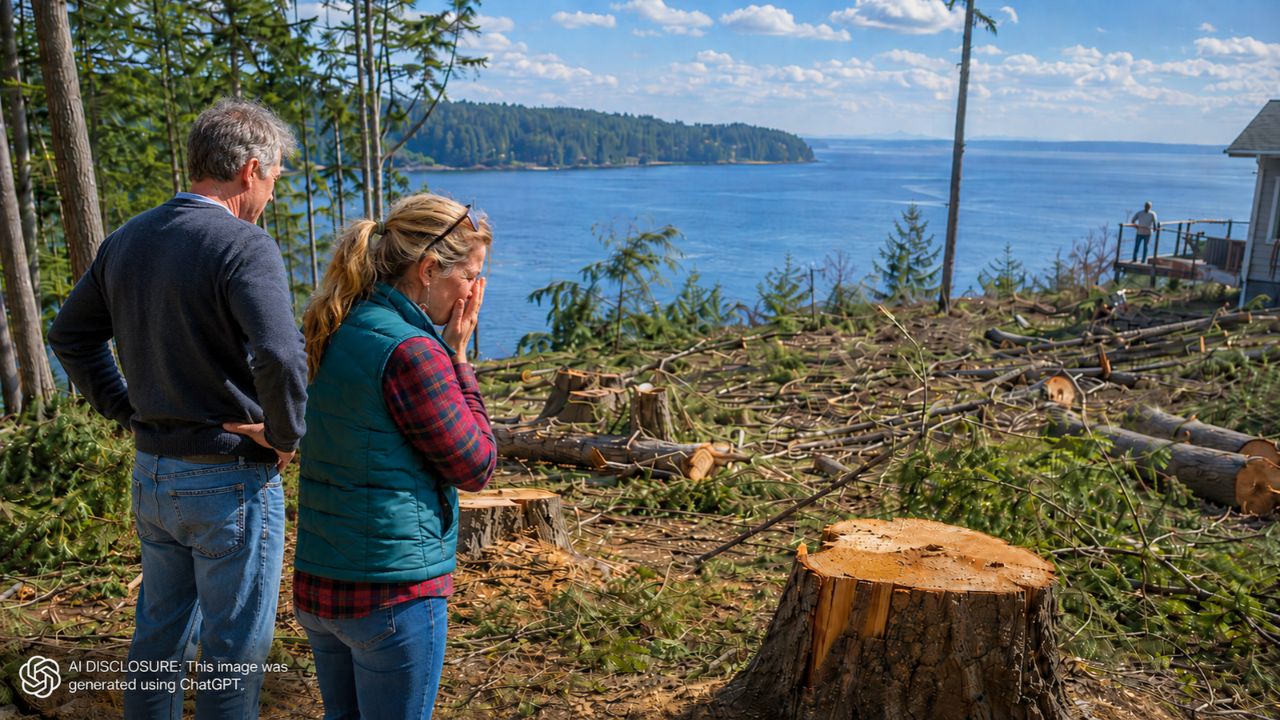
That’s what Carey Davidson and Peter Casperson say happened when they returned in late May 2024 to their 1.5-acre property on Knowles Heights Road in North Truro — and found 25 mature, healthy trees cut down, plus three more trees topped. The details were reported in the source post, which lays out a lawsuit that reads like every homeowner’s off-season nightmare: someone “cleaned up” the land while the owners were gone, and the reason alleged isn’t safety — it’s a better bay view for someone else.
Coming home to a different property
Davidson and Casperson own three rental cottages on the property, known as Lis Sur Mer. The trees weren’t just landscaping to them; the suit says the plantings created privacy for each cottage and turned what had been “a sandbar” into something like a cultivated oasis.
Casperson had history with that land, too. Court documents say he planted several of the trees back in the 1980s, the kind of long-term work that doesn’t show up as a line item until it’s gone.
They say they returned from a winter absence to find the work had already been done: 25 healthy trees felled, and three more left without tops. Not scattered across the lot, either — the suit claims the trees that came down were the ones blocking another property owner’s view of Cape Cod Bay.
How a “view” becomes a motive
Knowles Heights Road sits in a place where the water is the prize. The article notes that police logs in Truro have documented years of illicit tree cutting in that neighborhood, often off-season, when owners are away and there’s time to make a change before anyone notices.
In this case, Davidson and Casperson filed a civil lawsuit in Barnstable Superior Court on July 16, 2025. They allege that a nearby homeowner, Eric Martin of Whale Watch Drive, conspired with their property manager, Leo Parent, to remove the trees without permission — specifically to improve Martin’s view.
Martin’s property is described as lying behind theirs, and while it’s nearby, it does not share a property line with their land. That detail matters because it underlines how far a “view fix” can reach: not just trimming a shared edge, but allegedly going onto someone else’s property to change the sightline.
The property manager problem: when “maintenance” turns into removal
This isn’t framed as a random trespasser with a chainsaw. Davidson and Casperson’s lawsuit centers on a person with access and a role: their property manager, Leo Parent, who served from Jan. 28, 2023 to May 28, 2024, and was fired at the end of that period.
In Parent’s response, he claims one of his duties was to “bring 4 years of overgrowth back to life.” He also admitted that two trees, each around 20 feet tall, leaning onto fences, were removed for safety reasons while the owners were away.
Parent also addressed a locust tree that Davidson questioned him and Martin about when she returned. In Parent’s account, the tree had storm damage, and he removed a top limb to prevent it from falling through a rotting roof and damaging a boiler.
But Davidson and Casperson say what they found was much larger and more targeted than routine upkeep. They allege that the trees removed and topped were the ones that obscured Martin’s bay view, while other trees were left alone.
Denied, disputed, and suddenly very expensive
Martin and Parent have denied the claims. Martin admitted in court filings that he offered in November 2023 to cut down dead trees for free, and that he helped Parent remove “some dead trees and brush” while Davidson and Casperson were away. But he denied cutting any mature, healthy trees.
The lawsuit paints a different backstory: it says Martin befriended Parent in 2023 and used Parent as an intermediary to discuss the trees at Lis Sur Mer. It also says Martin met with Casperson on Nov. 18, 2023 and offered to remove dead trees at no cost in exchange for permission to cut live trees to improve his view — and Casperson declined.
Then there’s the money. Davidson and Casperson estimated replacement costs for the trees at $243,200. Massachusetts law goes further: if someone knowingly removes or destroys trees on another person’s land without permission, they can be responsible for three times the value. That’s how a landscape loss can turn into a claim nearing $750,000.
Martin’s liability insurer has hired an attorney for his defense, and the policy covers claims up to $1 million. But court documents say the company had not yet determined whether the alleged tree cutting would be covered.
Proof becomes the whole fight: stumps, timing, and who was there
Tree disputes have a brutal practical problem: by the time you see it, the best evidence is already cut down.
Davidson and Casperson say they were away from mid-March until late May 2024. The timing matters because Casperson did oversee removal of some trees killed by black pine blight in early March 2024 — legitimate work, done with a contractor, before they left. The lawsuit’s core claim is that the later removals were different: healthy trees, taken while they were gone, without consent.
An arborist inspected the property in early September to determine whether the trees were alive or dead when cut, based on the stumps. Those results weren’t yet available in the reporting, but that inspection hints at what these cases often come down to: stump condition, species health, and whether “deadwood cleanup” is believable once you look at what was actually cut.
Martin’s response pushed back on the quality of the evidence, saying the plaintiffs were relying on accounts from various neighbors and that there was “no credible basis” to conclude he removed live trees.
Neighbor reactions: cameras, history, and the fear of leaving town
Locals didn’t treat this like a one-off. The article notes that the Cape Cod Times reported back in 2015 that eight property owners in that same neighborhood reported illegal tree cutting to the Truro Police Dept. between 2012 and 2015.
One neighbor, Bev Larkin of Knowles Heights Road, told the Independent she has lost 90 trees over three separate episodes. She described the first as 12 trees taken, then a return visit two years later where 50 were cut, followed by another round a couple years after that.
Nearby Florence Way saw similar complaints in March 2024, according to police reports: one property owner reported tree cutting that had happened before, and another couple reported about two dozen trees cut, telling an officer they knew who did it and that the cutter benefited by getting an ocean view.
This is the part homeowners latch onto: if a neighborhood has a pattern of off-season cutting, it changes how people think about leaving for the winter, how they document their property, and how quickly a “nice view” turns into a motive worth fighting over.
For Davidson and Casperson, the fight is now in court, with the land itself stuck in the middle — more exposed, less private, and potentially far more expensive than anyone expects when they lock up for the season. In places where trees are both windbreak and boundary line, losing them isn’t just losing shade; it’s losing the way your property used to feel when you came home.
Like Fix It Homestead’s content? Be sure to follow us.