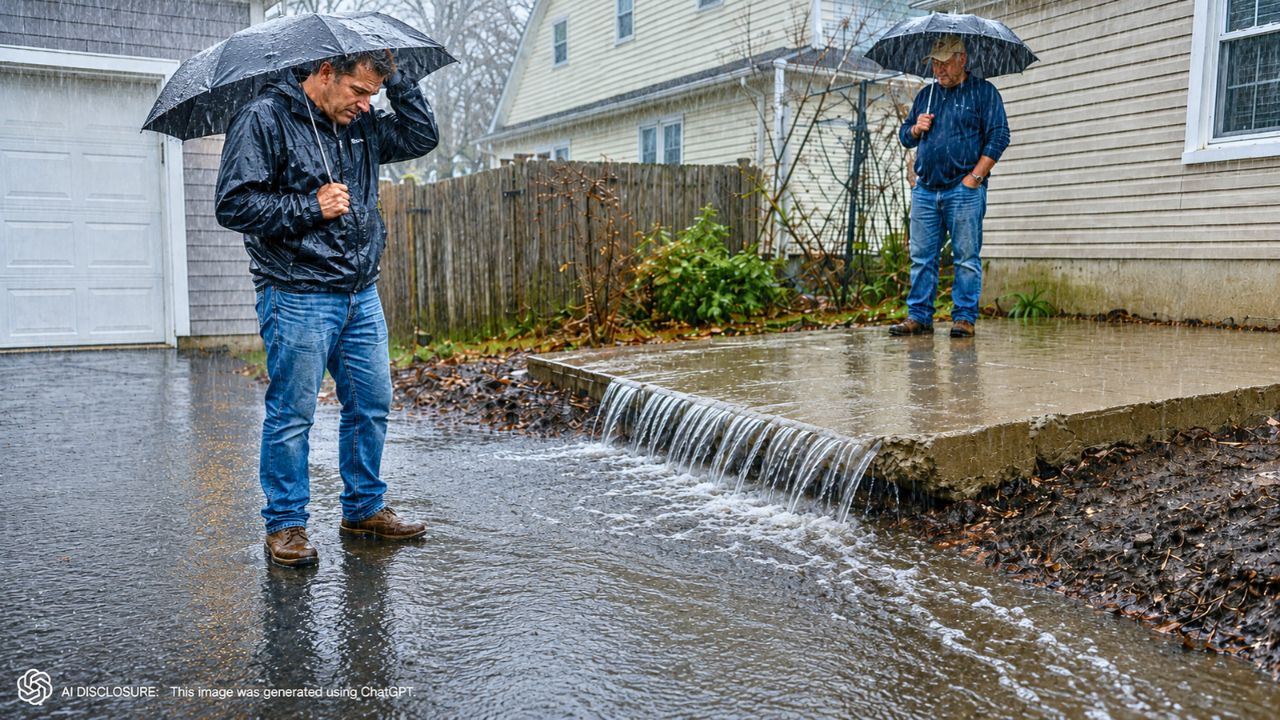
Massachusetts Homeowner Finds the Neighbor Poured a DIY Concrete Slab That Redirects Rainwater Onto the Driveway — Then Worries About It Turning Into a Black-Ice Machine All Winter
Photo credit: AI-generated image created using ChatGPT. Illustrative only.
It started the way a lot of property-line headaches start: one neighbor “fixes” a water problem on their side, and the effect shows up immediately on the other side. A homeowner in Eastern Massachusetts says their neighbors recently poured a DIY concrete slab meant to redirect rainwater—but it now sends the runoff straight onto the homeowner’s driveway.
In the original post, the homeowner says the neighbors didn’t reach out before doing the work. After a heavy rain, they watched the water flow the new slab created and realized this wasn’t just a “huh, that’s odd” kind of change. It was a re-route that makes their driveway the exit path.
The “fix” wasn’t a gutter repair—it was a concrete redirect
The homeowner’s frustration isn’t just about the water itself. It’s about how it got there. They describe the neighbors choosing to pour concrete rather than fixing their gutter and installing proper drainage.
That detail matters because it frames the whole thing as avoidable. In the homeowner’s eyes, a working gutter system could have controlled where the water goes. Instead, this slab now acts like a ramp, guiding runoff to the wrong side of the property line—onto a driveway that already has its own challenges.
And it’s not a theoretical complaint. The homeowner says they had heavy rain the day before and could “see what happens” in the last picture they shared. Water doesn’t care about intentions. It follows slope and gravity, and the slab apparently changed both.
A steep driveway in a Massachusetts winter is a different kind of problem
Plenty of neighbors argue about puddles in summer. This homeowner is thinking ahead to January. They describe their driveway as “fairly steep,” and that’s where their biggest fear kicks in: snow melt draining down the concrete slab, spilling onto the driveway, and turning it into what they call a “perpetual black ice machine.”
Anyone who’s dealt with New England freeze-thaw cycles knows how fast a little water can become a safety issue. It’s not just slipping while grabbing the mail. A steep, icy driveway can mean cars sliding, deliveries getting stuck, and a constant fight with salt and shovels—every time temperatures bounce above and below freezing.
What makes it worse is predictability. If runoff always funnels to the same place, it can refreeze in the same track over and over, building a slick that’s hard to eliminate. The homeowner isn’t talking about a one-off storm. They’re describing a winter-long pattern created by one weekend of concrete work.
The hidden damage worry: erosion and freeze-thaw on the retaining wall
Safety is the immediate fear, but the homeowner also points to the slow-burn damage that can pile up when water is forced where it shouldn’t be. They’re concerned about their retaining wall taking the hit through erosion and repeated freeze/thaw cycles.
Water can undermine soil, wash out joints, and exploit tiny cracks. Then winter hits, the moisture freezes, expands, and pries things apart. Even if nothing collapses dramatically, the homeowner is staring down the possibility of a wall that starts leaning, shifting, or failing over time—damage that tends to be expensive and never seems to happen at a convenient moment.
It also changes how a homeowner thinks about their own maintenance. If your driveway ices because someone else redirected water, you’re still the one spreading salt, paying for extra de-icing, and dealing with the wear that salt brings to concrete and stone.
Not being asked first is what makes this feel personal
The DIY concrete itself isn’t the only thing bothering them. It’s the way it happened: no conversation, no heads-up, no “hey, we’re trying to solve a drainage issue—can we look at options?” Just a new slab, and then rainwater behaving differently than it did last month.
That’s where neighbor problems tend to escalate. If the first communication happens after the water starts flowing—after the driveway is wet, after the wall is splashed, after the homeowner has photos from a storm—then every next step feels like a confrontation instead of a collaboration.
The homeowner says they plan to talk with the neighbors that weekend because, in their words, “this will 100% be my problem if left unmitigated.” It’s not a threat. It’s a realistic read of how water issues work: whoever gets the runoff gets the consequences.
What the homeowner thinks the “right” fix should look like
They’re not asking for something fancy. Their preferred solution is straightforward: fix the gutters and direct them toward the front of the house—toward the street and away from the driveway.
That’s the key difference between “redirecting” and “draining.” A slab can push water somewhere else, but it doesn’t necessarily manage volume, speed, or where it ends up during a downpour. Gutters and intentional drainage aim to capture and route water to a place designed to handle it.
The homeowner’s questions show they’re trying to get their footing before walking into an awkward conversation: Is there anything else they should be concerned about? What’s the right way to handle runoff? And bluntly—was this even legal?
They’re not only thinking about neighbor etiquette. They’re thinking about rules, responsibility, and what happens if the ice causes an accident or the wall starts failing. Once you see a water path change after a construction tweak, it’s hard to unsee it.
Most reactions in these disputes come down to proof and a calm first talk
Even without a comment-by-comment recap in the source material, this kind of drainage dispute usually pulls homeowners into the same two-track mindset: document what’s happening, and start with a direct conversation before it turns into a drawn-out fight.
The homeowner already has one of the most important pieces—timing. They can point to when the slab was poured and what changed afterward, and they’ve seen the runoff during heavy rain. In real life, being able to show “before and after” is what keeps this from turning into a he-said-she-said about where water “always” went.
At the same time, the homeowner’s plan to speak with the neighbor first is the move that can prevent a long, bitter standoff. Water problems don’t stay neatly on one side of the fence. But neither do neighbor grudges.
If the neighbor agrees it’s an issue, this could be as simple as altering the slope, adding a drain solution, or reworking the gutter discharge so the slab isn’t acting like a chute. If they don’t agree, the homeowner is left staring at a winter where every thaw feels like a new round of the same problem.
For now, the concrete is in, the rain has already tested it, and the homeowner is trying to head off a season of ice before it starts. In a place like Eastern Massachusetts, that window closes fast—and once the driveway turns slick, the “DIY fix” next door stops being their project and becomes everyone’s problem.
Like Fix It Homestead’s content? Be sure to follow us.