New Florida Landowner Buys Eighteen and a Half Acres of Old-Growth Forest for Beekeeping — Then Returns to Find a Neighbor Clear-Cut a Thirty-by-Three-Hundred-Foot Strip of Rare Basswood Trees
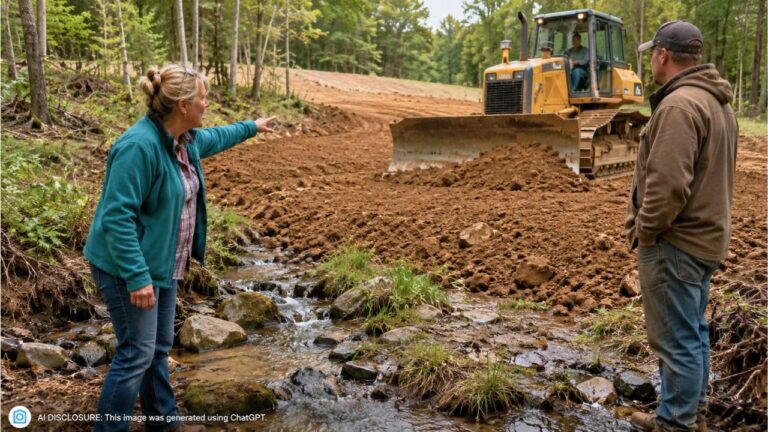
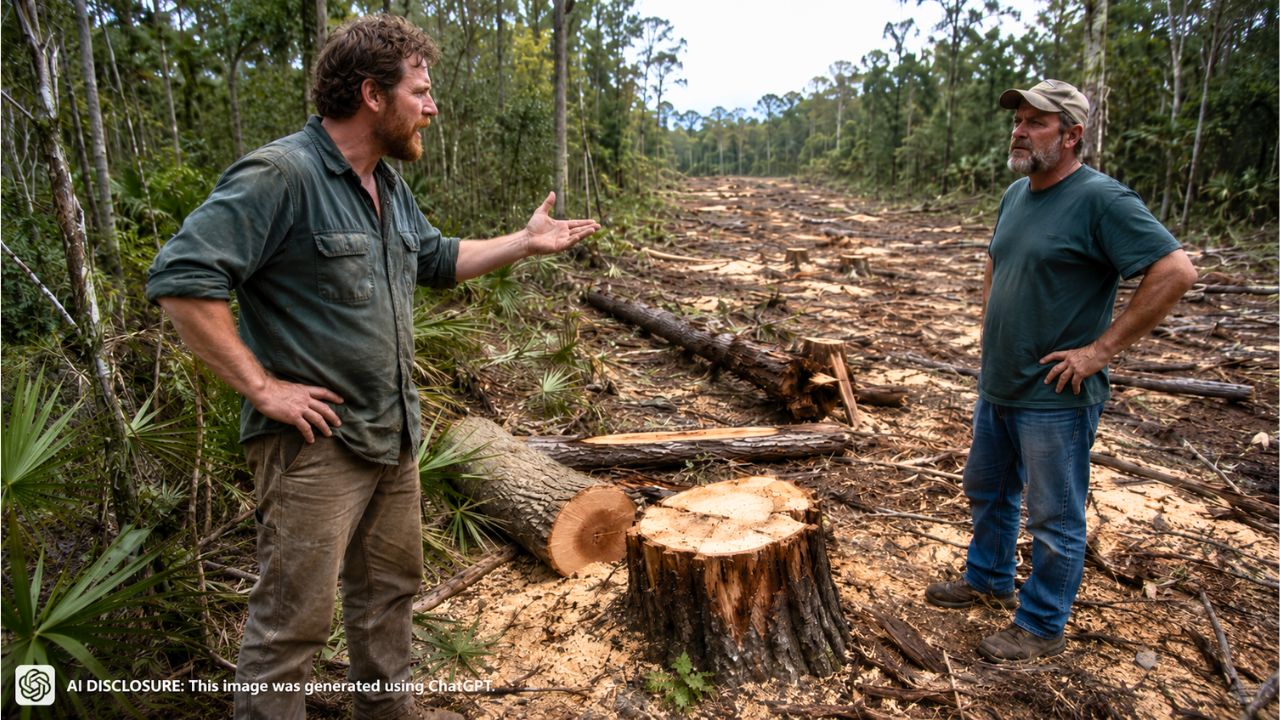
Photo credit: AI-generated image created using ChatGPT. Illustrative only.
He bought the kind of land most homesteaders only daydream about: 18.5 acres of heavily wooded, semi old-growth forest in north Central Florida, packed with basswood trees old enough to feel permanent. The plan wasn’t just privacy or hunting rights. He’s a beekeeper, and basswood nectar can mean serious honey—especially when the trees are already established and thriving.
Then he drove out to check on the place and found a chunk of that future erased. In the original post, he described a strip roughly 30 feet by 300 feet that had been completely cleared on what he says is his side of the line—trees down, ground scraped, and the leftovers shoved into long piles that can’t simply be burned away.
A beekeeper’s “dream section” of the property disappeared
The landowner said the southwestern portion of his property was dominated by basswoods—50-plus-year-old trees that he called rare in Florida. For honey production, that’s not a small detail. Mature nectar sources aren’t like planting a garden bed; if they’re gone, they’re gone for a long time.
He expected to spend years shaping the property the slow way, choosing what plant varieties would dominate and building toward reliable future honey crops. Instead, he arrived to find what he described as a clear-cut corridor through his woods. He estimated around 45 trees at 12 inches or more had been cut and dumped.
And it wasn’t clean removal. He said debris was pushed into “massive dirt/wood” piles along the edge of the cleared area—piles he can’t burn, and that now sit where he didn’t want them.
The neighbor didn’t stop—she built on it
When he first contacted the neighbor, he said he demanded she stop and told her she was clearing on his property, not hers. He described her response as a shifting set of promises: she’d buy replacement trees, she’d pay cash, she’d stop. But in his telling, none of those offers turned into action.
Life stepped in at exactly the wrong time. His first child was born, and he said he was absorbed in newborn life for several months. When he finally got back out to the land, the damage wasn’t just still there—it had progressed.
He said the neighbor’s driveway work continued and escalated: limerock laid and compacted, a utility line installed “on my property without any easements,” and a 53-foot metal container placed half on his land. At that point, this wasn’t just trees. It was infrastructure.
Surveys, stakes, and the brutal math of being land-rich and cash-poor
Property-line fights get expensive fast, even when you’re right. The landowner said they were forced to pay for a second survey within a year and have the boundaries clearly marked. They’d already budgeted tightly for the basics—septic, well, utility line, permits—trying to get to the point where they could live on their land rather than paying rent and a mortgage.
That second survey blew the plan apart. He described being “extremely poor” and said the extra cost pushed them into continuing to rent while also paying the mortgage, delaying their move to the property with an RV.
It’s the kind of slow-motion financial squeeze rural buyers know too well: the land is supposed to reduce your monthly burn rate, but unexpected disputes force you to keep paying for two lives at once.
To make matters more personal, he said he’s doing his own land clearing by hand and intends to build his house himself. In other words, he’s already living the bootstrap version of homesteading—there isn’t a spare pile of cash sitting around for surprise excavators, attorneys, or equipment rentals.
“Not our fault”: the contractor blame shuffle
One of the most infuriating parts of his account is how quickly responsibility got kicked down the road. He said a septic company did the clearing, but did it “under a guise independent of their septic company” and claimed they weren’t responsible. Meanwhile, he said the homeowner pointed the finger at the land clearing company and also claimed she wasn’t liable.
That leaves a landowner staring at physical proof—trees down, driveway base laid, utility line up, container sitting there—and still being told, essentially, that nobody owns the decision.
He also added a complicating layer that’s common in rural neighborhoods: the property owner is around 90 years old, and he believes her daughter orchestrated the work. It’s a dynamic that can turn simple neighbor conversations into a fog of “she didn’t know” and “they told us it was fine,” while the bulldozer tracks don’t care.
The mess left behind isn’t just ugly—it blocks the landowner from using his own land
The cut trees weren’t neatly removed. He said they were dumped onto his property, with “mostly dumping everything under my 200+ year old live oak.” That’s an especially cruel detail: the debris is now sitting in the one spot that might have been a centerpiece tree for shade, habitat, and the feel of the future homesite.
And because he can’t just burn the piles where they are, the cleanup becomes a second injury. Burning often requires appropriate conditions and management; moving piles means equipment, time, and money. Either way, the neighbor’s encroachment created a workload he didn’t choose.
For a beekeeper, the loss isn’t only what’s visible on the ground. He described it as destroying “my livelihood,” with honey income potentially affected for decades. Basswoods don’t grow back on a homestead timeline.
How readers pushed him: document everything, stop talking, start stacking proof
Even without seeing the comment thread in full here, his post shows exactly where most practical-minded readers tend to land in these disputes: proof and paper matter more than arguments across a property line. A second survey with clear markings is part of that. So is documenting the debris, the driveway build, the utility line, and the container placement—because the physical facts can change quickly once someone realizes they crossed the line.
People in these disputes also tend to stress keeping communication in writing and tracking every cost, because “I’ll pay you back” and “I didn’t know” have a way of evaporating once real bills show up. When multiple parties are involved—homeowner, daughter, septic company, clearing crew—the best lever is usually a clean record of what’s on your land and when it appeared.
But his central problem remains painfully practical: he can’t afford to hire someone to move a 53-foot container, and hiring a lawyer feels like it would break the entire homestead plan. He’s stuck balancing the need to act fast against the reality that every step costs money he doesn’t have.
That’s where the tension sits. He wanted a quiet piece of Florida woods where basswoods fed his bees and his family built a life slowly, by hand. Instead, he’s looking at a scraped corridor, piles of wood and dirt under an ancient live oak, and a neighbor’s improvements creeping over the line—plus the nagging fear that waiting any longer could make it even harder to unwind.
Like Fix It Homestead’s content? Be sure to follow us.