New Homeowner Finds a Basketball Court and Tower Ten Feet Onto the Land — Then the Neighbor Won’t Move It With Adverse Possession Three Years Away
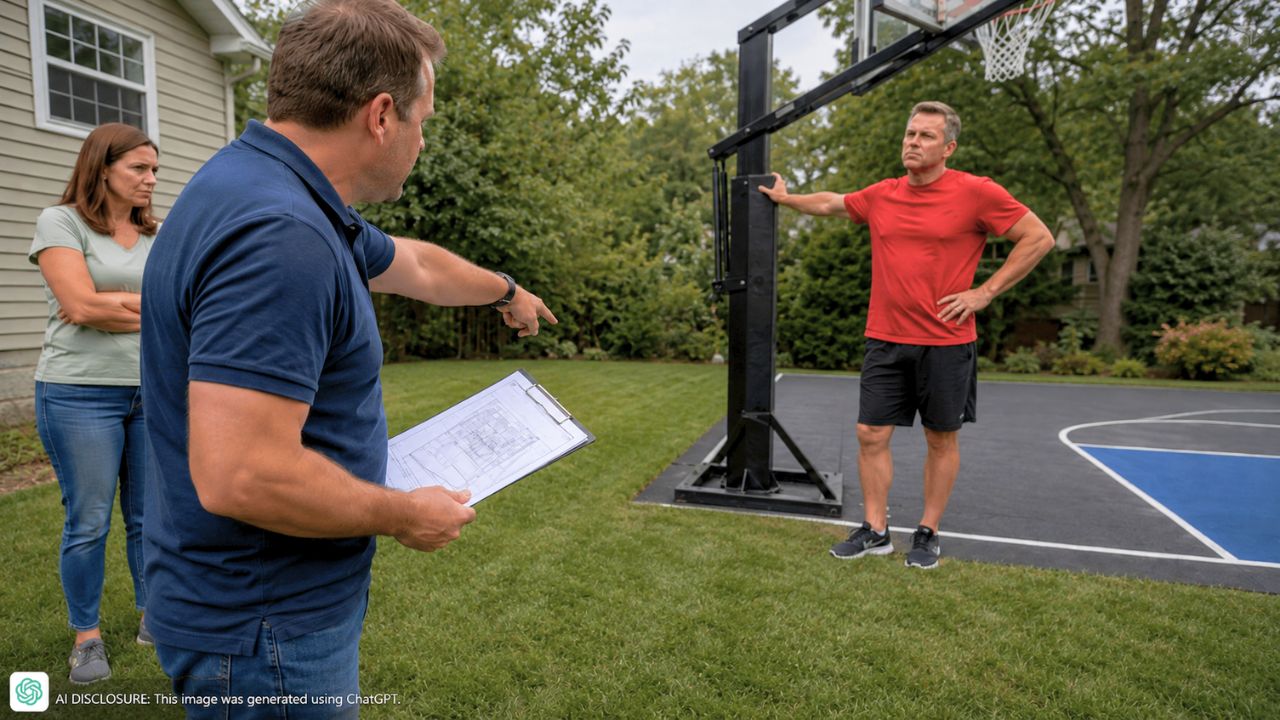
Photo credit: AI-generated image created using ChatGPT. Illustrative only.
The new homeowner thought they were doing the responsible, boring thing: get a survey, learn the boundaries, plan the next projects. Instead, the survey turned up a surprise that wasn’t subtle at all—part of the next-door neighbor’s basketball setup was sitting well over the line, complete with pavement and a tower.
In the original post, the homeowner said the encroachment measured about ten feet onto their land. And it wasn’t something freshly built last weekend. Town satellite photos showed it had been there for roughly 12 years, close enough to a key legal milestone that the timing suddenly mattered in a very real way.
The survey didn’t just find a line—it found a structure
Property line issues can feel theoretical until you see a physical object crossing into your yard. This wasn’t a fence that drifted a few inches. The homeowner described “ten feet of his basketball court, pavement and tower” on their side.
That mix—hardscape plus a big upright structure—changes the feel of the whole dispute. Asphalt or concrete isn’t something you nudge back with a shovel. And a basketball tower planted into a paved area tends to signal permanence: someone made decisions, spent money, and expected it to stay put.
For the new owner, it also means their own land isn’t fully usable. Ten feet can swallow a strip big enough to mess with future fences, sheds, gardens, drainage plans, or even just the ability to mow and maintain a clean edge without stepping into “their” space that now feels like someone else’s court.
Twelve years on the ground… and the clock was ticking
The number that immediately raised the stakes was 12 years. According to the homeowner, town satellite photos showed the court had been there that long. That history matters because the homeowner said adverse possession in their area is 15 years.
That’s where the tension tightens. A lot of neighbor disputes are about personalities or misunderstandings. This one has a timer attached. If the neighbor can claim some form of legal right to the strip after a certain number of years, then every season that passes without action feels like a door closing.
Even if you don’t know the legal details, you can feel the practical pressure: a new owner doesn’t want their first big “welcome home” project to be a boundary fight. But they also don’t want to look back in a few years and realize they waited too long to protect the land they thought they bought.
The neighbor’s answer: “I don’t want to move it”
The homeowner approached the neighbor, and the response wasn’t a friendly “let’s figure it out.” The neighbor didn’t want to move the court or tower. They also said they were talking to their lawyer.
That one sentence can freeze a neighborhood. The minute “my lawyer” enters the chat, people stop waving from the driveway and start thinking in documents. It signals the neighbor sees this as a fight worth having, not a mistake to correct.
It also hints at why the court ended up there in the first place. Sometimes people build right up to what they think is the line, trusting old markers, vague memories, or the way the yard has “always been.” Other times, they build where they want and assume nobody will push back. From the homeowner’s perspective, the reason almost doesn’t matter as much as the reality: the pavement and tower are on the wrong side.
Why this gets messy fast for a brand-new owner
Encroachments are rarely just about land. They’re about access, liability, and the day-to-day friction of living beside someone who’s physically occupying part of your property.
A basketball court is also an active use, not a quiet one. Even if the homeowner doesn’t mind the sound of a game, the location matters. Where do the players step when the ball rolls? Who walks onto whose land to retrieve it? If the tower or pavement needs repair, who shows up and starts working on your side without asking?
Then there’s the awkward maintenance layer. If the paved edge cracks, weeds grow at the seam, or water starts pooling and running the wrong direction, the boundary dispute can quickly turn into a dispute about damage. It’s hard to keep things civil when a drainage issue or a trip hazard becomes part of the same argument.
And for a new homeowner, there’s another quiet stressor: you bought a house assuming you knew what you were buying. Finding out a slice of it is functionally “occupied” can make everything feel unstable—like you can’t fully settle in until the line is respected.
Reactions tended to focus on proof and paperwork, not shouting matches
Even with only a few details shared, the shape of the problem points to the same practical instinct many homeowners have: when a boundary is in play, the paper trail becomes your best friend.
The homeowner already did the crucial first step by ordering a survey. They also referenced town satellite photos to establish how long the structures had been there. That kind of time-stamped documentation is often what people lean on when the other side starts digging in.
Once a neighbor says they’re consulting an attorney, casual conversations over the fence usually stop being useful. The dispute shifts into a world of written notices, recorded boundaries, and careful choices—because one wrong move can turn a solvable problem into a permanent feud.
And with the 15-year adverse possession mark looming in the background, it’s not surprising that reactions in these kinds of disputes often push the homeowner toward acting sooner rather than later—especially when the neighbor has already signaled they won’t move it voluntarily.
A ten-foot strip that can change the whole feel of home
On paper, ten feet can look small. In real life, it can be the difference between a private backyard and a backyard that never quite feels like yours. A paved court and tower aren’t easy to ignore; they broadcast “this is my space” every time you look out the window.
The homeowner is left standing at an uncomfortable crossroads: accept an unwanted setup sitting on their land, or press the issue and risk turning a new neighborhood into a long, tense standoff. With the neighbor refusing to move the court and openly mentioning a lawyer, the easy, friendly fix already seems off the table.
For now, the survey has done its job—revealing what’s actually there. The harder part is what comes next: whether the homeowner can reclaim the strip without the kind of blowup that makes every driveway moment feel like walking onto a court where nobody agrees on the rules.
Like Fix It Homestead’s content? Be sure to follow us.