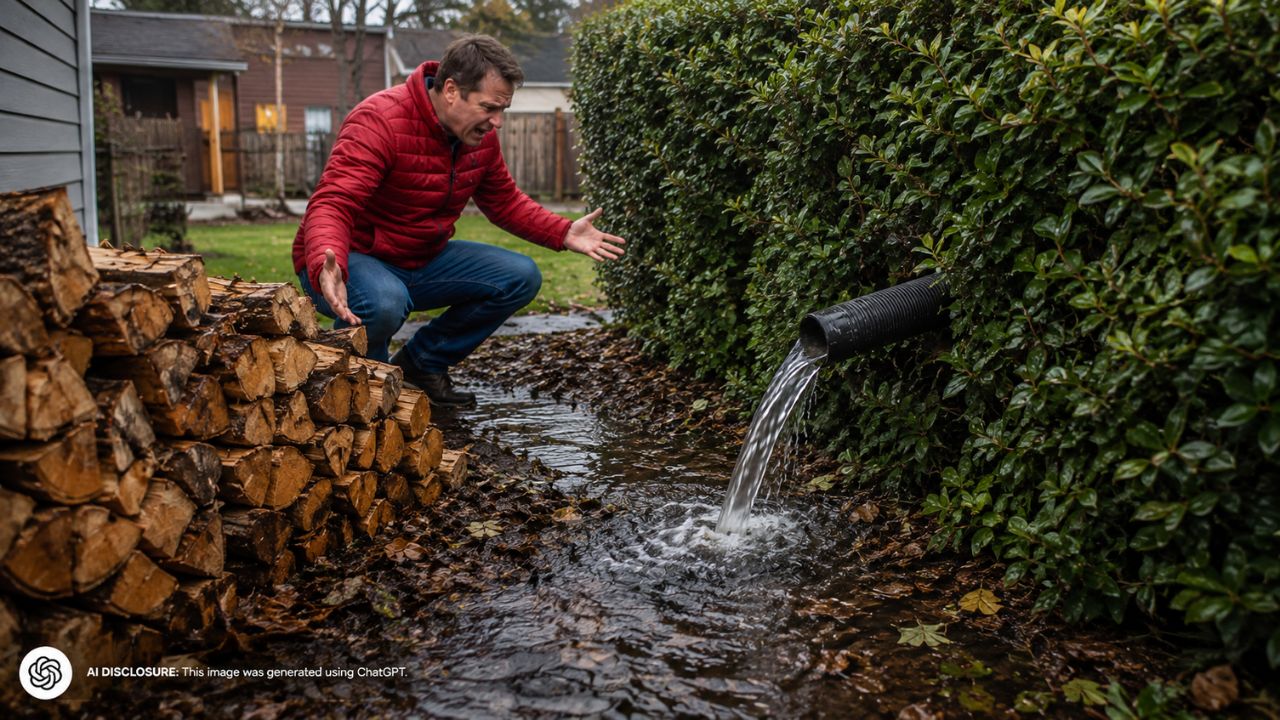
New Homeowner Finds the Neighbor Cut Through Property-Line Bushes to Install a Drainage Pipe — Then Watches It Ruin Stacks of Firewood
Photo credit: AI-generated image created using ChatGPT. Illustrative only.
It started with rainwater showing up where it had no business being: in the middle of a neatly stacked firewood pile meant for an indoor wood-burning stove. The new homeowner had just moved into a house that used to belong to their mother, and suddenly the wood—carefully saved for heat—was getting soaked and spoiled.
When they traced the source, they found a drainage pipe ending about an inch from the property line, aimed straight into their stacked logs. In the original post, the homeowner described how the pipe looked “recent,” and the giveaway wasn’t subtle: the overgrown bushes along the line on their side had been “obviously hacked out” to make room for it.
The pipe was close enough to feel intentional
The detail that made the whole thing feel personal wasn’t just the water. It was how carefully the neighbors seemed to have placed the pipe—close enough to dump water off their property, but not so far that it technically crossed over.
The homeowner said their mother remembered hearing the neighbors talk during installation about “just hide it under the wood pile.” That one sentence turned this from a simple drainage mistake into something that felt planned: disguise the outlet, keep it near the line, and let gravity do the rest.
And because it was set up to stop on their side by a hair, the neighbors could argue it was “on their property,” even though the water clearly wasn’t staying there.
The damage wasn’t theoretical—it was a ruined woodpile
Outdoor firewood gets wet sometimes. But this wasn’t a few damp logs after a storm. The homeowner said the pipe had “ruined the multiple stacks of firewood” that were meant for indoor use.
If you heat with wood, that kind of loss is more than annoyance. Wet wood is harder to light, burns poorly, and can lead to smoky fires that are tough on a stove and chimney. Even if the logs dry out eventually, being repeatedly soaked from a direct discharge can push wood toward rot, punky spots, and insect problems.
Meanwhile, the water didn’t just threaten the wood. It brought “some minor other issues” too—exactly the kind of vague-sounding line that makes homeowners nervous, because water has a way of turning small problems into expensive ones once it finds a path.
What made it worse: the fix sounded simple
The homeowner wasn’t describing an impossible engineering challenge. In fact, what they couldn’t get past was how close the neighbors already were to a better solution.
They wrote that with “an elbow joint and a few more ft” of PVC, the neighbors could have sent the discharge down the backyard hill, helped by “a small drain ditch.” It’s not even a rare approach in that neighborhood, according to the post. The street is a dead end up a significant hill, and there’s a creek at the bottom of the woods, so many properties route water downhill in a controlled way.
That’s what makes the current setup feel so aggravating. The pipe could have been redirected without much work, and yet it was left aimed at a woodpile—after shrubs were cut back to create the outlet path.
The hardest part wasn’t seeing it—it was hearing “no one can help”
Plenty of neighbor disputes stall out at the same place: the moment someone calls the local office and gets a shrug. The homeowner said their mother contacted the Borough and was told they “can’t do anything.”
That response can feel like a door slamming, especially to someone who just moved in and is already trying to get their bearings. A new homeowner expects to deal with normal settling-in tasks—changing locks, learning the quirks of the house, figuring out utilities. They don’t expect to inherit a stealth drainage outlet tucked into landscaping at the edge of a property line.
Now the homeowner is stuck with a messy question: if the neighbor refuses to redirect it, what can they do next?
Commenters pushed one theme: document first, then escalate carefully
Even without a blow-by-blow of replies included in the post, the pattern in these disputes is predictable, and homeowners tend to focus on the same practical moves when water is being diverted.
People usually urge documentation before confrontation gets heated: photos of the pipe location, the cut-back bushes, where the water discharges, and the damage to the stacked firewood after rain. The reason is simple—once someone gets defensive, things change fast. A pipe can be moved overnight. A woodpile can be blamed for “blocking” flow. Shrubs can grow back and erase the evidence of hacking.
Others typically point out that “it’s on my property” doesn’t necessarily solve the problem if the discharge is intentionally sending runoff onto someone else’s land. Water issues also tend to intersect with local stormwater rules, even when a front-desk answer says otherwise. Homeowners who have been through it often suggest getting everything in writing, because verbal “we can’t do anything” answers are easy to deny later.
And when a neighbor has already shown they’re willing to hide an outlet, homeowners often recommend keeping the communication calm and factual, not personal. The goal is to get the pipe redirected—not to win an argument that turns into years of staring at each other across the property line.
A small pipe can trigger a long-term neighbor war
What makes this kind of story stick is how lopsided it feels. The neighbor’s fix was small, cheap, and quick: drain their rainwater away. The cost, though, landed next door—in spoiled fuel for winter heat, a mess of soggy stacks, and the uneasy feeling that someone altered the edge of the property to make it happen.
It also puts the new homeowner in an awkward position. They’re not only protecting their own space; they’re stepping into a history their mother already tried to stop. The neighbor likely knows exactly what they did, and the homeowner knows their mother objected from the beginning.
For now, the pipe is still there, the wood has already taken the hit, and the most maddening detail remains the same: it sounds like it would take only a couple fittings and a short extension to send that water downhill—anywhere but into someone else’s firewood pile.
Like Fix It Homestead’s content? Be sure to follow us.