New Homeowner Lets a Neighbor’s Family Use an Old Shortcut Gate Through the Yard — Then the Neighbor Demands They Stop Letting Their Own Dog Use That Part of the Yard
Photo credit: AI-generated image created using ChatGPT. Illustrative only.
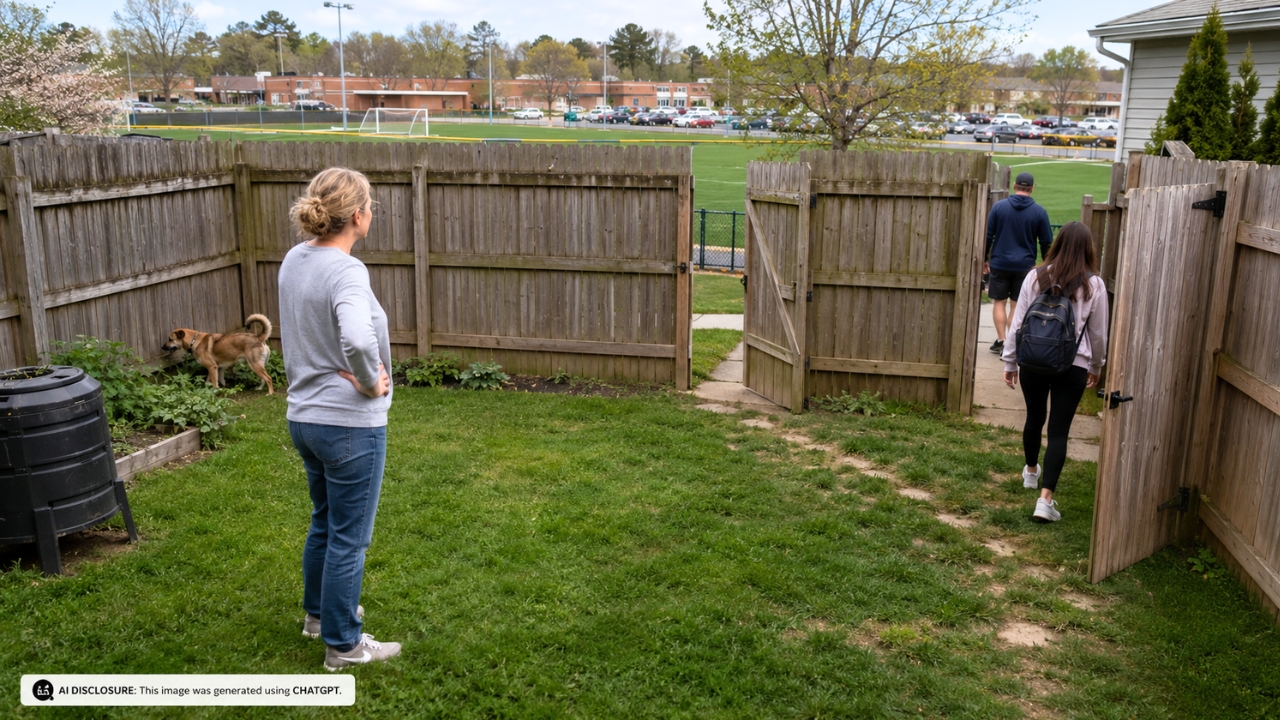
Moving into a new house comes with a thousand little surprises, but most people don’t expect to inherit their neighbor’s shortcut. One new homeowner says their backyard fence backs up to a school athletic field, and a gate in that fence opens out to the field and parking lots.
Then they found out the neighbor next door had been using that school-side gate for years—by walking through the new homeowner’s yard first. In the original post, the homeowner explains they were initially fine with it. The path was small, the traffic seemed minor, and being “super chill” felt like the neighborly way to start off in a new place.
A “small corner” of the yard turned into a regular walkway
The layout is what makes this story feel so lopsided. The homeowner’s property backs up to the school fence line, where the existing gate leads to athletic fields and parking. The neighbor’s property doesn’t connect to that fence line at all.
Instead of walking around through the subdivision, the neighbor previously worked out an arrangement with the former owners: they could cut through. To make it even easier, the neighbor installed their own gate that opens from their fence directly into the new homeowner’s yard. That way, their family and friends can pass from the neighbor’s yard into the homeowner’s yard, and then out the back gate to the school side.
The homeowner describes the distance as roughly 15 feet from gate to gate, limited to a back corner. On paper, it sounds like a harmless shortcut. In real life, it quietly turns part of someone’s fenced yard into a shared corridor.
The tone changed when the neighbor started making rules
For a while, the homeowner let it slide. They didn’t love the idea, but it didn’t feel worth a fight right after buying the place. Then the neighbor’s requests started stacking up.
First came the demands about the dog. The neighbor asked that the homeowner not let their dog poop back in that corner because, they claimed, their family was tracking it into their own yard. Then they added that the dog shouldn’t pee back there either.
And then it got even more personal: the neighbor complained that the homeowner’s compost bin was an eyesore and said it should come down. The reasoning wasn’t about property lines or smell or pests. It was about making the neighbor’s guests’ walk more “enjoyable” as they cut through the homeowner’s yard.
That’s the moment this stopped being “a favor” and started sounding like someone trying to manage another person’s backyard like it’s a shared space.
What’s really at stake: access, liability, and the new-owner reality
Homeowners are often willing to be accommodating when the request is simple and reciprocal. But this kind of informal access can get sticky fast, especially when it was negotiated with the previous owners.
The neighbor already has a physical gate that opens into the homeowner’s yard. That detail matters because it signals permanence. Even if the homeowner never signed anything, a gate cut into a fence is a daily reminder that someone else feels entitled to enter, and that entitlement can grow.
There’s also the basic reality of what happens when multiple households treat a corner of a yard like a walkway: worn grass, mud, trash, accidental damage, and awkward moments when the homeowner is outside with their dog. Even if everyone is polite, it can change how safe and private a fenced yard feels.
And the requests about poop and pee cut both ways. If the neighbor’s guests are walking through a space where a dog uses the yard normally, that’s not automatically the homeowner’s problem to solve. It’s a normal part of having a dog and a backyard. If anything, it highlights how unnatural it is to have “guests” routinely walking through someone else’s fenced area.
The compost bin complaint made it feel like the favor was being exploited
Most neighbors can work through one issue at a time. The dog mess request might have been irritating but manageable with a conversation about cleanup. The compost bin comment is what makes the story feel like it crossed into control.
A compost bin is a normal homestead-style backyard feature. Some people don’t like how they look, but a contained bin isn’t the same as junk piled against a fence. When the neighbor frames it as something that should be removed so their visitors enjoy a shortcut better, it flips the relationship.
Instead of “Thanks for letting us pass,” it becomes “We pass here, so you should maintain it to our preferences.” That’s the kind of mindset that turns a casual permission into a long-term headache.
The homeowner admits they’ve ignored the neighbor’s requests so far. But they also say they’re tempted to “slap a lock on that gate,” which is the clearest sign the goodwill is running out.
What people told the homeowner: document, define boundaries, and don’t negotiate privacy away
The post itself is a “What would you do?” vent, and it taps into a familiar homeowner instinct: fix the problem before it becomes a bigger one. When neighbors start making demands about how you use your own yard, many people see it as a warning that the arrangement has already shifted from optional to expected.
In these kinds of disputes, the most common practical advice tends to focus on creating clarity fast—because the longer it goes on, the harder it can feel to reverse without drama. That can mean having a direct conversation, resetting the terms, or ending the access entirely.
Many homeowners also push for basics like cameras and written communication when there’s an active access point into a yard. Not because every neighbor will escalate, but because misunderstandings happen: someone leaves the gate open, a dog gets out, a visitor trips, a fence gets damaged, or an argument turns into “You said we could.”
This homeowner is already sensing that slippery slope. The neighbor isn’t just using the gate; they’re trying to reshape the space around it.
A quiet lock, a hard conversation, or a drawn-out standoff
Right now, the homeowner is stuck between wanting peace and wanting their yard back. They started out accommodating because the shortcut only touched a small corner of grass. But the neighbor’s new rules—no poop, no pee, remove the compost—make it clear the neighbor sees that corner as part of their own “guest experience.”
That’s a tough dynamic to live with, especially for someone who just bought the home and likely wants to settle in without feeling watched or managed. The gate installed into their yard means the issue won’t fade on its own. Every weekend visitor cutting through reinforces the idea that this is normal.
If the homeowner does put a lock on the gate, it will end the shortcut quickly, but it may also trigger a direct confrontation. If they don’t, the neighbor may keep pushing—because the early “sure, no problem” already set a precedent.
For now, the homeowner is standing at that familiar new-house crossroads: keep the peace and lose a little more control of the property, or draw a boundary and deal with the fallout. Either way, that 15-foot stretch of backyard has become the most contested part of the whole purchase.
Like Fix It Homestead’s content? Be sure to follow us.