Off-Grid Landowners Find the Town Cut Off Their Cistern Water in a Vote Not on the Agenda — Then a New Well Is Quoted at $25,000
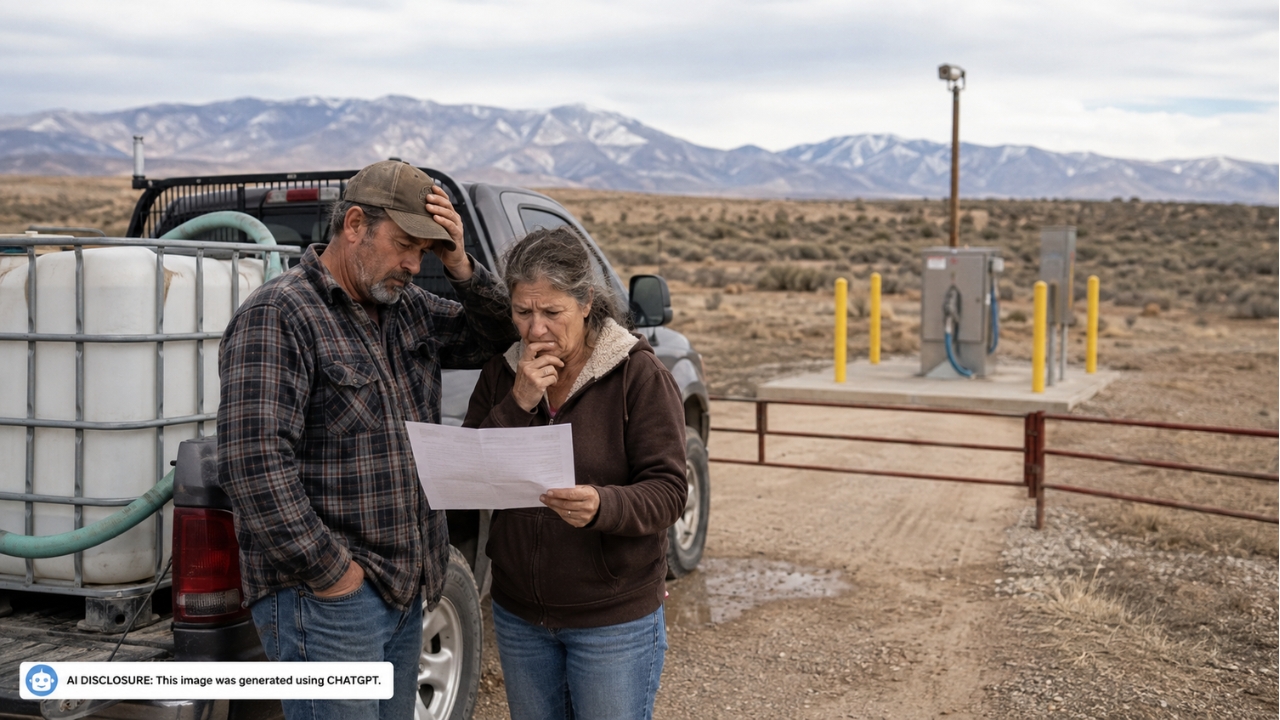
Photo credit: AI-generated image created using ChatGPT. Illustrative only.
Out in Costilla County’s high-desert ranchlands, “water day” isn’t a vibe — it’s the whole calendar. You plan your week around a 20-minute run into town, you keep straps and hoses in the truck, and you watch the gauge on an underground cistern like it’s your fuel tank.
Then, in Fort Garland, that routine snapped. People who’ve been buying bulk water to fill cisterns showed up and got turned away after a board vote that wasn’t even listed on the meeting agenda, as detailed in the source post. For a lot of off-grid households, the backup plan is a well — and the going quote is up to $25,000, with the small print that you might still come up dry.
Where “off-grid” still depended on one town tap
In the Sangre de Cristo Ranches — a huge residential area where homes range from decked-out mountain-view builds to campers and one-room cabins — drilling a well is a gamble. Elevation runs roughly 7,500 to 10,000 feet. You can spend big, drill deep, and not hit what you need.
So hundreds of residents do what people have done there for years: rely on cisterns. They bury a reservoir, pipe it to their sinks and showers, and haul water in tanks. Fort Garland sold that bulk water for about 10 cents a gallon, and for many households it was the functional “utility hookup” that made the place livable.
It wasn’t glamorous, but it was predictable. Until it wasn’t.
A broken pump, lawn-watering anger, and a vote that came out of nowhere
The fuse was Fort Garland’s water system itself. A pump failed in June, before a planned overhaul, and residents in town were asked to use the “bare minimum” — flush toilets, skip lawns.
The water district manager, Salina Pacheco, said she’d been warning the board for two years and had helped secure a $105,000 state grant for upgrades. She described “extreme water hammer” in the system — water moving in opposite directions colliding inside the pipes — and a board that already felt like it was coming apart.
At the Aug. 1 meeting, about 10 people showed up angry about restrictions and demanded the town stop selling bulk water to people outside the city limits. Pacheco recalled people “hollering” and cutting each other off. Then board members called for a vote anyway — even though cutting off rural sales wasn’t on the agenda — and it passed 3-2.
Rural customers didn’t get a warning letter or a timeline. They found out the hard way, including via Facebook, after being turned away at the filling station.
When the water stops, everything in the house changes overnight
This isn’t a spat about convenience. For off-grid households, losing the bulk water station means the basic mechanics of daily life get rewritten: cooking, dishes, toilets, bathing, laundry. If you’ve got a cistern plumbed into your home, your faucets work… right up until they don’t.
Amanda Ellis and Paul Branson, who live down a dirt road with no neighbors in sight, run an apothecary and a wildfire mitigation business and grow vegetables and herbs on solar power. They have a cistern buried near the driveway, with water piped indoors. Branson described the stress plainly: when water isn’t available, finding it becomes all-consuming.
Some residents have leaned on neighbors with wells, but well-sharing is illegal. Others are driving two hours to Pueblo just to buy water. The town of Blanca offered an emergency stopgap: a hose tied to a fire hydrant, available Tuesdays and Thursdays from 8 a.m. to noon, and only until the end of August.
That “temporary” word is what makes people’s stomachs drop. Older residents and people with disabilities are staring at a math problem they can’t muscle through.
The expensive option isn’t just expensive — it’s a year out, and not guaranteed
Once the bulk-water spigot is gone, the conversation always swings to wells. That’s where the numbers get ugly fast: quotes from $18,000 to $25,000, with wait lists around a year, and no guarantee you’ll hit usable water after drilling hundreds of feet.
Elaine, a 79-year-old widow living alone, said her family chose cistern life decades ago when the property was purchased. Now she’s counting flushes, tracking gallons per chore, and taking showers at the community center. She’s also doing something that shows how serious this is: thinking about leaving the home she planned to spend her later years in.
Another couple, John and Debi Marks, bought in two years ago planning a solar-powered retirement build among the pines. They paid for a $500 cistern permit, buried a tank, and were living in a camper on-site — rattlesnakes and all — while they worked toward the house. When the Fort Garland cutoff hit, they turned their routine into a strict rationing program, making repeated morning runs to Blanca to fill a 275-gallon pickup tank and trying to top off a 1,750-gallon cistern they hope can stretch for months.
They even stopped flowing water through the camper system and started hauling in 6 gallons at a time just to track usage more precisely. That’s the kind of “fix” people land on when the real fix is out of reach.
The board says it doesn’t have to sell water — but it used to, and people built their lives around that
Fort Garland uses about 120 acre-feet of water per year, and Pacheco said cistern customers account for roughly 1 acre-foot — a tiny slice. The bulk-water program also brought in about $43,000 a year, around 15% of total district revenue.
Still, one board member, Anthony Neville, said the district bylaws don’t require selling water outside town limits. He described in-town residents as paying “religiously” for metered water and being angry they couldn’t water lawns while others were buying water. He also said he’d be willing to vote later to restore rural sales and hoped a petition could push the board to revisit it.
That’s the homeowner gut-punch here: even if something has been done “for a very long time,” it can disappear fast if it’s not guaranteed on paper. Ellis put it bluntly: having water was never a guarantee — but cutting people off with no warning and no time to prepare felt unethical.
Practical reactions: receipts, petitions, and a backup plan that takes a year
In moments like this, the most “homestead” move is also the most boring one: document everything. People started tracking gallons meticulously. Some shifted to smaller measured containers so they could see usage and plan trips. Others started calling well drillers, not because they wanted to, but because they were trying to figure out how long they could stay put.
On the public-process side, residents took their complaint to the Costilla County commissioners. One resident, Wesley Barnett, pitched a county-run metered bulk water filling station on county property, modeled after systems elsewhere and using prepaid accounts. The proposed build cost was $120,000 to $240,000, plus annual operating and water costs — but with the possibility of grants covering much of it and the station eventually netting revenue.
The catch is time. Barnett estimated about a year to get it together, and he said plainly: there’s still a gap. A more immediate idea floated was bringing a private water tanker onto county property in Fort Garland.
Meanwhile, the pump in Fort Garland is fixed. The water is flowing again — just not to the people who built their off-grid lives around that one dependable place to fill a cistern. And out on those sandy roads under the piñon and yucca, the question has gotten painfully small and specific: how many gallons are left, and how far do you have to drive to get more?
Like Fix It Homestead’s content? Be sure to follow us.