Oklahoma Families Who’ve Shared a Dirt Road for Generations Find It Blocked by Large Cement Rocks — Then Learn the Neighbor Who Doesn’t Even Use the Road Did It Because People “Drive Too Fast”
Photo credit: AI-generated image created using ChatGPT. Illustrative only.
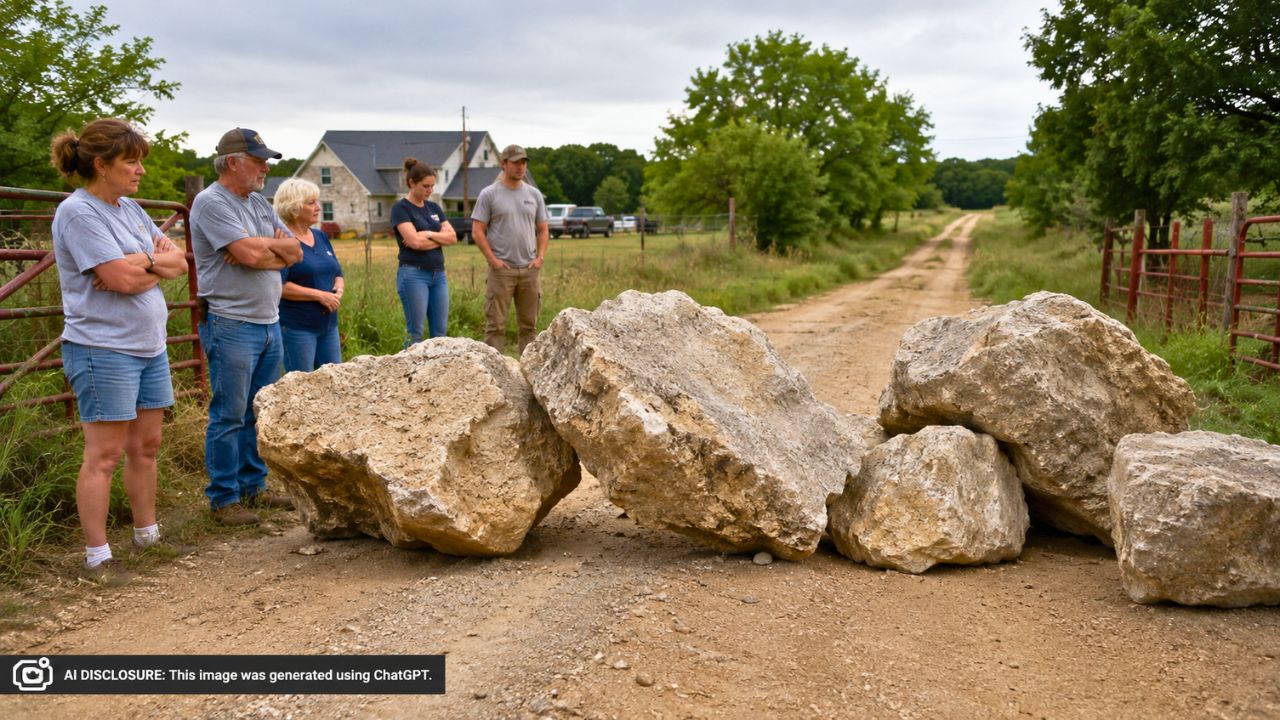
It was already dark when an Oklahoma family turned off the main road and headed home—only to find their way blocked by something that shouldn’t have been there. Across the dirt road that serves multiple households sat large chunks of cement, dropped like a barricade. No warning, no note, just a hard stop where the only way in and out is supposed to be.
In the original post, the resident explained that about six families use the same little dirt road every day. It’s not a scenic shortcut or a back way to a hunting spot—it’s the route to their homes, including elderly and disabled neighbors who can’t exactly hop out and drag heavy objects off the road whenever they need groceries or a doctor’s visit.
A shared dirt road that suddenly wasn’t shared
The road in question is the kind of rural access point most people don’t think about until it’s gone: a narrow strip of dirt that’s been driven for decades, connecting a handful of homes to the rest of the world. The poster said their family and others have lived down it for generations, and their mother believes it’s been used publicly as the only route for more than 50 years.
Then one neighbor—who reportedly doesn’t even use the road but can see it from his house—decided he was done watching vehicles roll by. His complaint, according to the resident: people “drive too fast down it.” The poster suspected he meant trash trucks and delivery trucks, not the families who live there, but the fix he chose didn’t target speed. It targeted access.
The result was immediate. Coming home at night turned into a roadside problem-solving session, with residents forced to park, get out, and figure out how to move heavy concrete pieces just to reach their own driveways.
The move that pushed it from annoying to dangerous
It’s one thing to be irritated by dust, noise, or a fast-moving pickup on a washboard road. It’s another to block the only route serving multiple households. That’s where this turned from a neighbor gripe into something with real stakes.
The poster described the practical problem in plain terms: some residents physically cannot move “large cement rocks” every time they want to leave or come home. That’s not a minor inconvenience. That’s a safety issue, especially when you think about ambulances, fire response, and even routine medical transportation.
And the timing made it worse. The neighbor allegedly put the barricade up “after dark,” meaning families encountered it unexpectedly, when visibility was low and options were limited. That detail matters in rural areas where lighting is scarce and cell service can be spotty—one surprise obstruction can turn into a stuck vehicle, a damaged undercarriage, or a panicked call for help.
The family’s first response was simple and direct: they got out, moved the rocks, put them back, and continued home. But the resident expected the next round would be “even worse come daylight,” a classic rural escalation pattern—one person makes a bold move, the affected neighbors fix it, and then the person comes back with something heavier, bigger, or harder to undo.
“He owns it” versus “we’ve always used it”
The detail that complicates everything is ownership. The poster said the road is “legally owned by him,” referring to the neighbor who placed the concrete across it. That’s the kind of sentence that makes rural families go quiet, because it suggests the access everyone took for granted may have been informal, inherited, or simply never questioned.
At the same time, the resident described decades of reliance: multiple families living down the road, traveling it daily, and treating it as the only route. In rural Oklahoma—and across much of the country—there are plenty of lanes and dirt roads that function like shared access for generations even when the paperwork tells a different story.
That’s where things get tense fast. If a route has been used openly for a long time, families may assume it’s “public” in the practical sense, even if a deed says otherwise. And the moment someone decides to enforce their version of ownership with concrete, the reality hits: long-standing habits don’t always come with clear legal rights attached.
For the families down the road, this wasn’t about winning an argument. It was about being able to live normally—get to work, get kids to school, receive deliveries, and know emergency services can reach them without delay.
Calls went out before the checkbook did
With tempers high and money tight, the poster’s updates showed a familiar sequence: try the low-cost channels first, document what’s happening, and hope someone with authority tells the neighbor to knock it off.
They said they called the police department and the fire marshal. Both reportedly said they’d come out and take a look, although the poster wasn’t sure yet whether anyone had arrived. That’s often how these rural access fights feel in the early days—lots of waiting, lots of uncertainty, and the nagging worry that the “official” answer will be slower than the problem.
In the meantime, the resident did what they could physically do: they moved most of the rocks off the road while walking down to check the mail. The way they described it made it clear this wasn’t a neat cleanup. They “threw them off into the grass,” treating the concrete like the hazard it was, not a landscaping feature.
They also noted they were trying to handle it the “easy way” before spending money they don’t have on a lawyer. That line carries a lot of weight. Access disputes can turn into expensive paperwork battles, and families who live on rural roads aren’t always sitting on a legal fund, especially when the immediate need is simply getting home tonight.
People focused on safety, proof, and not escalating face-to-face
Even without a long thread of comments included in the source material, the post itself points to the kinds of practical responses these disputes usually trigger: involve authorities, focus on emergency access, and avoid a direct confrontation that could make the next move more aggressive.
The mention of elderly and disabled neighbors shifts the argument away from “driving too fast” and toward basic livability. Blocking a road doesn’t just punish the supposed speeders; it punishes everyone, including the people least able to adapt.
And by contacting both police and the fire marshal, the family signaled they weren’t treating this as a petty squabble. They were framing it as an access and safety problem—something bigger than a neighbor’s frustration with dust or traffic.
That approach also creates a paper trail. Even if nothing happens immediately, it records that the obstruction existed and that residents raised concerns about access for emergency vehicles and vulnerable neighbors.
Then, suddenly, the rocks were stacked neatly off to the side
The second update introduced a twist that rural families know well: sometimes the barricade disappears as mysteriously as it arrived. When the poster went back to check, they found “all the rocks were off the road and placed to the side in stacks.”
They emphasized they didn’t stack them—when they moved them earlier, they tossed them into the grass. So someone else, at some point after, came through and tidied the concrete into neat piles.
Who did it? The poster didn’t say. It could have been the neighbor reconsidering, another affected resident trying to restore access, or an official who decided the road needed to be passable. What matters for the families living down that dirt road is that, for the moment, they could get in and out without hauling concrete in the dark.
But the tension doesn’t evaporate just because the road is temporarily clear. Once someone has tried to shut off access with cement, everyone living down that lane starts thinking in contingencies—what happens next time, what gets placed there next, and how quickly it could turn into a real emergency.
For now, the road is open again. The families are watching. And in a place where one dirt road is the difference between home and being stranded, nobody is assuming the problem is truly over just because the rocks are stacked off to the side.
Like Fix It Homestead’s content? Be sure to follow us.