Rural Iowa Homeowner’s Only Driveway Has Crossed the Neighbor’s Field Since the 1960s — Then the Neighbor Says It Was Only Ever a Verbal Favor
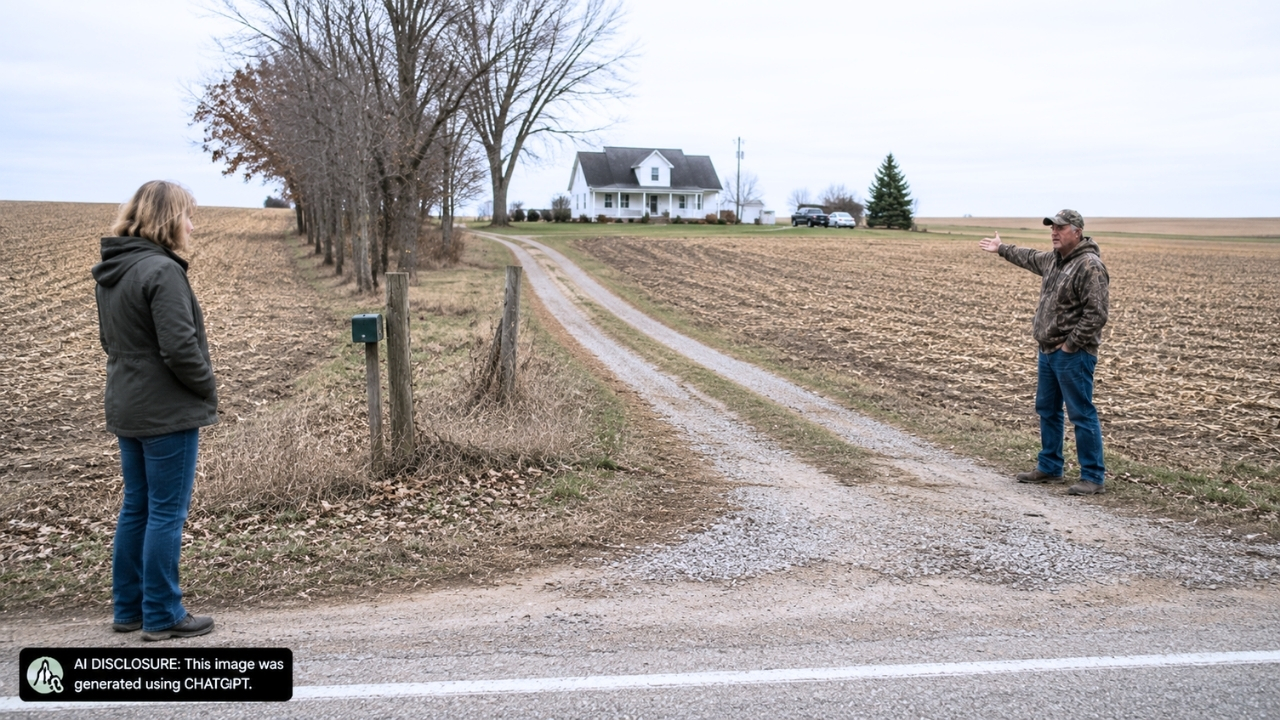
Photo credit: AI-generated image created using ChatGPT. Illustrative only.
In rural Iowa, a driveway can be the difference between “my place” and “a landlocked patch of ground.” For one small 0.42-acre parcel in Keokuk County, the only practical way in and out had been the same drive cutting across the neighbor’s field for decades—long enough that locals treated it like it had always been there.
Then the neighbor decided it wasn’t “the” driveway. It was a favor. And when the homeowner’s estate tried to turn that long, familiar use into a legal right, the courts weren’t buying it. The details are laid out in the Iowa Court of Appeals decision, and it reads like a slow-burn rural property feud where every “we’ve always done it this way” runs into a deed and a survey.
When the only way home runs through someone else’s ground
The parcel belonged to Willard Decker Jr., and it was small—less than half an acre. But the access was the real issue. The driveway crossed neighboring land owned by Joseph and Julie Clubb, and witnesses said that route had been used in essentially the same location since at least the 1960s, maybe even the 1950s.
In the countryside, that kind of “everybody knows where the drive is” history can feel as solid as a recorded easement. A fence line, a tree line, and decades of tire tracks can start to look like a boundary you don’t question—until someone does.
“It’s yours” versus “I let you use it”
Joseph Clubb’s version was blunt: when he bought his property, he believed the strip the driveway ran over was legally his. He testified there was a verbal agreement letting Decker use it, basically because Decker didn’t have another way in yet.
That distinction—permission versus ownership—sounds like splitting hairs until you realize it’s the whole case. If you’re using it because the neighbor said you could, you’re not acting like the owner. You’re a guest. And guests can be told to leave.
The estate argued the opposite. After all that time, with the driveway sitting where it always sat and fences and trees marking the landscape, they claimed the boundary people lived by had become the boundary that mattered.
The nursing home move is where things snapped
The conflict didn’t fully ignite until Decker moved into a nursing home. That’s when Joseph posted no-trespassing signs and installed surveillance cameras—big, visible signals that the “help yourself like always” era was over.
After Decker died in 2023, Tony and Robbin Clubb inherited the parcel and became executors of his estate. In 2024, Tony tried to bring a bulldozer in over that same driveway, and Joseph’s sons blocked him.
That’s the kind of moment rural neighbors remember: equipment on the line, somebody standing in the way, and the question hanging in the air—who’s got the right to be here? Tony eventually found another route through adjacent land, but by then the fight wasn’t just about access. It was about control and who had been “right” all along.
Two surveys, one strip of land, and a fence everyone argued about
The estate pushed two theories: adverse possession (we used it long enough that it’s ours now) and boundary by acquiescence (both sides treated a certain line as the boundary long enough that it becomes the boundary).
Surveys didn’t make it simpler. The estate’s survey identified roughly a 0.42-acre disputed tract. Joseph’s survey stuck to the deed descriptions and placed that tract inside Joseph’s property.
In the middle sat the kind of rural markers people rely on: the fence and the tree line. Witnesses testified those features had been there for decades, and some longtime residents believed the fence represented the boundary. One even tied that belief back to the 1950s.
But belief isn’t paperwork, and the court kept pulling the conversation back to one question: did the actual owners on both sides mutually recognize that fence or tree line as the legal boundary for at least 10 straight years?
The court said long use isn’t enough when it started as permission
The trial court rejected both of the estate’s claims, and the Iowa Court of Appeals affirmed that decision. On appeal, the estate focused mostly on boundary by acquiescence, which in Iowa requires proof that adjacent owners mutually recognized a marked line—like a fence or tree line—as the property boundary for at least 10 consecutive years.
The estate had history, but not the kind the court needed. The appeals court said there wasn’t clear evidence that the real property owners on both sides had mutually treated that fence or tree line as the boundary for the required period. Testimony from neighbors about what they thought the boundary was didn’t prove the owners themselves had agreed to it.
Adverse possession failed too, for a reason that will sound familiar to anyone who’s ever heard “sure, go ahead” from a neighbor. Iowa requires the use to be hostile for at least 10 years. But if Joseph gave Decker permission to use the driveway, it wasn’t hostile. It was allowed.
And Joseph’s later actions—no-trespassing signs, cameras, and blocking the bulldozer—looked to the court like asserting ownership, not accepting some alternative boundary.
The reactions people always have in driveway fights
When stories like this circulate among homeowners, the practical reactions tend to be consistent: get it in writing, get it surveyed, and don’t wait until the property changes hands. A long-running handshake arrangement can survive for decades—right up until a sale, a death, a nursing home move, or a family member who doesn’t feel bound by old habits.
People also zero in on the escalation steps because they’re so recognizable. First come the signs. Then cameras. Then a physical block when someone tries to move equipment through. Those moves aren’t just about stopping a truck; they’re about creating a record that says, “I did not agree to this,” and making the other side think twice before treating the path like it’s theirs.
In rural areas, there’s also an unspoken fear underneath it: if you don’t draw a line now, you might not be able to later. That’s why permission can be offered with one hand and revoked with the other.
For the estate, the end result was as concrete as it gets. Decades of using a driveway in the same place didn’t turn it into ownership. The property changed hands, the neighbor asserted control, and the courts agreed with the neighbor’s deed-based boundaries. The estate found another way in—but the lesson is sitting there in the dirt: if your only access crosses someone else’s land, “we’ve always used it” can disappear faster than you think.
Like Fix It Homestead’s content? Be sure to follow us.