Rural Texas Landowner Loses Nine Hundred Fifty Feet of Cattle Fence to a Neighbor’s Unauthorized Teardown — Then She Says They “Should Be Thankful” and Refuses to Pay the $8,500 Replacement Bill
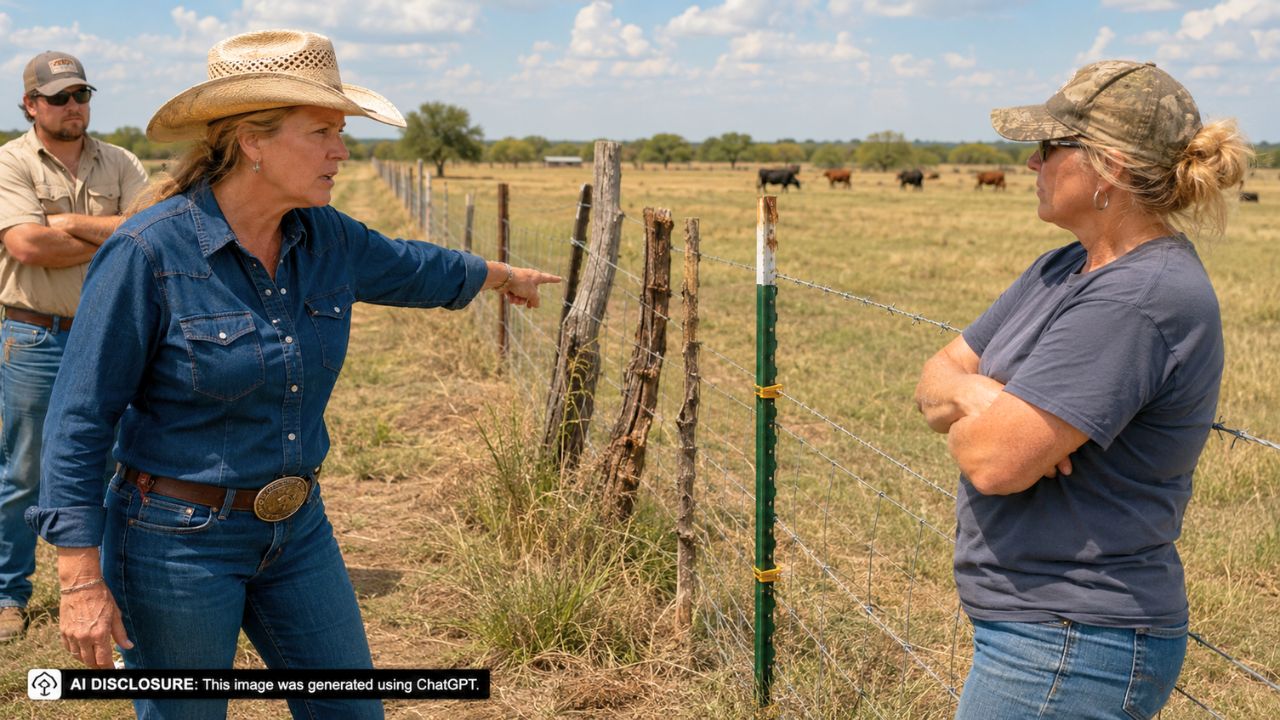
Photo credit: AI-generated image created using ChatGPT. Illustrative only.
On rural land, fences aren’t decorative. They’re the line that keeps livestock where they belong, keeps peace with neighbors, and prevents one bad afternoon from turning into a wreck on a county road. So when a Texas landowner walked out to find nearly a thousand feet of her cedar-post barbed-wire fence gone, the shock wasn’t just about wood and wire—it was about what comes next.
In the original post, she described how a new neighbor tore down roughly 950 feet of an older fence that was still in “great condition” and doing its job: keeping the cows in. The neighbor didn’t ask. She just removed it and built a different fence in its place.
A fence that worked suddenly wasn’t there
The landowner’s frustration wasn’t that the fence was old. In the country, old can still mean solid—cedar posts and barbed wire can last a long time if they’re set right and maintained. Her point was simple: it was still a good cattle fence.
Then, without permission, it was taken down. Not a few posts. Not a small stretch that might be argued over. Nine hundred fifty feet is a long run, the kind of length that changes how animals move and how a pasture “holds.”
The neighbor replaced it with a new fence, but that didn’t settle anything. It created a brand-new problem: the landowner believed the replacement fence would get damaged by the cows, and she didn’t want the neighbor coming back later claiming the cattle ruined it.
The “be thankful” response lit the fuse
Plenty of neighbor disputes start with misunderstandings and end with an apology. This one didn’t. When the landowner contacted the neighbor to say the torn-down fence needed to be replaced, the neighbor’s response wasn’t cooperative.
According to the landowner, the neighbor said they “should be thankful” she removed their “old crappy fence” and made it clear she wasn’t going to pay for a new one. That wording matters because it turns what could have been framed as “I thought I was helping” into “I’m not taking responsibility.”
It also left the landowner boxed in. If you accept the new fence as-is, you’re potentially accepting the neighbor’s version of events—that the old fence was junk and removal was a favor. But if your cows lean, rub, or push and the replacement isn’t built for that kind of pressure, you can be staring at a livestock escape and a fresh accusation.
Rural consequences aren’t theoretical
In town, a fence fight is usually about privacy, pets, or aesthetics. In cattle country, the stakes are heavier and more immediate. A reliable boundary is part of basic daily safety.
If cows get out, you don’t just lose sleep—you risk damaged property, injured animals, or a serious road hazard if they wander. And even when nothing catastrophic happens, chasing livestock back through gates and brush is hard on animals and people.
There’s also the wear-and-tear reality. Cattle test fences. They scratch, they press, they look for weak spots when grass is greener on the other side. A fence that’s “new” isn’t automatically “right,” especially if it wasn’t built with livestock in mind.
The money number made it impossible to ignore
The landowner didn’t guess at the cost. She got an estimate: $8,500 to replace the fence that was torn down. That’s real homestead money—money that could have gone to feed, vet bills, tractor repairs, or a dozen other unglamorous necessities.
And unlike some neighbor disputes, this isn’t a matter of “just split it and move on.” The fence wasn’t mutually removed after a discussion. It was taken down unilaterally, and the replacement was done without permission, leaving the landowner to deal with the consequences either way.
That estimate also changes the emotional temperature. An apology and a handshake don’t rebuild 950 feet of cattle fence. Someone pays. Either the neighbor does, or the landowner eats it, or it becomes a court fight.
When the police say “civil matter,” frustration spikes
Looking for help, the landowner called the police. The response was blunt: there wasn’t much they could do, and it needed to go to small claims court. That’s a moment many property owners recognize—the sudden realization that something that feels like a clear wrong doesn’t come with an immediate fix.
That “civil matter” answer can feel like being told to go solve it yourself, even when you’re standing there with your fence already gone. But it also signals what the next steps would likely require: documentation, estimates, and proof that the fence was theirs and was removed without consent.
Now the landowner is left with the question that hangs over so many rural disputes: is suing worth the time and stress, or is it throwing good money after bad?
What commenters tended to push: proof, paperwork, and boundaries
Even without a long thread of back-and-forth included in the source material, the basic direction of public advice in these cases is predictable: treat it like a property damage dispute, not a shouting match across the fence line.
People typically urge landowners to lock down the basics first—photos of what was removed, any remnants of old posts or wire, a clear record of the neighbor’s refusal to pay, and written estimates showing the replacement cost. In fence conflicts, the story you can prove matters more than the story you can tell.
Another common refrain in rural boundary problems is to be sure about the line itself. When a new neighbor moves in and starts tearing out fencing, it can be a sign they believe the boundary is somewhere else—or that they’re willing to act like they believe it is. Whether that comes down to deeds, markers, or a survey, uncertainty is where these disputes breed.
And finally, commenters in these disputes often warn against letting the neighbor control the narrative. If someone calls your working fence “crappy” and frames the teardown as a favor, the longer you let that sit, the more normalized it becomes—especially if the replacement fence stays and the old one disappears without a paper trail.
In the end, the landowner is staring at a hard rural truth: fences are physical, but fence disputes are paperwork. Without permission, nearly a thousand feet of functional cattle barrier was removed, replaced with something she doesn’t trust, and then dismissed with a “be thankful” on top of it. Whether she takes it to court or not, the neighbor has already shown how they handle boundaries—and that’s the kind of thing you don’t forget when you live next to someone for years.
Like Fix It Homestead’s content? Be sure to follow us.