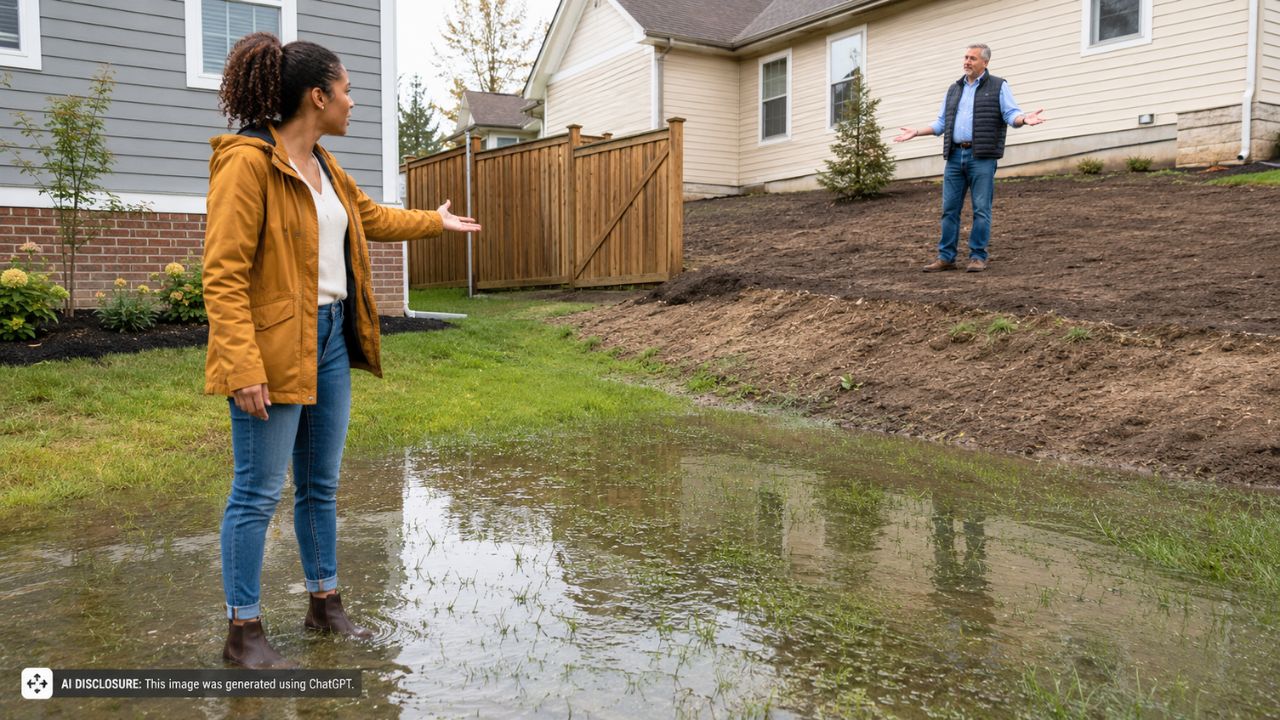
New Homeowner Finds Two Inches of Standing Water Across Half the Yard Traced to a Neighbor’s Regraded Lot — Then the Neighbor Says the Water “Has to Go Somewhere”
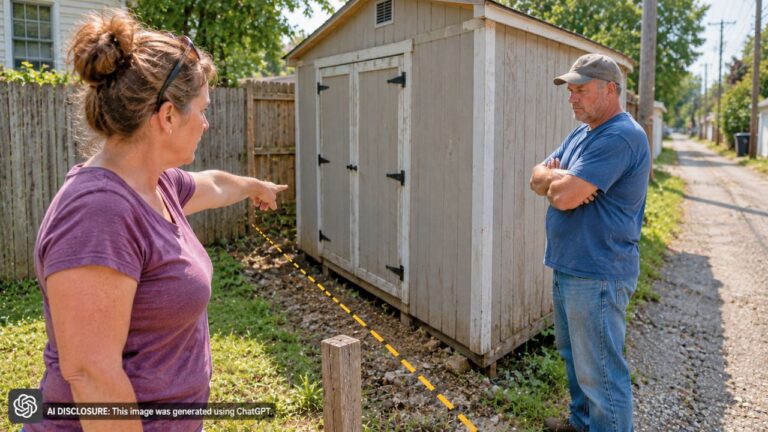
Photo credit: AI-generated image created using ChatGPT. Illustrative only.
The first time the backyard held water a little longer than usual, it probably felt like a fluke—one of those rainy-week annoyances you shrug off and assume will drain out. But when half the yard starts behaving like a shallow pond and it stays that way for over a week, it stops being “weather” and starts feeling like something changed.
That’s where one homeowner found themselves after their neighbor revamped an entire backyard—adding a pool, concrete walkways, steps set on block, and gravel, while also removing most or all of the lawn. In the original post, the homeowner says that after the upgrades, rainwater that used to disappear in a couple of days now lingers for 8 to 10.
The yard didn’t used to behave like this
The homeowner’s baseline matters here, because it’s not just “my yard gets wet when it rains.” They describe a normal pattern: a day of rain would leave water behind, but it would be gone within two days. That’s typical for plenty of lawns—soft soil, grass acting like a sponge, and enough slope to move water along.
After the neighbor’s work, that timing changed dramatically. Now, even a two-hour rain can leave standing water for three days or more on the surface. The homeowner says the runoff is flowing onto their property and collecting, turning part of the yard into a persistent pond.
Then the neighbor’s upgrades made the slope feel personal
From the homeowner’s perspective, the “before and after” is hard to ignore. The neighbor didn’t just add one feature; they reshaped the whole back area—pool construction, hardscape on both sides of the property, steps, block, gravel, and what sounds like a big reduction in lawn area.
Even without anyone intentionally aiming water at a property line, those kinds of changes can alter how rain moves. Replacing grass with concrete and gravel reduces absorption. Building up grades around a pool and new walkways can subtly create a higher elevation that sheds water faster. The homeowner suspects it’s a side effect of the improvements, not sabotage, but the result is the same: their yard is now receiving the runoff.
They also mention that neither property has a French drain system, and that “all water exit from the gutter freely.” So instead of runoff being managed underground or redirected to a proper outflow, it’s just doing what gravity tells it to do—except now gravity’s been reshaped by construction.
Messages were exchanged, but the problem stayed put
The homeowner did what most people try first: they reached out. They exchanged messages with the neighbor, trying to connect the timeline of the renovations with the sudden drainage problems.
The neighbor, according to the post, didn’t want to admit the improvements caused the water to dump into the homeowner’s yard. That response leaves the homeowner stuck in the worst part of a property-line dispute: the “prove it” stage. It’s not dramatic shouting over fences. It’s a quiet refusal to take ownership while the water keeps sitting there, day after day.
And unlike a loud party or a barking dog, this issue doesn’t end when the neighbor goes back inside. It seeps—literally—into the ground, the turf, and whatever is below the surface.
The real pressure point: water that won’t leave creates other problems
Standing water across half a yard isn’t just ugly. It’s disruptive. When water sits for 8 to 10 days, it can turn grass to mush, kill sections of lawn, and leave ruts and low spots that hold even more water the next time it rains.
Even if the homeowner doesn’t spell out every downstream effect, the practical consequences are easy to picture: a yard that can’t be used, mud that gets tracked indoors, and a constant worry about what prolonged saturation is doing near the house. People also start thinking about mosquitoes and other pests as soon as the yard becomes reliably wet.
The worst part is the way it compounds. Once a yard becomes the low point, it keeps becoming the low point. The soil structure changes. The surface compresses. The next storm arrives and the “new normal” is already set.
The expensive option showed up fast: “Do I really have to pay for a French drain?”
The homeowner is already doing what homeowners often do when they feel trapped: calling around for quotes. They’re looking at installing a French drain, even though they don’t believe they caused the problem.
You can feel the resentment in the post—not toward the idea of fixing drainage, but toward paying for a fix to someone else’s unintended side effect. They describe it as frustrating to have to “shell out big bucks in this economy.” That’s the catch with water: you can wait, or you can pay, and both options feel bad when the source appears to be next door.
At the same time, drainage work isn’t something you want to rush into blindly. If the flow is coming from a regraded neighboring lot, any solution on the homeowner’s side risks being a bandage unless the overall drainage path is understood. And if the neighbor continues shedding water faster than before, the homeowner’s new system could be overwhelmed—or simply redirect the problem to a different corner of their own yard.
Readers tended to focus on proof, paper trails, and avoiding a driveway showdown
Even without a full comment thread included, this kind of post typically pulls homeowners toward the same first steps: document what’s happening and treat it like a property issue, not a personal feud. When a neighbor won’t acknowledge a cause, the next move usually isn’t louder messaging—it’s better records.
Homeowners in similar disputes often emphasize taking photos and videos during and after storms, keeping a timeline of when the changes were made, and gathering any estimates that describe the suspected source of water. Another common theme is getting third-party eyes on it—whether that’s a drainage professional explaining the grade and flow in plain language, or a survey that clarifies where the low points and property line sit.
Those steps don’t magically fix the puddle, but they change the dynamic. It’s harder to brush off “my yard is a pond for 10 days now” when there’s a clear rain-to-runoff record and a contractor’s assessment describing how water is entering the property.
For now, the homeowner is stuck balancing two competing urges: fix it quickly so the yard stops holding water, and slow down long enough to avoid paying for a solution that doesn’t address what changed next door. The neighbor’s backyard may look nicer after all that concrete and pool work, but on the other side of the line, the upgrade is showing up as standing water that just won’t go away.
Like Fix It Homestead’s content? Be sure to follow us.