Homeowner Spends $20,000 on New Lawn and Drainage After a Neighbor’s Fence and Trench Turn Out to Sit Entirely on Their Property — Then the Neighbor Adds a Gravel Wall So Runoff Floods Back Onto Their Yard Instead of His
Photo credit: AI-generated image created using ChatGPT. Illustrative only.
Four years after moving in, a homeowner thought they finally had the yard problems under control. The backyard had been cleared, a new lawn installed, and drainage work completed—about $20,000 worth—specifically to stop flooding. Then the front yard started acting up again, and the trigger seemed to be coming from next door.
In the original post, the homeowner describes a neighbor who had long treated a skinny strip of land as his own. There was a short white fence, a trench dug for water, and—after a survey—an uncomfortable discovery: the fence and trench weren’t on the neighbor’s property at all.
The fence line “he owned” wasn’t his
When the homeowner bought the house, the neighbor already had a two-foot white fence separating the yards. From the start, the neighbor told them he owned the fence line and even claimed an extra six inches past it.
At first, that kind of statement can sound like neighborhood lore—something said with enough confidence that you don’t immediately challenge it. The fence was already there, and new homeowners have a long list of projects before they start fighting over inches of grass.
But fences have a way of becoming permanent, even when they’re wrong. Once a line is treated as “the line,” everything else follows it: mowing habits, landscaping, where you pile snow, and where water gets “handled.”
A trench appeared, and the yard started looking worse
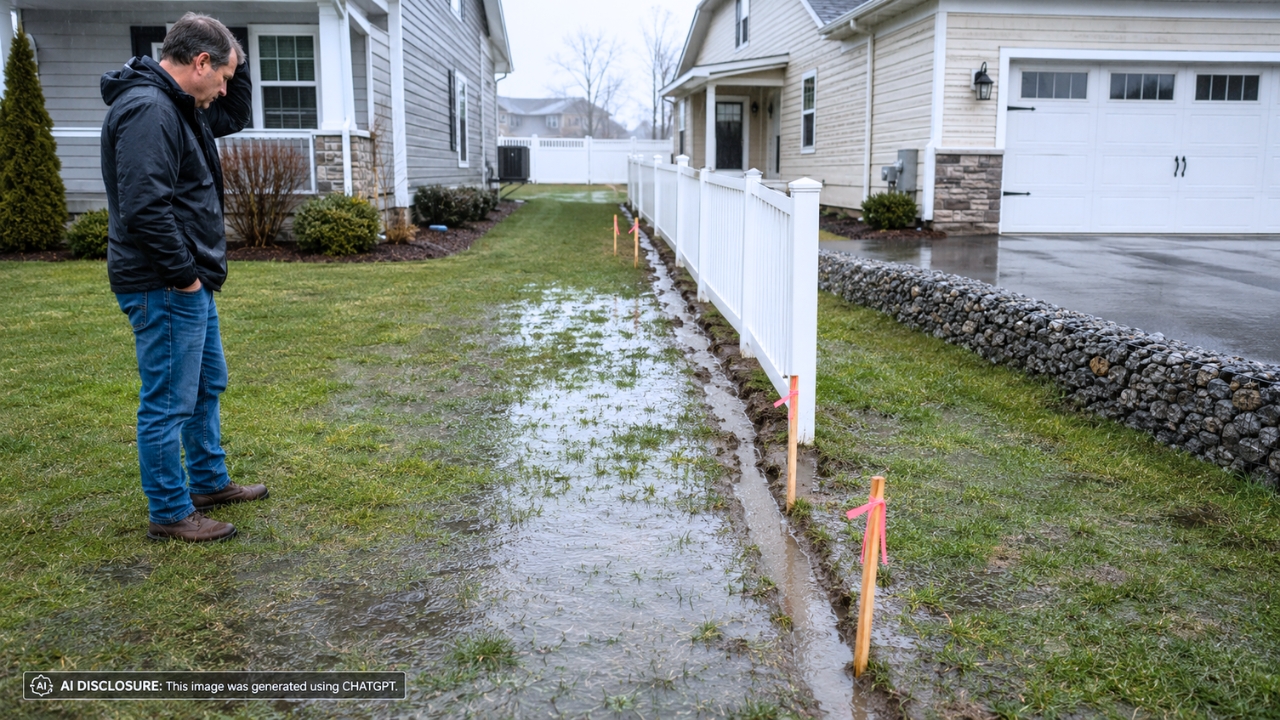
A year after the home purchase, the neighbor dug a trench on what he considered his side of that white fence. The goal, according to the homeowner, was for water to collect there.
The trouble is that a collection trench isn’t neutral. It changes how runoff moves, where it sits, and what happens in a heavy rain. The homeowner says the trench filled with water, and the side of their yard started to look rough.
Instead of being a hidden drainage fix, it became a visible scar that held water—one more patch of yard that couldn’t easily be cleaned up without knowing whose problem it really was.
The survey changed the whole story
The homeowner’s plans to fence in the backyard forced the issue. Before installing anything new, they paid for a property survey.
That’s when the “he owns it” story collapsed. The survey showed the neighbor’s white fence was on the homeowner’s property—and the trench dug along it was also on the homeowner’s land. In other words, the neighbor had placed improvements across the line without verifying it first.
Suddenly, this wasn’t just an annoying trench. It was damage and alteration on land the homeowner legally owned, paired with a neighbor who had been speaking as if the boundary question was already settled.
$20,000 in drainage work… and then the front yard got hit
The homeowner says they’d already spent $20,000 clearing the backyard, installing a new lawn, and putting in drainage to prevent flooding. That kind of spend usually comes after months—or years—of trying smaller fixes and realizing the water problem won’t politely go away.
Then came the escalation: the neighbor added what the homeowner describes as a 10-inch wall of gravel along the end of the neighbor’s driveway. The homeowner believes this gravel barrier changes where the overflow goes when the trench fills up during rain.
The result, as they describe it, is that water overflows back onto their property instead of spilling onto the neighbor’s. After all that money trying to stop flooding, they’re staring at a brand-new cause of it in the front yard—created, in their view, by a neighbor redirecting runoff to protect his own side.
It’s the kind of move that feels small when you’re stacking stones, but enormous when you’re the one watching water spread across grass you just paid to rebuild.
When water starts crossing lines, it gets personal fast
Drainage disputes tend to get ugly because they’re repetitive. It’s not one loud party or one fallen tree. It’s every storm, every season, and every time you try to improve your yard only to see it washed out again.
What makes this one even tighter is the combination of boundary and runoff: a fence in the wrong place, a trench dug in the wrong place, and now a barrier that appears designed to keep the neighbor’s driveway area drier by pushing overflow elsewhere.
The homeowner’s frustration comes through clearly: they don’t think they should have to pay again to fix a problem they didn’t create. And they’re not just talking about aesthetics. Flooding can wreck turf, compact soil, create muddy sink spots, and push water toward foundations—turning a “front yard” problem into a house problem if it persists.
How other homeowners tend to react: proof first, then pressure
Even without a long comment thread included, this type of post usually draws a predictable set of practical reactions from other homeowners: get everything documented, keep the survey handy, and stop treating the issue as a casual neighbor disagreement.
When a fence and drainage feature are shown to be fully on your property, the leverage shifts. The most common next steps people push in scenarios like this are to communicate in writing, take photos after rain, and keep records of the timeline—especially now that the homeowner says a gravel wall was added specifically where it would affect overflow.
Another common reaction is to avoid “fixing it quietly” a second time. When someone spends big money to correct drainage and then the pattern returns because a neighbor changed grading or installed a barrier, homeowners often feel forced into being more formal—because informal can turn into “we’ve always done it this way,” and suddenly you’re the one defending why your yard shouldn’t be the neighborhood detention basin.
The homeowner is left with a choice nobody enjoys: eat the cost and resentment, or start treating the fence, trench, and runoff as property damage and encroachment that needs to be corrected by the person who created it.
For now, the yard is caught between paper boundaries and real water flow. The survey may have clarified where the property line is, but the next rainfall will decide where the water goes—and whether the homeowner’s $20,000 fix stays a solution or becomes just the first round of an expensive neighbor war.
Like Fix It Homestead’s content? Be sure to follow us.