Homeowner Finds a Survey Marker Moved Into the Middle of a Mulch Ring — Then Finds the Tree the Neighbor Planted There Over a Year Ago
Photo credit: AI-generated image created using ChatGPT. Illustrative only.
The new-house to-do list is supposed to be simple stuff: change the locks, find the trash day, figure out where the sun hits the yard. For one homeowner, it was a 65-pound dog delivering daily reminders that a fence needed to happen soon.
So they did the responsible thing first—paid for a survey and had the boundary marked. And almost immediately, that plan ran into a problem that lives right at the edge of “awkward neighbor misunderstanding” and “please don’t touch my property lines.” The details came from the original post, where the homeowner shared what they found and asked how to handle it without starting a feud three weeks after moving in.
A fence project turned into a property line surprise
The survey didn’t just confirm the boundary—it shifted the homeowner’s understanding of the backyard. About 15 feet of what they’d assumed belonged to the neighbor was actually theirs.
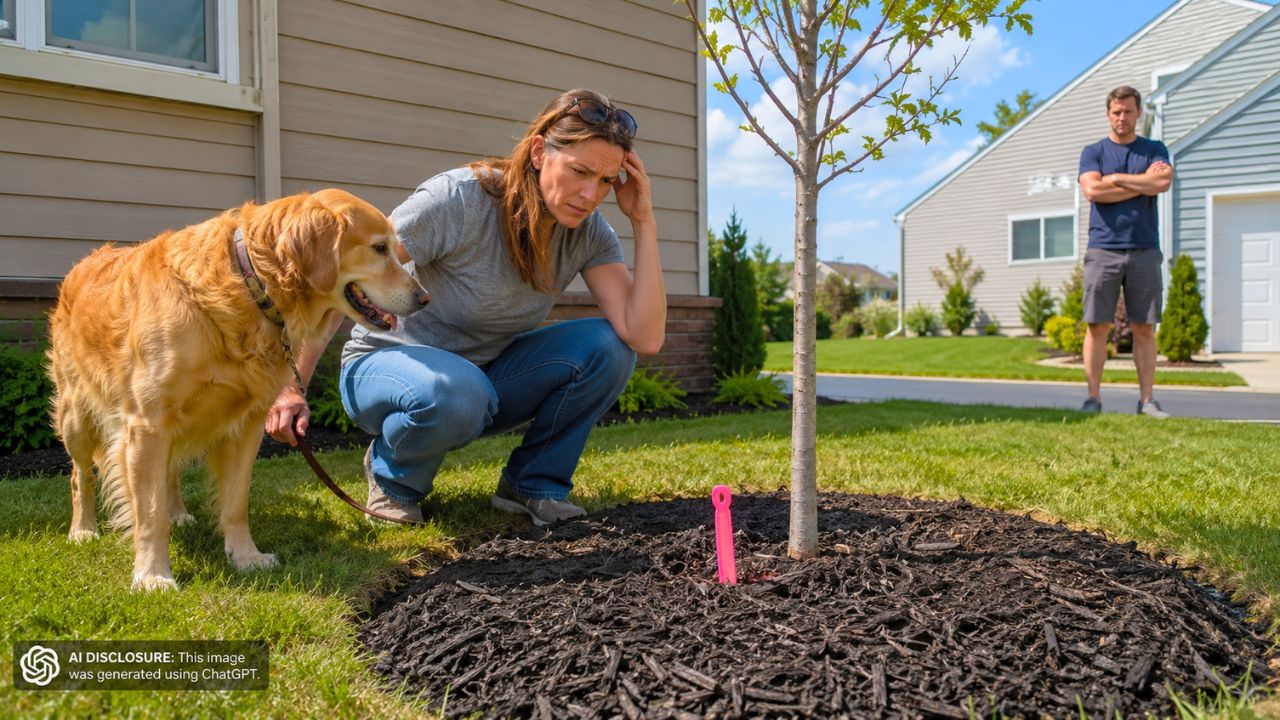
That extra strip wasn’t empty, either. In the photo they shared, the survey marker sat roughly in the middle of a mulched tree ring, the kind of neat landscaping detail that usually signals, “This is ours. Please don’t mess with it.”
Worse (or at least more complicated), there was also a tree sitting entirely on the homeowner’s side of the line—one the neighbor had planted within the last 12 to 18 months, based on how it looked.
The moment the flag moved, it stopped feeling accidental
Then came the morning that changed the vibe. While walking the dog in the backyard, the homeowner noticed the marker had been moved.
It wasn’t the in-ground iron marker itself—there was a metal bolt/secondary marker in the ground that stayed put. But the visible flag that identifies where that iron marker is? That had been shifted about 10 feet back into the homeowner’s property.
If you’ve ever dealt with yard work near a property line, you know what that flag represents: not just a point on the ground, but a statement. Moving it doesn’t change the actual boundary, but it absolutely changes what a casual glance suggests. It’s the difference between “the line is here” and “the line is wherever I say it is.”
And because the homeowner had only lived there about three weeks and hadn’t met the neighbors yet, there wasn’t any relationship to lean on—no friendly baseline to assume it was an honest mistake.
The landscaping makes it personal fast
A relocated flag is one thing. A mulched ring and a newly planted tree add a whole other layer.
Mulch rings take time and intention. Someone edged that circle, hauled mulch, and decided the tree was going to be part of the yard’s “finished” look. When a survey says that ring sits on your property, it creates an immediate, practical question: are you expected to maintain it, avoid it, or remove it?
The tree is even trickier. A fence plan can run straight through where the neighbor apparently already committed to planting. And if the homeowner wants a fence for a dog, it’s not a someday problem. It’s a safety-and-peace-of-mind problem that’s now tangled with someone else’s landscaping choices.
It also sets up a long-term headache. Trees don’t stay small. Roots spread, branches grow, and what starts as a polite “Can we just leave it?” can become “Who pays when it damages something?” years later.
They tried to introduce themselves—and hit a wall
The homeowner didn’t jump straight to threats or printed maps taped to the neighbor’s door. Instead, they tried the most normal first step: walking over to introduce themselves.
No one answered. About 30 minutes later, guests showed up at the neighbor’s home, which didn’t exactly make the earlier no-answer feel reassuring.
Back at home, the homeowner replaced the flag marking the iron marker. In other words: they reset the visible marker back where the survey said it belonged, without touching the actual iron in the ground.
Then they took one more step aimed at keeping things civil. They wrote a greeting card, put it in the mail, introduced themselves, and mentioned they’d had a survey done. The note asked a simple, pointed question: who planted the trees on the property line?
Homeowners watching from the sidelines focused on proof
The homeowner’s question wasn’t just “What do I do?” It was “How do I do it without being a jerk?” That’s the part that hits home for a lot of people—because nobody wants their first neighbor interaction to be about boundaries, flags, and who’s been planting what where.
But the flag being moved is the detail that tends to push people toward documentation and clarity. Even when the in-ground marker stays put, shifting the visible flag can complicate everything that happens next: fence quotes, landscaping plans, even casual assumptions from visitors or contractors about where the property line sits.
The homeowner didn’t describe a blowup or any direct confrontation yet. But the steps they did take—replacing the flag and communicating in writing—show the same instinct a lot of experienced homeowners have: get your facts straight, then keep the conversation calm and trackable.
A mailed note is also a quiet way of saying, “I’m not here to fight, but I am paying attention.” It creates a record of the first outreach without escalating into a face-to-face argument that can get heated fast.
When you need a fence, the boundary can’t stay fuzzy
This all started with a dog and a fence. That’s what makes the whole thing so frustrating: it wasn’t a petty property-line obsession until the homeowner needed to build something functional.
A fence can’t be built on assumptions, especially when the survey reveals that a chunk of yard everyone thought belonged to the neighbor is actually yours. Suddenly, every inch matters. Setbacks matter. Where posts go matters. And “we’ve always treated it like ours” stops being a harmless habit and starts being a real obstacle.
By the end of the update, the tension was still there, just contained. The flag was back where it belonged. The greeting card was mailed. And the homeowner was waiting to see whether the neighbor would respond like a reasonable person—or double down on the idea that moving a marker flag changes reality.
In a perfect world, the next interaction is a friendly conversation and a mutual plan for the tree ring and any future fence. But the homeowner already learned the hard lesson that comes with property lines: the ground doesn’t move, but people will try.
Like Fix It Homestead’s content? Be sure to follow us.