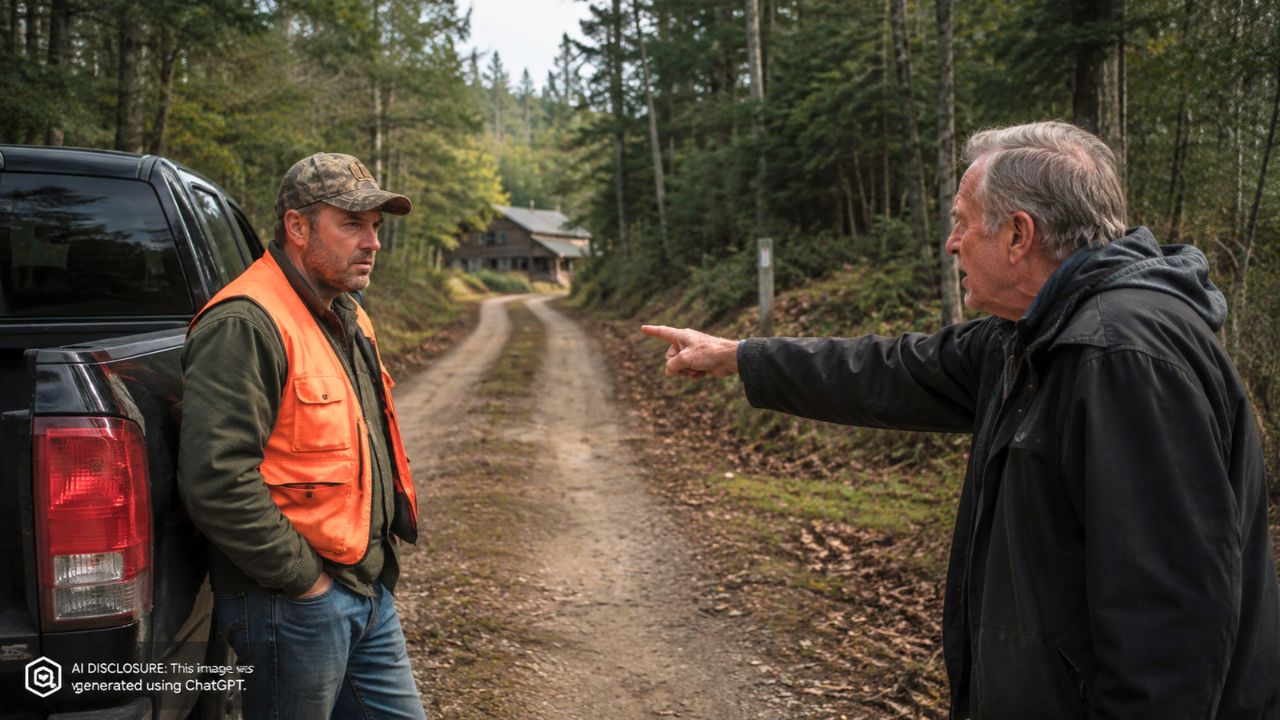
Landowner Drives His Ten-Mile Easement to Reach His Cabin — Then the New Neighbor Sues to Stop Him Hunting the Public Land Along the Way
Photo credit: AI-generated image created using ChatGPT. Illustrative only.
In rural Wyoming, “my driveway” can be a ten-mile ribbon of dirt and gravel cutting across multiple ownerships, with gates, cattle guards, snow drifts, and the kind of neighborly assumptions that only feel solid until somebody new buys the surrounding land.
That’s the backdrop for a Campbell County fight laid out in the original post: a landowner can legally use a recorded easement to reach his own place, but his new neighbor is suing to stop him from pulling off to hunt public land that sits along the route.
A ten-mile “driveway” that isn’t really a driveway
The man at the center of the dispute is Calvin Ten Braak, a Rozet resident with a cabin property in southeastern Campbell County. His access isn’t a quick turn off a county road—it’s an approximately 10-mile-long easement that was recorded in November 2024.
That access road cuts through a patchwork: private land (including acreage now owned by the Maestri family’s LLCs), plus state-owned and Bureau of Land Management ground. If you’ve ever lived where your “lane” crosses three fences and two jurisdictions, you already know how quickly a simple drive turns into a rulebook.
And along that same route is a large chunk of otherwise hard-to-reach public land. According to the GPS mapping app OnX Hunt, the BLM parcel accessed via the easement totals more than 16,500 acres.
The new neighbor arrives, and the rules suddenly change
The landowner suing is Corral Maestri LLC and Maestri Ranch Company, LLC, managed by Frank and Michael Maestri, according to legal documents included with the lawsuit. The Maestris recently purchased thousands of acres of private land that the easement crosses.
In June, Ten Braak received a cease-and-desist letter from the Maestris. The letter frames the easement as strictly a pass-through: “The purpose of the Easement is to allow access to the grantees’ property, not public property,” it states, adding that it “shall solely be used for ingress and egress.”
The letter goes further, spelling it out in plain language: “Simply put, this Easement does not give you a right to cross private land as a thoroughfare to public land for hunting.” In other words, drive through to your cabin, but don’t treat the road like a way to hop out and recreate.
If you’ve ever dealt with a shared driveway after a property sale, this part feels familiar. The physical road doesn’t change overnight, but the interpretation does—especially when the new owner starts reading every word like it’s a boundary fence.
“Baseless and in bad faith”: the response that turned it into a lawsuit
Ten Braak hired counsel. In July, his attorney, Alan Harding of Laramie, sent a response pushing back hard, calling the cease-and-desist letter and trespass notice “baseless and in bad faith.”
Harding’s letter argues that the easement holders don’t get to police public land use: “The Easement does not confer upon your clients any authority to regulate or limit the use of public lands,” it reads. “Public lands are held in trust for the benefit of the public, and access to such lands cannot be curtailed by private parties absent statutory authority or ownership interest.”
Less than three weeks later, the dispute moved from letters to court. The Maestri entities filed suit, and the case is now working its way through Campbell County District Court.
The timeline alone explains why these things explode: one land sale, one letter, one rebuttal, and suddenly you’re staring down a multi-year legal fight instead of just watching for deer in the tree line.
Not just a hunting argument—this is about how you live out there
On paper, it’s a question about what “ingress and egress” means. On the ground, it’s about routine. If your place is remote, your access road is everything: hauling water, bringing in supplies, checking on buildings, getting out during storms, and yes, stopping along the way when you’re legally on public ground.
The public-land piece matters because the BLM acreage in question is described as “landlocked” public land—areas that technically belong to the public, but are functionally unreachable unless you can legally cross something to get there.
Access advocates are watching because this dispute adds to a list of fights that challenge the public’s ability to reach and use public land for hunting. It also follows Wyoming’s highly publicized “corner crossing” battle in Carbon County, where the outcome ultimately favored the public.
Frank Maestri, reached by WyoFile, said he wanted to make one “short and simple” point: “I just want to be clear: This is a private land case. It has nothing to do with access to public land.”
That line is going to sound very different depending on which side of the gate you live on. If you’re the one who bought the private land being crossed, it’s about controlling use of your property. If you’re the one relying on a long-established route to reach public ground along the way, it feels like access being choked off without anyone admitting it.
Where the homestead drama turns personal: veterans, guides, and a road everyone used
This isn’t only about one man and one neighbor. For the past seven years, Ten Braak has shared access to his easement with Hunting with Heroes, a Casper-based nonprofit that takes disabled veterans hunting, fishing, and outdoors.
Sundance resident Terry Wilkerson has guided those outings, taking veterans onto state and BLM land via Ten Braak’s road. He told WyoFile about hunts with a 90-year-old Korean War veteran and a 100% disabled Air Force veteran with terminal brain cancer—hunts that depended on being able to reach public ground.
Wilkerson said he was surprised the lawsuit wasn’t immediately dismissed, and he worries about what a ruling in the Maestris’ favor could do elsewhere. “I would think it would be a no-brainer that the judge would say, ‘You can’t keep them from going on public land,’” he said. “If this is upheld, I think it’s going to have a tremendous negative impact on access to a lot of public land.”
That’s the part that feels like real rural living, not an abstract property-rights seminar. Access isn’t just a personal convenience—it can be the difference between a tradition continuing and a gate quietly closing.
The court calendar is set, but the road still has to be used
The case is still early. Harding filed a motion to dismiss in August, the plaintiffs responded in September, and Judge Mike McGrady held a hearing last week. A trial has been scheduled for December 2026.
That’s a long time to live next to someone while lawyers argue over what counts as “solely” using an easement for ingress and egress. And it’s a long time to keep driving the same route knowing every stop, every parking spot, and every “just for a minute” pull-off can be interpreted as proof of wrongdoing.
Ten Braak declined to be interviewed for the story under guidance of his attorney, who also declined. So for now, the only things that are truly fixed in place are the recorded easement line on the map, and the reality that a ten-mile access road can turn two neighbors into courtroom opponents in a hurry.
Out there, people don’t just argue over inches of fence. They argue over the only way in, the only way out, and what you’re allowed to do once you’ve driven all that distance to reach a piece of land that was supposed to belong to everyone.
Like Fix It Homestead’s content? Be sure to follow us.