Homeowner Finds Her Fence Built a Foot and a Half Onto the Neighbor’s Yard — Then the Fence Company Says Knowing the Property Line Was Her Job
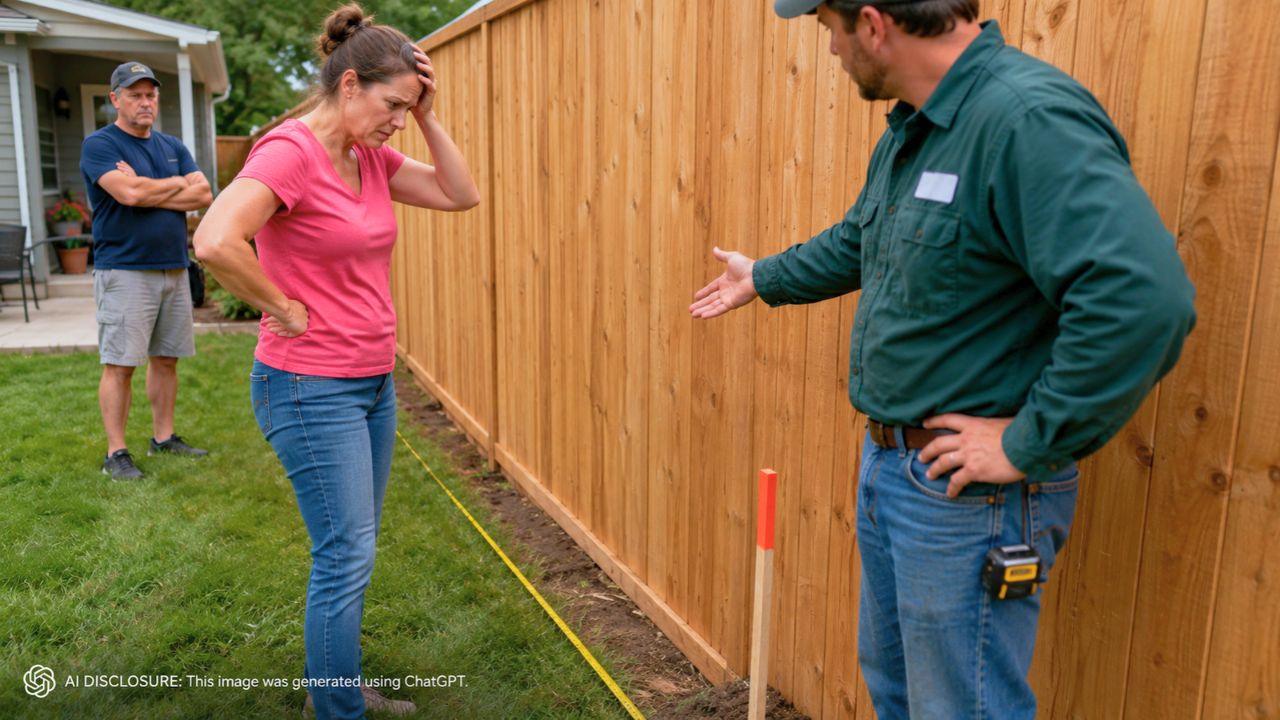
Photo credit: AI-generated image created using ChatGPT. Illustrative only.
It started the way a lot of backyard projects start: a homeowner trying to make her place safer and more livable. In Cabarrus County, North Carolina, Lorie Card hired B&H Fencing to put up a fence so her pit bull could run around away from children. The panels went up, the line looked straight, and for a moment it probably felt like a problem solved.
Then the “straight line” turned into a very crooked headache. Part of the fence wasn’t on Card’s property at all—it was built into the neighbor’s yard by about a foot and a half, a detail first reported in the original post from WSOC-TV’s Action 9.
The fence went up for safety—and that’s what made the stakes higher
Card’s reason for fencing wasn’t aesthetic. She wanted a contained space for her dog, specifically a pit bull, so the dog could be outside without mixing with children. That kind of motivation changes the pressure on the project. You’re not just thinking about curb appeal—you’re thinking about daily routines, gates being shut, and a dog testing every corner the minute you turn your back.
When a fence like that is wrong, it’s not just a “whoops.” It can turn into a neighbor problem fast, because now the boundary isn’t theoretical. It’s a physical structure that dictates where someone can walk, mow, plant, or even let their own pets out.
The moment the property line became real
At some point after installation, it became clear that neither Card nor B&H Fencing actually knew the true boundary line. One wall ended up roughly a foot and a half over the line, sitting on the neighbor’s side.
That number matters because it’s enough to be noticed in a backyard. A foot and a half can swallow a strip of lawn, shift how a shed door opens, or change where someone thinks they can put a garden bed. And once a fence is in, it “teaches” everyone a new reality—kids play to it, dogs run it, and neighbors start treating it like the official edge of the world.
In property disputes, that’s often the worst timing. The longer a fence stays put, the more normal it feels, and the harder it is for anyone to back down without feeling like they’re losing something.
“That’s your job,” the company said—and experts backed them up
When the error came out, B&H Fencing’s stance was blunt: knowing the property line was the homeowner’s responsibility. The company’s owner, Bill Rutan, said customers need to know where their stakes are and know their boundaries—and if they can’t find them, hire a surveyor.
Action 9 brought in a real estate lawyer, Ralph McMillan, who said the same thing in plain terms: “Know your boundary lines.” In other words, even if a contractor is the one digging and setting posts, the risk of “building it on the wrong dirt” often lands on the person ordering the work.
That’s a rough lesson because it’s not how most homeowners think a project works. People assume the “pros” will handle the technical part. But property lines aren’t like plumbing or electrical—there’s no universal “standard location.” The only standard is the paperwork, the stakes, and sometimes a survey.
The neighbor factor: one misplaced wall can poison the whole block
The source material doesn’t spell out a blow-by-blow of the neighbor’s reaction, but you can read between the fence posts. A fence built onto someone else’s land isn’t just annoying; it can feel like a quiet land grab, even if it’s accidental.
It also traps the neighbor in a decision they didn’t ask for. Do they demand it be moved immediately? Do they let it slide to keep peace, then worry later about what that “permission” could turn into? Do they avoid confrontation and resent it every time they look out the window?
Even if the neighbor is calm, there’s still the day-to-day friction. Who maintains the strip of yard on “their” side of the fence? Who has access? What happens if the fence needs repairs? Boundary mistakes don’t stay theoretical; they show up every weekend when someone wants to mow.
Instead of digging in, the company moved it—free
This is where the story takes a turn that most homeowners in a contractor dispute wish they’d get. Despite insisting it was Card’s job to know the line (and despite experts agreeing), Rutan promised to move the entire side anyway and do it for free.
According to Card, the company followed through. “He did a great job, he really did,” she said after the work was done. That’s not the kind of quote you hear after most property-line fights, where people are usually stuck arguing over invoices, damage to landscaping, and whose fault it was that the gate doesn’t latch anymore.
It also quietly signals how messy the alternative can get. If a fence stays on the wrong side, it can create long-term tension. If it gets moved later, it can mean new holes, shifted posts, torn-up grass, and another round of disruption. Moving it sooner—especially at no cost—cuts off a lot of future pain.
The “keep it there” option people talk about
Action 9 also mentioned something many neighbors don’t know exists until they’re already stressed: a “permissive-use agreement.” It’s basically a written understanding where the neighbor agrees to let the fence stay put for now, with the catch that if anything ever happens to the fence, it will be rebuilt in the correct spot.
That kind of agreement is the middle path when everyone wants the drama to stop but nobody wants to accidentally surrender rights. It acknowledges reality—there’s already a fence there—while putting a boundary around what it means going forward.
In this case, the physical fix happened instead. But the fact that permissive-use agreements got mentioned tells you how common this problem is, and how often people end up looking for paperwork solutions when the wood and posts are already in the ground.
Card’s neighbor, meanwhile, was reportedly thinking about putting up a fence too. After watching a boundary line shift by a foot and a half, you can imagine the renewed interest in getting it exactly right the first time.
The fence is now where it’s supposed to be, but the story still leaves that familiar homeowner aftertaste: the job you thought was simple wasn’t simple at all. It wasn’t the digging or the materials that caused the headache—it was the invisible line underneath it all, the one nobody double-checked until it was already framed in wood.
Like Fix It Homestead’s content? Be sure to follow us.