Neighbors Watch a Fence Go Up Through a Home’s Garage and Pool — Then the City Council Votes to Let the Owner Build on the 15-Foot Sliver
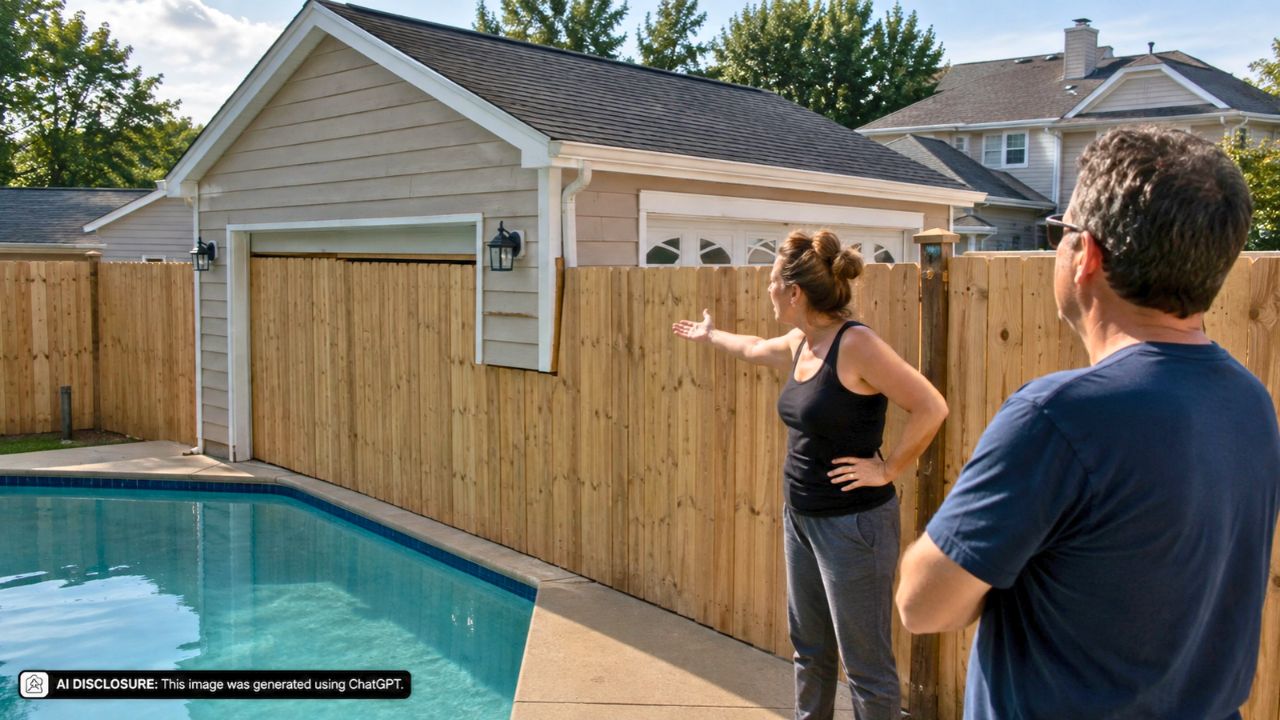
Photo credit: AI-generated image created using ChatGPT. Illustrative only.
Most property line arguments stay in the realm of angry emails, blurry plat maps, and passive-aggressive landscaping. This one ended up with a fence physically cutting through a garage and a pool—like someone took a ruler to a house and decided half of it belonged to somebody else.
In Orlando’s Delaney Park area, neighbors watched the standoff escalate until the city had to step in. The details, including how the land got split and why the fence ended up where it did, are laid out in the source post from WFTV.
A fence line that didn’t stop at the yard
The key visual in this dispute is almost too strange to picture until you force yourself to: a fence installed straight down a property line that doesn’t just slice a backyard—it slices through the middle of the built structures. That includes running through the home’s garage and even the pool.
It’s the kind of thing that makes a neighborhood stop mid-walk and stare, because it turns a “paper” boundary into something you can trip over. And once a physical barrier goes up, it’s not just a disagreement anymore—it’s access, safety, liability, and the future of a whole property wrapped into one awkward row of posts.
How two mortgages turned into two owners
Years earlier, one person owned both properties but financed them separately, with two mortgages. Then a house was built “in the middle,” straddling what would later become two different parcels.
When foreclosure hit, the split became real: the side with the home went to a bank, while the other side reverted back to the property’s original owner. That’s how you end up with a situation where two different parties can claim they’re simply using what they legally own, even if the house itself was never designed to live under those rules.
Adding to the tension: nobody has lived in the home for six years. An empty house doesn’t just sit quietly. It becomes a magnet for problems that spill onto everyone else’s block.
The neighbors got stuck with the day-to-day mess
While the two owners stayed locked in their positions, the neighborhood dealt with what happens when a property goes dark for years. One neighbor, Richard Sconyers, described having to deal with people getting onto the property and the constant effort of keeping an eye on it.
That’s the part that doesn’t show up in property records but matters the most to the people living next door: the time spent calling things in, chasing off trespassers, noticing small changes, and wondering what’s happening behind a garage door that nobody opens anymore.
And when a fence suddenly runs through a structure, it’s not hard to imagine the practical headaches multiplying—how do you secure a garage that’s now effectively cut in half? What happens to a pool when access is disputed? Even “simple” maintenance becomes a negotiation.
When code blocks building, people get creative
The smaller parcel—described as a 15-foot sliver—came with a brutal limitation. City code wouldn’t allow the owner of that smaller piece to build on it, according to the report. So the owner took another route: establish the line in the most literal way possible.
That’s how the fence ended up exactly where the survey says the boundary is, even if that boundary runs through a garage and pool. It reads like a move designed to force the issue: either the other party negotiates, or everybody lives with the absurd result.
To break the stalemate, money was put on the table—but the numbers show just how far apart the sides were. The smaller-plot owner offered $300,000 to buy the property with the home. The bank offered $40,000 to buy the sliver of land that included half the garage and pool.
Eight months went by with no agreement. And during that time, the fence stayed. The empty home stayed. The neighborhood stayed stuck looking at it.
City Council steps in: “Hatfields and McCoys”
With neither side backing down, Orlando’s City Council got involved. Councilwoman Patty Sheehan summed up the tone in the room with a line that tells you this wasn’t a calm, tidy mediation: “Y’all are like the Hatfields and McCoys here — you’re never going to go agree.”
In the end, the Council voted to allow the owner of the small property to build a home on it. Jeff Aaron of the GrayRobinson law firm called it “a great outcome,” saying they “paid good money for a piece of land” and that “for four years, Deutsche Bank has held us hostage, unable to develop our land.”
From a homeowner’s perspective, that vote changes the trajectory of the sliver parcel. But it doesn’t magically undo the physical reality already planted in the ground—and it doesn’t heal the neighborhood’s concern about the existing house sitting vacant and sliced up.
The practical fear: an unsellable house and a long-term eyesore
Neighbors weren’t celebrating. Their frustration wasn’t just about who “wins” on paper. They worried the vote didn’t fix the most visible problem—the fence through the garage and pool—and didn’t make the half-a-house property any more appealing to a buyer.
It’s a very real fear: once a property becomes notorious, it can stay stuck for years. Not because nobody wants housing, but because the specifics are so messy that buyers, insurers, and lenders get skittish. Even investors who like distressed properties don’t love uncertainty about access, use, and boundaries—especially when the boundary literally bisects major features like a garage and pool.
And that circles back to the neighborhood reality. An empty structure can deteriorate faster than people think. It can become a target. It can become a dumping ground for everyone else’s stress, even if everyone agrees it “should” be someone else’s responsibility.
For now, the fence is still a symbol of what happens when property lines and buildings don’t match, and when a stalemate lasts long enough that the city has to pick a path forward. The Council’s vote may open the door for new construction on that narrow slice, but the bigger question for the block is simpler: what finally happens to the vacant home that’s been split down the middle and left for the neighbors to watch?
Like Fix It Homestead’s content? Be sure to follow us.