Homeowners Find a Letter Saying a Crew Will Cut Down Their Trees in a Week — Then Nobody Can Say Where the Alley Boundary Actually Is
Photo credit: AI-generated image created using ChatGPT. Illustrative only.
Jorge Cardenas and Griselda Barbosa Martinez thought they knew every inch of their place. They’ve lived in their West Colfax home for more than 20 years, rebuilding it from what Cardenas described as “destroyed” when they bought it. Then a letter showed up that made their yard feel like it wasn’t theirs anymore.
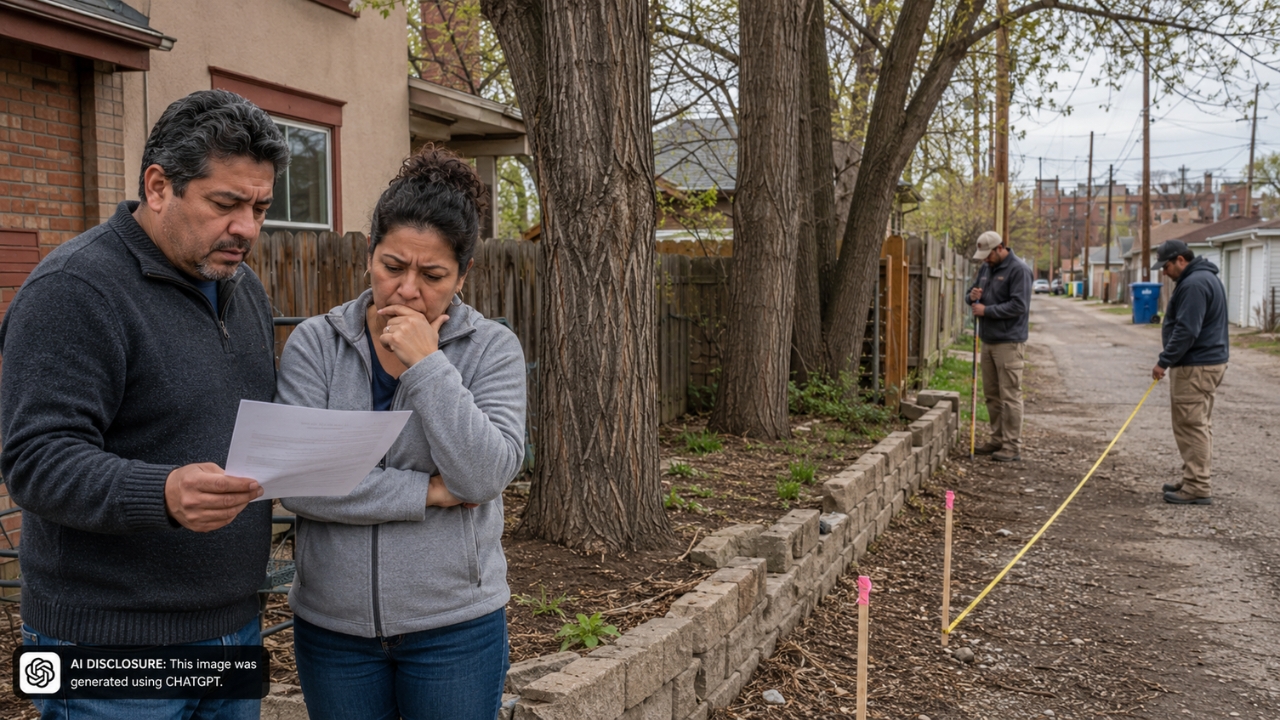
The note, they say, warned that a private company—authorized by the City of Denver—would be coming onto their property in about a week to remove trees for “alley maintenance.” The couple’s account, their attorney’s statements, and the legal fight are laid out in the original post. The short version: they say the alley line was quietly pushed closer to their home, and nobody could plainly show where the boundary actually was.
A door letter that didn’t sound like a request
Most homeowners have had a weird notice taped to the door at some point—utility work, street sweeping, a “we’ll be in the area” flyer. This one wasn’t that. According to the lawsuit described in the report, the letter told them a crew would be coming onto their property and cutting down their trees.
Not trimming. Not evaluating. Removing. And it wasn’t framed as a neighbor-to-neighbor disagreement, either—it came with the weight of city authorization behind it, which changes how a person hears every word on the page.
The couple’s attorney, Anna Martinez, put it in everyday terms: “You could never go to your neighbor’s house and say, ‘Your trees are in my yard, so I’m chopping them down.’ But that’s essentially what the threat was.”
Next door construction turned a quiet line into a moving target
The timing matters. In 2022, construction began next door, part of the larger reshaping happening in Denver as older homes are replaced by townhomes and apartment buildings. Cardenas and Barbosa Martinez say they’d already been getting unsolicited offers to sell, including one for $180,000 that year, but they didn’t take them.
Then came the alley issue—an alley they believed had been shifted closer to their house. It’s the kind of thing that sounds abstract until you picture what’s usually sitting along an alley edge: mature trees, fences, a bit of retaining wall, maybe a narrow strip of dirt that keeps water moving the way it’s been moving for decades.
The couple claims the shift put a retaining wall and several mature trees in danger. When an “alley” becomes the justification, it can start to feel like the land is being re-labeled out from under you, especially if you’re the one losing shade, roots, and soil stability.
The part that would spook any homeowner: nobody could point to the line
Property line fights are nasty even when both sides have paperwork. This one, as described by the homeowners, has an extra twist: they allege that neither the city nor the developers could clearly explain where the boundary of the alley actually was.
That’s the nightmare fuel. If there’s no clear line, everything becomes a guessing game with real consequences—chainsaws, heavy equipment, trucks backing in, roots disturbed, and the possibility of damage that shows up later. A retaining wall doesn’t always fail the day it’s undermined. Sometimes it waits for the next freeze-thaw cycle or the next heavy rain.
The lawsuit is more than 50 pages and accuses the City of Denver, a property developer, and Saunders Construction of violating their rights and threatening their property. The couple argues that no due process was followed before the threat to come onto their land and remove the trees.
“This is our home” isn’t a slogan when you rebuilt it yourself
The emotional temperature in this story comes from the years they’ve already put into the property. Cardenas said in Spanish that when they bought the house, it was destroyed. They spent two decades reconstructing it, turning it into the kind of place you don’t casually walk away from, even when the neighborhood’s price tags start climbing.
Barbosa Martinez kept it simpler: “This is our home.” When you’ve rebuilt walls, fixed whatever the last owner neglected, and watched trees grow, the yard isn’t decorative. It’s part of how the home works—shade on the hot days, privacy from the alley, roots holding soil where it’s supposed to be.
That’s why the idea of someone stepping in with “city authorization” to remove mature trees hits differently than a regular dispute about weeds creeping under a fence.
The legal fight is on paper, but the pressure is physical
The defendants have filed a motion to dismiss and deny wrongdoing, according to the report. The City of Denver and Saunders Construction declined to comment because of pending litigation. So, for now, the couple is stuck in the most exhausting part of a property dispute: the stretch where nothing is “resolved,” but everything still feels urgent.
Because while lawyers trade filings, the homeowner brain runs through practical scenarios. What happens if a crew shows up and believes they have the right to enter? What happens if a tree is cut and it turns out later it wasn’t on alley property? What happens if a retaining wall shifts and now you’re staring at a repair that wasn’t in your budget?
Even if nothing is touched, there’s the day-to-day strain of feeling like you have to guard your own yard—like the default setting has flipped from “private property” to “prove it.”
How people tend to react when the line is blurry but the stakes are high
Stories like this usually split homeowners into two camps: the folks who immediately want a survey and the folks who immediately want cameras. And when the threat involves trees and an access area like an alley, people tend to want both—documentation of where the boundary is supposed to be, and documentation of what anyone does on the ground.
In plain homeowner terms, the instinct is to create a paper trail before anything irreversible happens. Tree removal doesn’t “undo.” A moved boundary doesn’t feel theoretical once a root system is disturbed or a wall cracks. Even a small misstep with equipment near a retaining wall can become an expensive mystery later: was it age, water, construction vibration, or a change in grading?
That’s also why attorney Martinez framed it as a rights issue, not just a landscaping issue. If nobody can clearly identify the line, then showing up with a crew starts to look less like maintenance and more like forced guesswork—with the homeowners carrying the risk.
For now, Cardenas and Barbosa Martinez are waiting on a court decision on whether their case will proceed. But the core tension is already clear: it’s hard to feel safe in your own home when the boundary is treated like a movable suggestion, and the first notice you get is a countdown to losing trees you’ve lived with for years.
Like Fix It Homestead’s content? Be sure to follow us.