Homeowner Shares a Y-Shaped Driveway Easement With the House Next Door — Then the Renters There Repeatedly Block Both Entry and Exit Despite Being Asked to Stop
Photo credit: AI-generated image created using ChatGPT. Illustrative only.
It starts as a small irritation: you pull up after a long day and someone’s car is sitting where it shouldn’t be. But for one longtime homeowner, that irritation has turned into a two-year grind where getting home—or leaving it—depends on whether the renters next door feel like treating a shared driveway as shared.
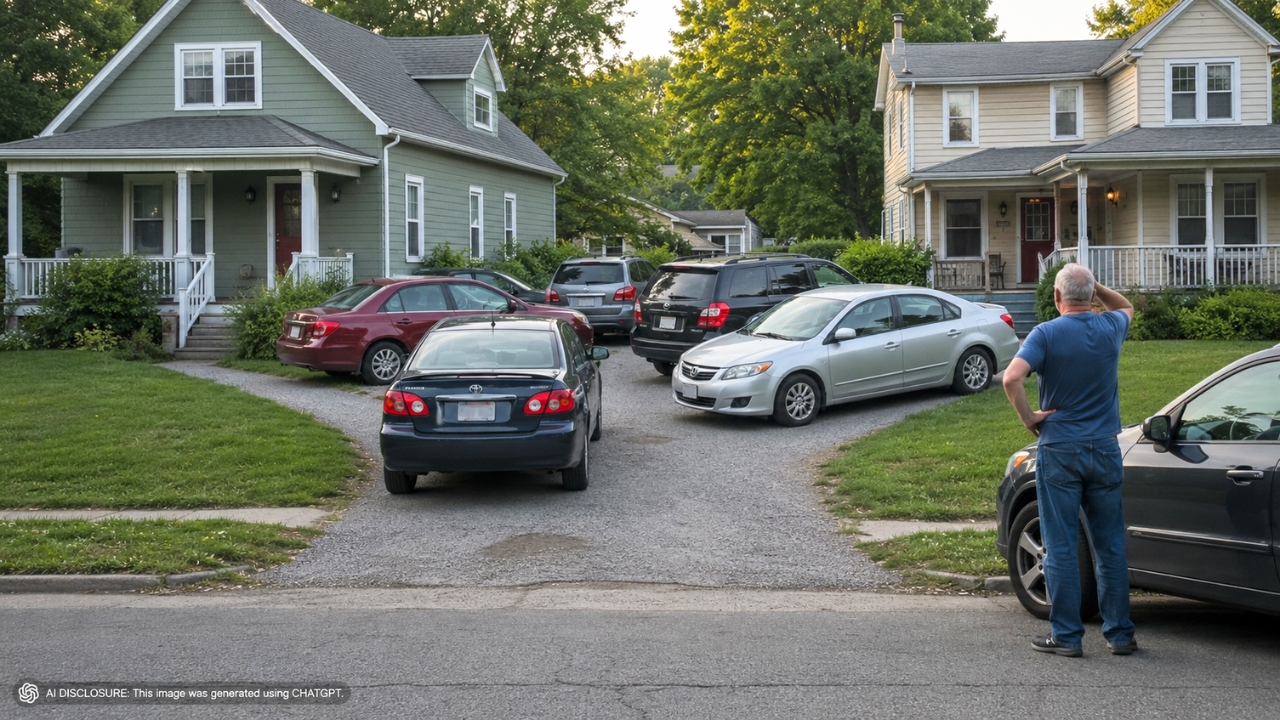
In the original post, the homeowner describes a Y-shaped shared driveway easement split between two properties. They’ve lived there for 22 years. The neighbors have been renting for about two. And despite repeated polite requests, the renters keep parking in ways that block both entry and exit, sometimes stacking so many cars that the bottom “stick” of the Y is blocked all the way out to the street.
A shared driveway that works only when everyone plays fair
The homeowner’s description is easy to picture if you’ve ever lived with tight parking: one stem that meets the road, then two branches that split to serve each house. When it’s clear, it’s simple. When it’s clogged, it’s a trap.
What makes this more than “annoying neighbor parking” is the layout. If someone blocks the shared portion of the Y, it doesn’t just inconvenience one household—it can lock both houses in or out. The homeowner says that’s exactly what keeps happening: they can’t get into the driveway, and they can’t get out of it.
And because the driveway is an easement that each side “owns half” of, the usual impulse—call a tow—doesn’t feel straightforward. The homeowner has tried looking up local ordinances but keeps hitting dead ends, and the longer it goes on, the more it stops feeling like a misunderstanding and starts feeling like a choice.
Two years of asking nicely can wear a person down
This isn’t a one-off weekend party or a temporary moving truck. The homeowner says they’ve asked nicely for two years. That’s a long time to keep your voice calm while walking around a car that’s blocking your own driveway.
That timeline also changes the emotional math. At first, most people give neighbors the benefit of the doubt: maybe they didn’t realize, maybe they’re new, maybe they’ll adjust. But when it repeats over and over, it turns everyday routines into a low-grade emergency.
Even if nothing dramatic happens, being unable to leave on time for work, appointments, or family obligations can cost real money. And being unable to get into your own driveway is the kind of thing that forces awkward choices—parking on the street, risking a ticket, or hiking groceries and kids across a yard because someone else’s car is in the way.
When the “Y” becomes a bottleneck, the stakes get real
The detail that jumps out is the part about the renters sometimes having “so many cars pulled in” that they block the shared stem all the way to the street. That’s not a minor overhang. That’s treating the common access point like overflow parking.
It’s also the kind of setup that can create safety problems fast. If a household can’t pull out in a hurry, that’s not just inconvenient. And if a delivery vehicle, a service truck, or an emergency response vehicle can’t access the drive, the driveway stops being a convenience and becomes a liability.
Shared access is one of those things you don’t think about until it fails. Then it becomes all you think about, because every arrival home comes with a question: “Am I getting in tonight, or am I negotiating again?”
The towing question: tempting, but not as simple as it sounds
The homeowner’s instinct is the same one a lot of people have after they’ve exhausted politeness: start towing. But they’re hung up on the easement split—if each property has rights in that shared space, can one side have the other side’s guests or vehicles removed?
That uncertainty is part of what makes shared-driveway disputes so ugly. In a normal single-owner driveway, the boundary is clear and so is the authority. In an easement, the “right to use” can get tangled with the idea of ownership, and it’s easy to fear that doing the wrong thing—even if you’re desperate—could backfire.
So the homeowner is stuck in a familiar loop: they’re blocked, they ask, it happens again, and now they’re considering escalation but don’t want to step into a legal mess. The result is paralysis, which is exactly what makes the behavior feel like it keeps working for the people doing it.
How neighbors pushed the conversation toward proof and paper trails
In homeowner disputes like this, the practical voices tend to steer away from driveway shouting matches and toward documentation—because the person who can calmly show a pattern often has more leverage than the person who can only describe it.
While the post itself focuses on the homeowner’s frustration and their question about towing, the underlying theme is a common one: when a problem repeats for years, “asking nicely” becomes background noise unless something changes. In many communities, that “something” is a paper trail—dates, times, photos of the blockage, and any written messages where the homeowner asked for the behavior to stop.
Another common direction these discussions go is toward whoever ultimately controls the rental: if the neighbors are renters, there is usually an owner somewhere who may care a lot more once they learn their tenants are creating access problems. Even without getting dramatic, shifting the issue from personal friction to property-management attention can change the tone overnight.
The part that keeps homeowners up at night
The most draining part of a shared-driveway fight isn’t a single blocked morning. It’s the uncertainty. The homeowner can’t plan on their own access staying clear, and that turns a basic part of home life into a daily gamble.
There’s also a bigger feeling underneath the post: they’ve lived there for more than two decades, and suddenly their ability to use their own property is being negotiated in real time with people who don’t seem invested in the long-term neighbor relationship. That dynamic can make even small interactions feel tense.
For now, the homeowner is still in that in-between stage—angry, exhausted, and weighing the next step—while the shared Y-shaped driveway remains the same: a design that works beautifully when it’s respected, and completely fails when it’s treated like a private parking lot.
Like Fix It Homestead’s content? Be sure to follow us.