Homeowner Returns From Vacation to Find Mud Cascading Under the Fence and an Inch of Silt Across Backyards — Then the Developer Declines to Comment
Photo credit: AI-generated image created using ChatGPT. Illustrative only.
Mike Putt was on a plane back from a Montana vacation when his phone lit up: a neighbor texting that their street was flooding. Not the normal fall rain kind of flooding—this was muddy water sliding downhill like it had a job to do, pushing right through the neighborhood and leaving evidence behind.
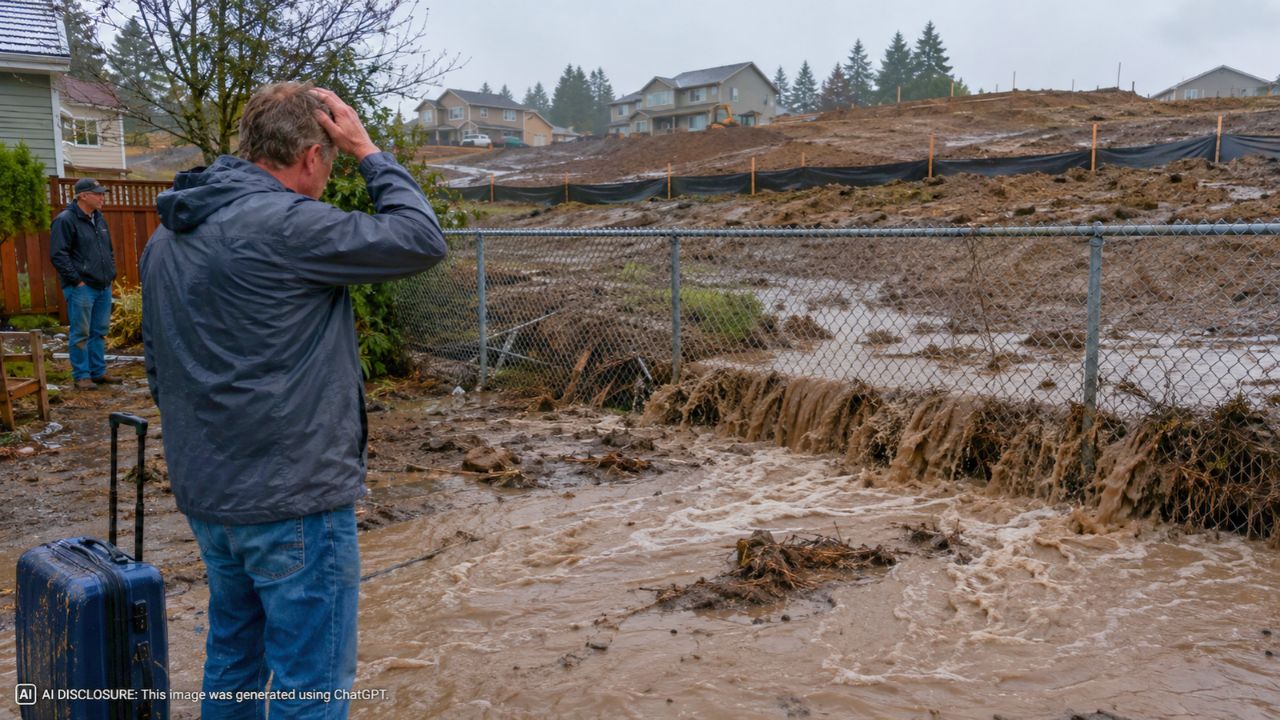
By the time he got home to Snohomish, the mess had a clear “from-to” path. Muddy water had been cascading from under a chain-link fence that separates the Greenleaf HOA neighborhood from a massive development site above them, a project called Eastview Village. The details were reported in the original post, and it reads like the kind of homeowner nightmare where the damage spreads faster than the answers.
One fence line, and suddenly your yard is a catch basin
The weekend of Oct. 12 brought the first real rains of fall, but residents said what happened on 79th Avenue was totally different from anything they’d seen. Mud and silty water came downhill, clogged drains, flooded the street, and then kept going—straight into backyards.
Multiple homes ended up with an inch-thick layer of gunk across yards and walkways. If you’ve ever tried to shovel wet silt, you know it’s not “hose it off” dirt. It cakes onto everything, settles into low spots, and turns lawns into a gritty sponge.
Above the fence line is a 144-acre construction site owned by Pacific Ridge Homes, which is owned by D.R. Horton. The plan is big: 1,311 residential units (houses and apartments) plus 61,000 square feet of commercial space.
The change happened fast: trees out, dirt exposed, rain hits
Neighbors weren’t imagining the before-and-after. Construction started in August, and residents’ drone photos showed a previously forested area turning into a wide expanse of exposed dirt.
Then fall rain arrived, and exposed dirt became mud. Gravity did the rest. The runoff carried silt downhill, and once it hit street drains, residents said the drains clogged—so the water found the next easiest route: across pavement, over curb lines, and into private property.
For homeowners, that’s where the stress spikes. It’s one thing to watch a construction site look ugly. It’s another thing to watch that ugliness show up in your yard, especially when it’s mixed with stormwater and whatever else is being carried off a work site.
Neighbors wanted a plan, not a cleanup crew
Putt summed up the frustration while standing in his driveway days later: people from the builder and the county had been out there, but he said nobody would tell residents the plan to stabilize the slope and keep it from happening again.
That’s the part that tends to make neighbors dig in. A cleanup can feel like a one-time courtesy. A stabilization plan is what you need when the rainy season is just getting started.
Greenleaf residents also pointed to county drainage manual language for construction sites: “No soils shall remain exposed and unworked for more than seven days during the dry season… or two days during the wet season…” and that permits should require soils be stabilized when precipitation is likely. Residents claimed the site wasn’t in compliance.
Pacific Ridge’s John Mirante, a division vice president of land development, said the company declined to comment.
County and state agencies stepped in, but homeowners still had to live with it
Snohomish County Planning and Development Services said staff took “swift action” to assess what happened and to ensure protection of public and private property. Their statement said the county mandated quick cleanup, required the contractor to meet with affected property owners, and worked with the owner to identify the point of failure and put “multiple mechanisms” in place to prevent a repeat.
The county also said staff met with Pacific Ridge, verified the company self-reported the event to the Washington Department of Ecology, and sent a county drainage engineer to the site on Oct. 17. A county inspector issued a correction order to the owner and contractor.
Meanwhile, the Washington Department of Ecology got a complaint from a nearby resident on Oct. 13 and visited the site multiple times. The agency said its immediate focus was preventing further polluted discharges with rain in the forecast—specifically mentioning steps like a sedimentation pond and a stormwater vault to expand stormwater capture capacity.
Ecology also said it was beginning to investigate whether D.R. Horton was complying with its construction stormwater permit, including whether the stormwater pollution prevention plan and best management practices were adequate, and whether the Oct. 12 discharge affected local waterbodies.
Cleanup happened, but the “new normal” brought a different kind of damage
After the flooding, Putt said D.R. Horton excavated a new retention pond at the top of 79th and covered a newly formed dam with plastic sheeting and sandbags. Crews were also hired to clean up the layer of dirt coating backyards and walkways.
But the mess didn’t end neatly at the fence line. Putt said high winds on Oct. 19 brought down a tree in his and his wife’s front yard—previously protected by the forested area that used to surround the home. It was the second tree the couple had lost since construction began.
Now their worry is a large maple at the front corner of the property. With the forest cleared and wind patterns changed, Putt said it’s “completely exposed” and at serious risk of falling—possibly onto a neighbor’s home.
That’s a specific kind of homeowner stress: watching a healthy, long-standing tree turn into a liability because the environment around it changed. Even if nobody did anything “to” the tree directly, the removal of surrounding protection can change what that tree does in a windstorm.
The practical homeowner reaction: document everything, because mud doesn’t argue—people do
Residents contacted the media with photographs of damage and forwarded communications from the builder. That tracks with how these problems usually play out at ground level: the first fight is about what happened, and the second fight is about whether it will happen again.
Homeowners in this spot tend to get very serious, very quickly, about proof. Photos right after the rain. Videos of water movement. Notes about dates and weather. Copies of any messages from the builder. Anything showing where the water entered, what it damaged, and what the cleanup did (and didn’t) restore.
And when the street drains clog and yards get coated, it’s not just about a dirty lawn. It’s about whether there’s silt packed into drain lines, whether soil got pushed under fences, whether patios and walkways shifted, and whether the next storm will hit before any fixes are truly in place.
For the Greenleaf neighborhood, the immediate mess got scraped and bagged, but the bigger tension is still sitting there on the slope above them: a huge development site, more rain to come, and homeowners trying to protect their property while the official process grinds forward one inspection, one correction order, and one storm at a time.
Like Fix It Homestead’s content? Be sure to follow us.
- Man Says He Found Out the Fence He Paid For Wasn’t Actually on His Property
- Woman Says Her Neighbor Started Taking Mulch From Her Delivery Pile Before She Could Even Spread It
- I made Joanna Gaines’s Friendsgiving casserole and here is what I would keep
- What Caliber Works Best for Groundhogs, Armadillos, and Other Digging Pests?