Homeowner’s Trail Camera Catches a Log Barreling Down the Hill Toward Her Backyard — Then the County Finds 142 Trees Cut for a Mountain View
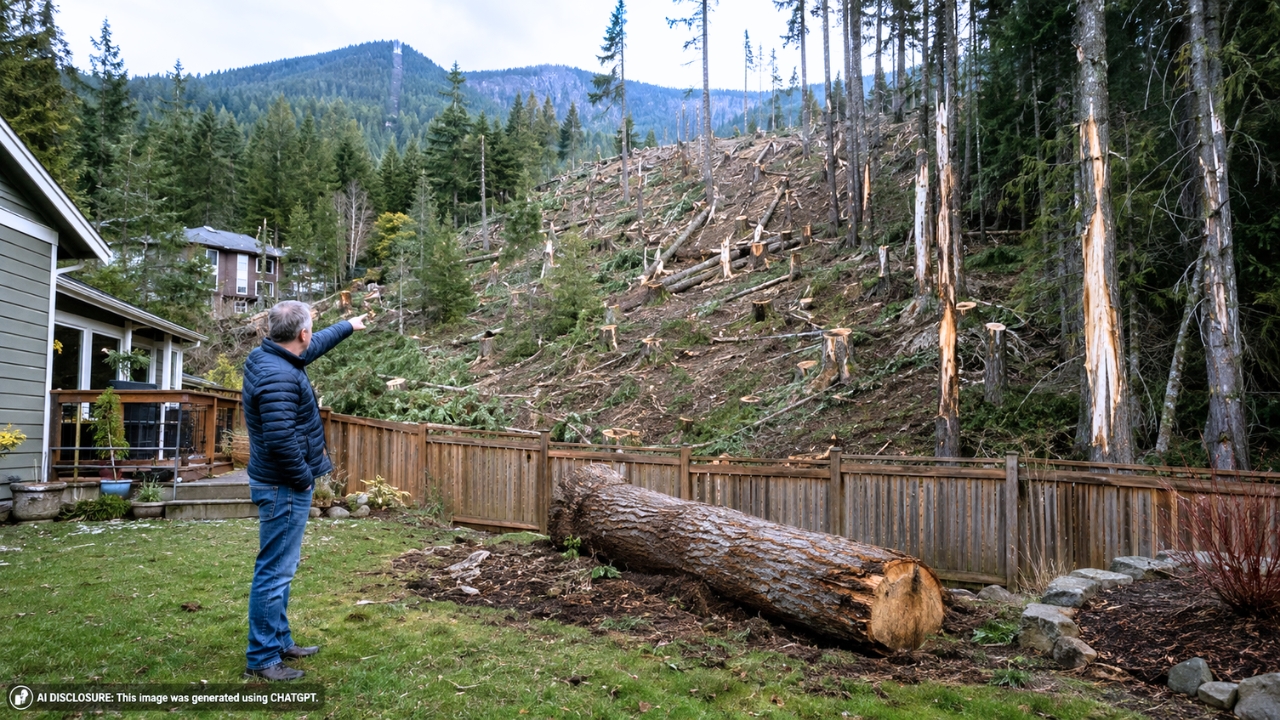
Photo credit: AI-generated image created using ChatGPT. Illustrative only.
It’s one thing to hear a random thud from the woods and assume it was “just nature.” It’s another thing to watch a full-on log rip downhill on your trail cam, headed straight toward the back of your neighborhood.
That’s what set off alarms for a family living near Grand Ridge Park in Issaquah, Washington—and what eventually led to King County alleging that public forestland above them had been illegally cut up for the sake of a better view. The details come from the source post, and the numbers are hard to ignore: the county says 142 trees were cut down or damaged without permits or authorization.
A backyard camera caught the moment everything changed
The first warning didn’t come from a letter, a ranger, or a posted notice. It came from a trail camera pointed at the woods—something a lot of homeowners set up for deer, coyotes, or the occasional late-night porch prowler.
Instead of wildlife, the camera caught a “large log barreling down the hill” toward homes at the bottom. Caitlin McNulty, one of the residents, described it as moving so fast it felt “incredibly unsafe.”
And this wasn’t happening out in the middle of nowhere. McNulty said the log came to rest just a few hundred feet from her backyard, near a wooded area where her two-year-old son likes to play. That’s the kind of detail that turns a weird clip into a “we need to go look right now” moment.
The walk uphill turned into a paper trail
After the log came down, McNulty’s husband and a neighbor went up the hill to figure out what could have sent something that heavy rolling toward houses.
What they found wasn’t a single fallen tree that had slid loose on its own. They discovered other trees that had been cut or damaged further up, enough to make them believe something deliberate had been going on. They reported it to King County.
For a lot of homeowners, this is the tricky fork in the road. If you confront someone too early, they deny it. If you wait too long, evidence disappears into brush piles and “cleanup.” In this case, the camera footage and what they saw up the hillside gave the neighbors something concrete to bring to the county.
The county says it wasn’t one bad cut—it was widespread damage
King County’s claims go far beyond one dangerous log. The county says 142 trees on public land were damaged in different ways: cut, split, topped, or debarked.
That list matters because it paints a picture of more than a one-time mistake. Cutting is obvious, but “topping” and “debarking” are the kinds of actions that can quietly kill trees over time or make them structurally weaker—exactly the kind of slow-motion hazard that turns into falling limbs, erosion, and future slide risk.
The trees were in Grand Ridge Park, described by the county as a “lush 1,200-acre forest” maintained as a natural resource preservation space for passive recreation—hikers, equestrians, mountain bikers, naturalists, and everyone who uses a park like that as the buffer behind their neighborhood.
King County says whoever did the work didn’t have permits or authorization. They’re suing a group of homeowners and the people they may have hired, claiming trespass, negligence, and damage to public resources.
The scariest part wasn’t the view—it was what could’ve happened next
The log that triggered the whole discovery didn’t just land in the woods and stop being a problem. King County says at least one tree “negligently” flew down the hillside and nearly crossed a road, “posing a risk of serious injury or death.”
This is where the story stops being “tree drama” and starts sounding like the kind of nightmare homeowners run drills for. A heavy object coming downhill doesn’t care about property lines, fences, or who paid for what. It hits what it hits.
McNulty put it in terms any parent understands: her family was scared. Not just annoyed, not just angry—scared. Because the area where the log landed is near where her young child plays, and because once you’ve seen a log travel that fast, you don’t assume it was a fluke. You assume another one could come.
There’s also the neighborhood tension angle that always follows: the people at the bottom of the hill are dealing with the risk, while the alleged benefit—the improved sightline—would be enjoyed from above.
Follow the motive: a better mountain view
King County says the alleged cutting was done to benefit the defendants’ properties. Specifically, the county claims at least one home now has a significantly improved view of West Tiger Mountain.
Anyone who’s lived in a hilly, wooded area knows how this temptation shows up. Trees grow. Views disappear. A house that once looked out over a ridge turns into a wall of green. Some people live with it, others pay for legal trimming on their own land, and a few decide the rules don’t apply if the trees aren’t technically in someone’s backyard.
The difference here is that the county is treating it like a serious offense against shared land, not a minor code complaint. McNulty called the park trees “shared resources” and said they aren’t something you can rebuild easily—many took hundreds of years to grow.
And King County isn’t just asking for restoration costs. The county is also asking for an additional civil penalty that could include the amount of increased home value tied to the improved views. That’s a big deal in a market where “view” can move the price needle fast.
The homeowner takeaway online: cameras, documentation, and don’t assume it’s “just the wind”
Stories like this tend to pull the same practical reactions from homeowners: get cameras up, save footage, and document changes the moment something feels off. The trail cam did exactly what it was supposed to do—capture a moment that would otherwise turn into rumor.
There’s also a second theme people latch onto: don’t treat hillside changes as cosmetic. When trees get removed above you, you’re not just losing shade or hearing more road noise. You may be inheriting drainage changes, slope instability, and future debris coming down in storms.
McNulty’s family didn’t try to handle it as a neighbor-to-neighbor argument first. They went to look, saw enough to worry them, and reported it. That choice matters because once a hillside is altered, fixing it isn’t as simple as planting a sapling. The stakes become safety, access, and who’s financially responsible when the damage isn’t confined to one lot.
KIRO 7 reported it attempted to contact the defendants but didn’t receive responses from those with readily available contract information. Meanwhile, the county is seeking more than $7 million in damages, plus other fees to compensate for negligence or trespassing.
For the neighbors below the park, the footage of that log is the kind of clip you can’t unsee. It’s not an abstract environmental loss. It’s a heavy piece of a tree, moving fast, landing close enough to turn an ordinary backyard into a place you double-check before letting your kid run out to play.
Like Fix It Homestead’s content? Be sure to follow us.