Lakefront Homeowners Find the Neighbor’s Dock, Paddleboard Rack and Stone Pavers Across the Property Line — Then His Guests Start Parking Across Their Driveway
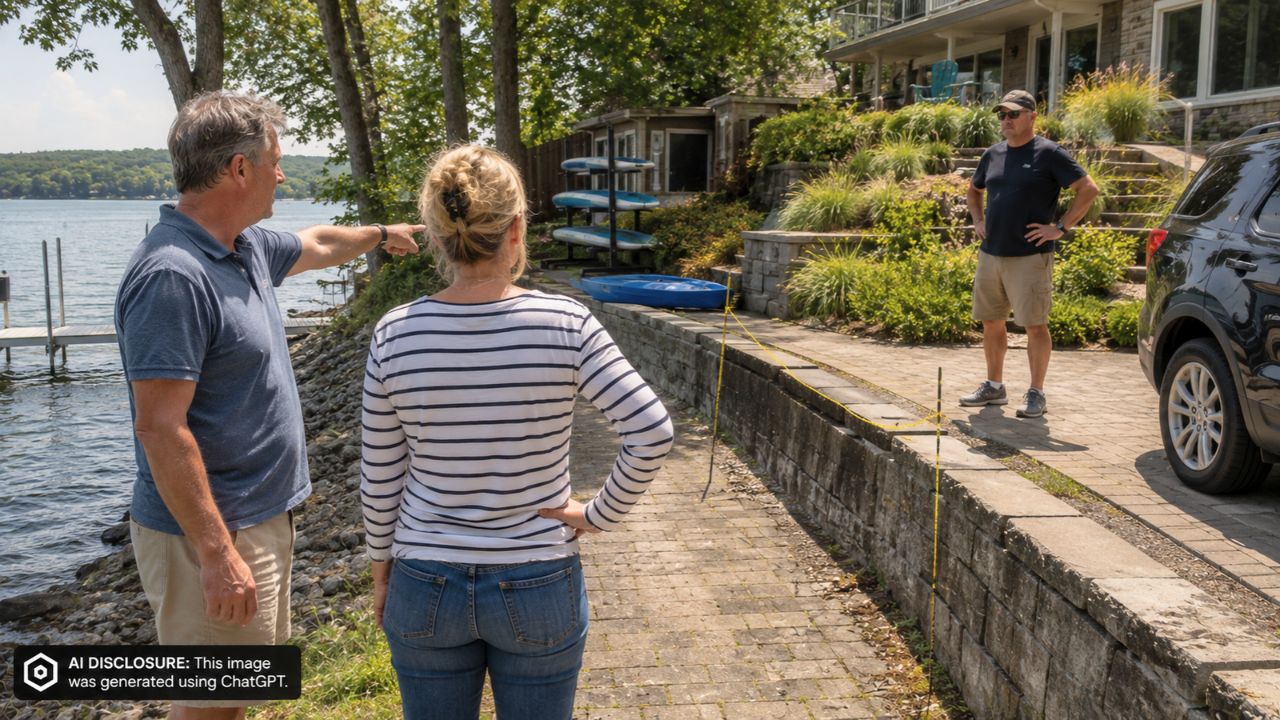
Photo credit: AI-generated image created using ChatGPT. Illustrative only.
Lakefront living is supposed to be about calm water, quiet mornings, and a dock you can walk down barefoot. For two neighboring households on Lake Wangumbaug in Coventry, Connecticut, it turned into measuring tape warfare: a dock creeping over a line, a paddleboard rack planted where it didn’t belong, stone pavers and blocks showing up like someone slowly redrew the map overnight.
What started as “maybe it’s close, but it’s fine” eventually escalated into signs, shouting, parking fights, and courtroom orders—laid out in the source post from the Connecticut Appellate Court. And if you’ve ever had a neighbor treat your driveway like overflow parking, you already know how quickly a small boundary dispute can become all-consuming.
The first sign was easy to brush off
Thomas and Susan Crossen owned one lakefront property. Next door were Heidi Diehl and Michael Martin. The trial court found the neighbors initially got along, the way people often do when the lake is the common backdrop and everyone wants summer to be easy.
Then, around 2018, the Crossens said the tone changed. The court found Diehl and Martin began using pieces of the Crossens’ property without permission. On paper, that might sound like a minor “whoops”—but at the shoreline, inches matter because that’s where access, views, and usable space are the whole point of the property.
The encroachments weren’t just one object, either. The trial court found a paddleboard rack, dock, banners, cement blocks, and stone pavers placed across the boundary area in dispute.
It wasn’t just the dock—stuff kept “creeping” over
People picture a property-line dispute as one big item placed wrong. Here, it was more like a slow-motion takeover. The court found that fresh sand and stones were repeatedly added along a wall that gradually “crept” farther onto the Crossens’ land.
That’s the kind of thing that messes with more than a survey. Sand and stones change grades, cover up the original edge, and create the “new normal” that visitors assume has always been there. The trial court also found vegetation and soil were damaged, which is a huge deal on lakefront lots where erosion control and plantings can be the only thing holding your yard together.
And then there was the social side of it—the part every homeowner recognizes as the moment you stop thinking this will resolve with a polite chat. Guests allegedly parked on or crossed the Crossens’ property and used their waterfront to reach the lake. The headline complaint about cars blocking access wasn’t a one-off annoyance; it was part of a bigger pattern of treating the Crossens’ space as shared.
Surveys and littoral rights turned a “feeling” into proof
When people are angry, everyone claims they’re “sure” where the line is. The Crossens went the route that actually matters: surveys. The trial court accepted their survey evidence as establishing the boundary. One survey showed the defendants’ dock extended about 6.3 feet across the line.
In lakefront settings, the fight isn’t only about the dry land. The court also recognized the Crossens’ littoral rights extending into the lake—meaning their property rights weren’t limited to what you can mow. If a dock is over the line, it’s not just a technical violation; it can interfere with access to the water and enjoyment of the shoreline in a way that’s hard to “unsee” once you notice it.
The trial court found that even after the boundary was marked and signs were installed, the encroachments continued. That’s an important detail because it shifts the story from misunderstanding to persistence. The appellate court later pointed to photos and testimony showing repeated encroachments into the lakefront area.
When the property fight turned personal
This wasn’t a quiet disagreement where everyone avoids eye contact. The trial court found the defendants yelled profanities, made obscene gestures, and put up antagonistic signs facing the Crossens’ property. It also found interference with survey work, and that areas were blocked with vehicles.
Lake neighbors see each other constantly—loading kayaks, hosting guests, pulling in trash cans—so tension becomes a daily feature of life. The court found confrontations with the Crossens and their family members. In one moment described by the trial court, Martin allegedly drove close enough to Thomas Crossen that he had to jump out of the way.
Another confrontation became central in the case: during the pandemic, Martin approached Thomas Crossen while Crossen was recording video from the road. The trial court found Martin got extremely close, challenged him to fight, and spit on him twice while shouting and cursing. That act became the basis for multiple claims at trial.
The court ordered removal—and still kept the damages modest
On the property issues, the Crossens won the core point: the court sided with their boundary position, found trespass, ordered the encroachments removed, and permanently barred similar future encroachments. In other words, it wasn’t just “stop doing that”—it was an injunction with teeth.
The trial court awarded $5,000 for five years of interference with their use and enjoyment of the property and waterfront. The appellate court upheld that award, even though the Crossens hadn’t proven a measurable drop in market value. Connecticut law allows damages for lost use, discomfort, and annoyance when someone invades your property rights, and the trial judge’s $1,000-per-year approach stood.
On appeal, Diehl and Martin didn’t provide competing evidence strong enough to undermine the survey and other proof, so the appellate court affirmed the key findings—specifically noting the 6.3-foot dock intrusion and the intentional interference with the Crossens’ waterfront use.
The emotional-distress part came out differently. The trial court had found Martin liable for intentional and negligent infliction of emotional distress, in part reasoning that being spit on during COVID-19 was especially distressing. But the appellate court reversed both emotional-distress judgments, saying there was no evidence Thomas Crossen personally experienced greater distress because of the pandemic, and the court couldn’t just assume that factor without testimony.
The civil-assault finding survived, though. The appellate court said the video and other evidence still supported that Martin threatened and spit on Crossen—enough for offensive contact and apprehension regardless of the pandemic context. Because the emotional-distress award ($50,000) was overturned, the case went back to recalculate compensatory and punitive damages for civil assault alone, using the evidence already presented.
How homeowners reacted: document first, argue later
Property-line fights bring out strong opinions, but the practical homeowner takeaway people repeat is simple: don’t rely on memory or “everyone knows.” Surveys, photos, and clear markers matter, especially when the dispute involves movable items like racks, pavers, and blocks that can appear, disappear, and reappear in slightly different places.
Another common reaction in disputes like this is to stop treating “guest behavior” as separate from the neighbor problem. If visitors are crossing your yard or parking across your driveway, it’s not random—it’s the result of what the host allows. The Crossens’ story shows how quickly that behavior can become routine, and how hard it is to reverse once it’s normalized.
And when things get heated, video and contemporaneous documentation can be the difference between “he said, she said” and a court finding. Here, the courts credited testimony and visual evidence not only for the shoreline encroachments, but also for the confrontation that led to the civil-assault ruling.
In the end, the lake didn’t change, but the neighbors’ relationship did—and the property itself became a scoreboard. The Crossens kept their boundary win, littoral-rights recognition, injunction, and $5,000 trespass award. The most volatile personal claims got narrowed on appeal, but the court still left a clear message behind: lakefront “creep” is still trespass, even when it’s dressed up as landscaping and weekend convenience.
Like Fix It Homestead’s content? Be sure to follow us.