Neighbors Watch a Buyer Carve 107 Acres of Ranchland Into Seventeen Lots — Then Point to a 2004 Covenant Barring Any Resubdivision Without Written Approval
Photo credit: AI-generated image created using ChatGPT. Illustrative only.
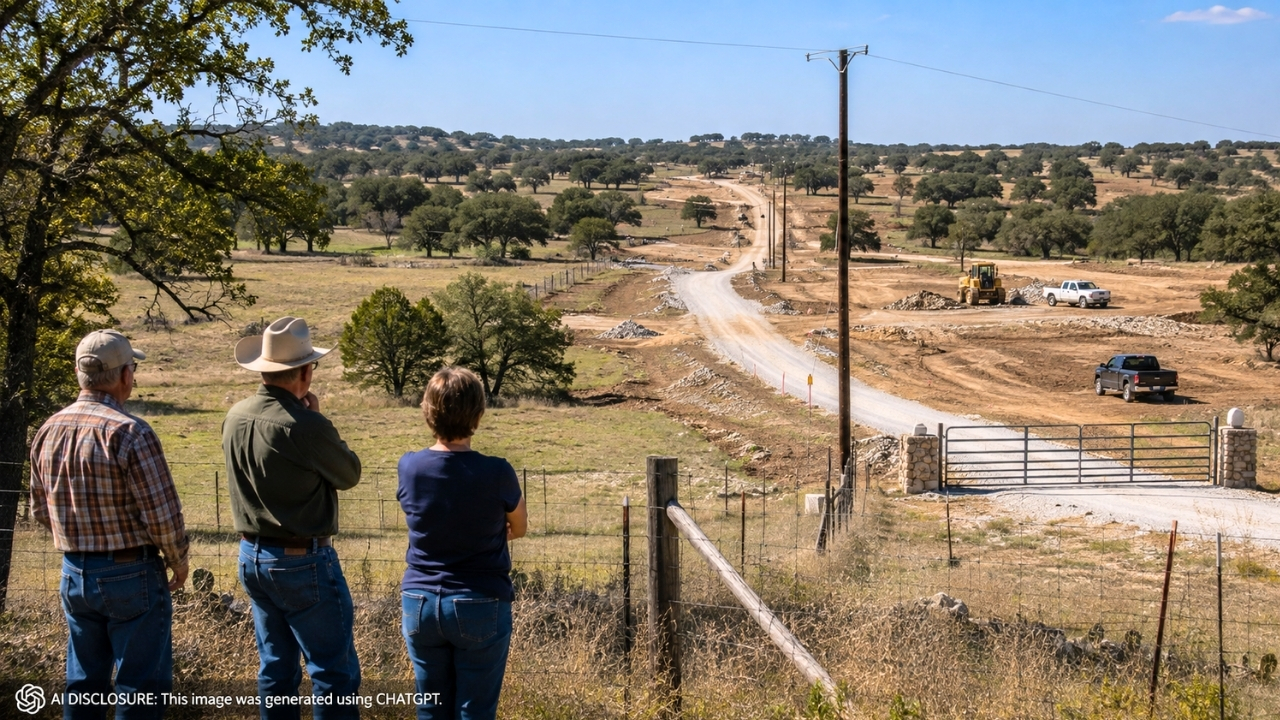
Out in Burnet County, Texas, the kind of quiet that makes people buy acreage in the first place started getting interrupted by a different sound: equipment. A buyer picked up a massive 1,472-acre tract, then carved out 107 acres and turned it into 17 lots—each roughly five to eight acres—complete with a gate, a road, and powerlines.
Nearby landowners watched it happen and pointed to paperwork they believed should have stopped it cold: a 2004 restrictive covenant saying you can’t resubdivide lots without written approval. The fight made it all the way to the Texas Court of Appeals, and the details in the court’s opinion read like a familiar rural neighbor nightmare—only with a twist ending.
The first sign wasn’t a fence line—it was a plat map
The developer, Recreational Land Sales, LLC (RLS), didn’t just talk about a future project. It went through the county approval process for a subdivision, then put improvements in the ground. A gate went up. A road got built. Powerlines came in. And the lots were sold off.
To neighbors James Allen and Charles and Deborah Cedars, that kind of change isn’t abstract. Even if no one’s living there yet, they saw the direction of travel: more driveways, more vehicles, more lights, and more chances for trespassing and noise where they expected ranchland to stay ranchland.
They sued, saying RLS breached restrictive covenants and created a nuisance. They described the rural character they thought they’d paid for—space, quiet, and the ability to use their land without the pressure of a new mini-neighborhood popping up next door.
Then came the “here’s what this will turn into” fears
The neighbors didn’t just argue about paperwork. They painted a picture of what 17 lots could become: houses, septic systems, wells, traffic, dust, lights, noise, and congestion. The complaint wasn’t only about the roadwork. It was about what the roadwork was for.
And if you’ve ever lived out on acreage, you know how fast “a little development” can reshape your day-to-day. Headlights where there used to be dark sky. Dogs you don’t know running loose. A steady trickle of vehicles down a road that used to see a few ranch trucks a week. It doesn’t take an apartment complex to change the feel of a place.
But at trial, the evidence showed a key fact that undercut the whole nuisance theory: the 17 lots were still undeveloped. No houses. No wells. No septic systems. No one living there. The neighbors could still hunt, fish, garden, tend cattle, and use their property largely as before.
A jury still handed down big nuisance damages
Despite that, a jury found RLS liable for negligent nuisance and awarded what most rural property owners would consider life-changing money for “annoyance, loss of enjoyment, and discomfort.” Allen received $195,000, and Charles and Deborah Cedars received $197,500 each—$590,000 total.
The jury rejected an intentional-nuisance claim, but the negligent-nuisance win still looked like a strong message: you don’t get to bulldoze toward a subdivision and tell the neighbors to wait for the damage to arrive before they complain.
That’s where the appeal mattered. RLS took it up, arguing the claim wasn’t even ready for court yet—because the harms were mostly predictions of what might happen later.
The appeals court zeroed in on one word: “ripe”
The Texas Court of Appeals didn’t re-try the case. It focused on whether the nuisance claim was “ripe,” meaning there had to be a real, concrete injury for the court to resolve, not a mostly hypothetical future problem.
Texas nuisance law requires a “substantial and objectively unreasonable interference” with the use and enjoyment of property. The neighbors described future homes and the problems that usually follow them, but the court pointed out that the development plans only showed what might be built. There was no evidence houses were actually being constructed, and no evidence construction was imminent.
The opinion highlights testimony along those lines—Deborah described what would happen when houses were built; Allen acknowledged nobody could predict the future. Without something more concrete, the court treated the claimed nuisance as speculative.
The court also looked at what had already happened and said it didn’t rise to a legal nuisance. Allen could still hunt, fish, raise cattle, and enjoy his land. Charles complained about dust and noise from road construction and cedar debris, but couldn’t give evidence about how long or how frequently those issues occurred, and he conceded that he could still hunt and that Deborah could still garden.
That combination—future impacts not sufficiently imminent, current impacts too minor—meant the negligent-nuisance claim wasn’t ripe. And if a claim isn’t ripe, it’s not just a “not guilty” moment; the court said the trial court lacked subject-matter jurisdiction to decide it at all.
The covenant angle didn’t pay out either
The neighbors also challenged the dismissal of their restrictive-covenant claim. This is the part that grabbed attention: the covenant they pointed to barred resubdivision without written approval. In a lot of rural subdivisions, those old restrictions are the only thing keeping “one ranch lot” from becoming “seventeen mini-ranches with a shared road.”
But the neighbors wanted a particular kind of remedy: “loss of enjoyment” damages tied to the alleged covenant violation. The appeals court rejected that measure of damages, noting that no Texas court had recognized loss-of-enjoyment damages as recoverable for breach of a restrictive covenant.
So even though the covenant language was central to why they objected in the first place, the damages theory they were pushing didn’t survive on appeal.
How people reacted: document everything, but timing matters
Cases like this tend to split homeowners into two camps. One side hears “undeveloped lots” and thinks, “So you’re suing over vibes.” The other side hears “county approval, roads, powerlines, and lots already sold” and thinks, “If you wait until the first septic goes in, you’ve already lost the character of the land.”
The practical takeaway people latch onto is proof and timing. If your complaint is dust for two weeks during roadwork, you’ll need specifics—how often, how long, how it changed your ability to use your place. If your complaint is what the new owners might do someday, courts may want to see more than a map and a reasonable fear.
On the covenant side, it’s a reminder that restrictions can be powerful, but you still have to match the remedy to what the law actually allows. Paperwork can stop a resubdivision, but a court might not hand out personal “loss of enjoyment” money just because the neighborhood feels different.
In the end, RLS walked away with the appellate win: the Texas Court of Appeals reversed the jury judgment and dismissed for lack of subject-matter jurisdiction. The land next door had been transformed on paper and partially on the ground—gate, road, lines, lots sold—but the neighbors’ big-dollar nuisance case fell apart because the worst parts hadn’t actually arrived yet.
For anyone living on acreage, that’s the unnerving part. Sometimes the change is already rolling forward, and sometimes the courtroom won’t step in until the impacts stop being predictions and start being your daily reality.
Like Fix It Homestead’s content? Be sure to follow us.