Homeowner Learns His Skinny Lot Exists Because the Neighbor Quietly Claimed Half His Lawn Years Ago While the House Sat Derelict — Then She Sits on Her Porch Yelling at His Kids to Get Off “Her Land”
Photo credit: AI-generated image created using ChatGPT. Illustrative only.
When you buy a house, you expect surprises inside the walls—old wiring, a tired roof, maybe a basement that smells like yesterday. This homeowner’s surprise was outside: the yard he thought came with the place was already treated like it belonged to someone else.
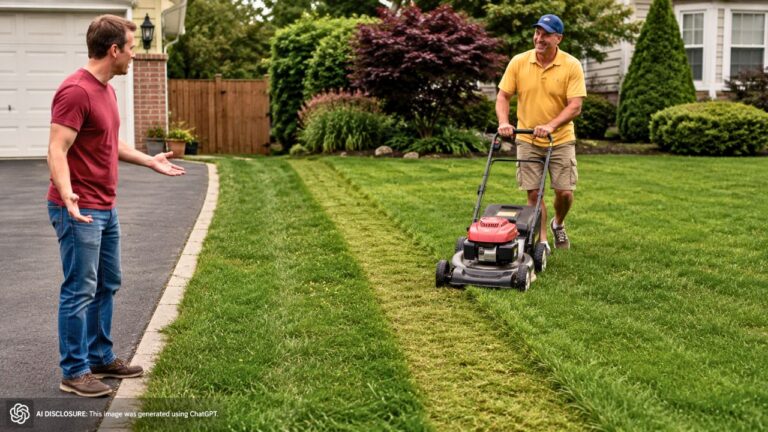
In the original post, a homeowner in Upstate New York said he recently learned his lot is “extremely skinny” for a reason that predates him. A nearby neighbor told him that years ago—back when his house was derelict—his immediate next-door neighbor had her landscaper son regularly mow a big portion of what should have been his lawn, and eventually “claimed ownership” of that slice of property.
The yard felt wrong, but the yelling made it personal
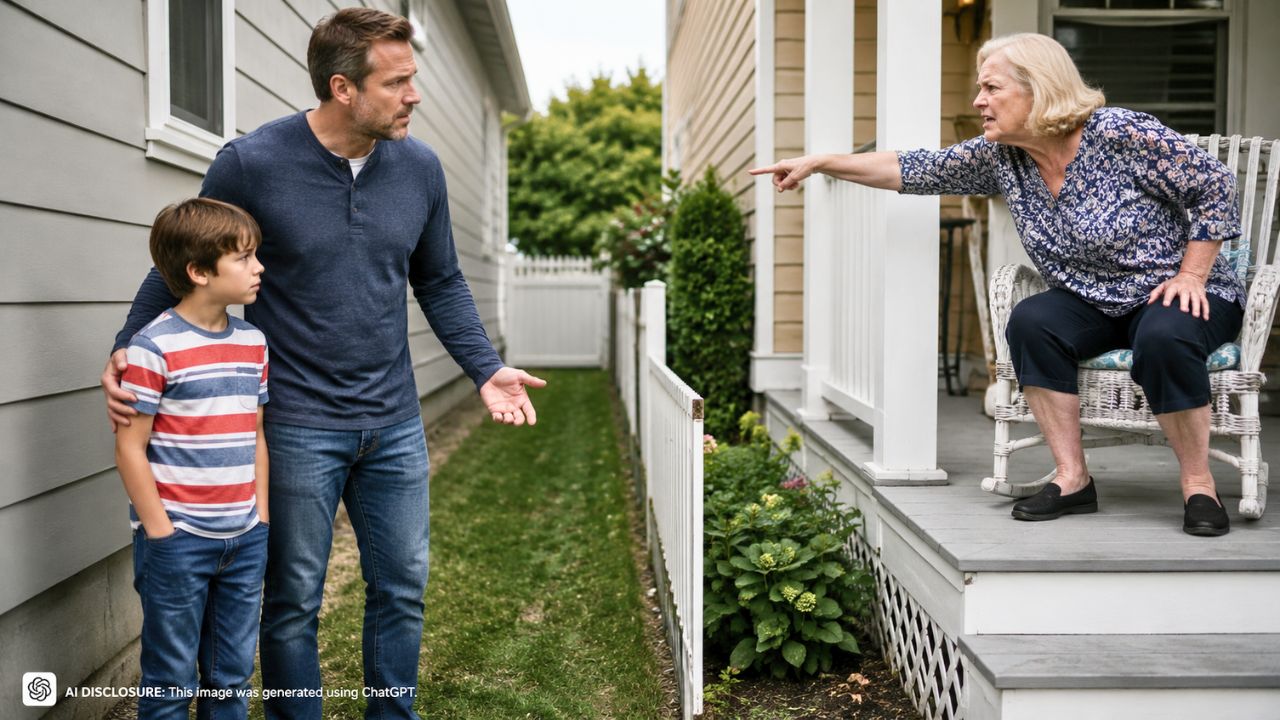
The homeowner isn’t describing a friendly neighbor who’s out gardening and chatting over the fence line. He calls her a “very grumpy old lady” who “does not in any way, shape, or form, come outside, use her lawn, etc.” The part that stings is the imbalance: he’s got three kids and less usable space, while she has “two gigantic side lawns” she doesn’t seem to use.
And yet, she treats the strip she absorbed as if it’s sacred ground. He says she regularly tries to chase his kids off what she calls “her land.” Not by walking over and talking like a normal person, either—she “chooses to plant herself on her front porch to yell at and threaten them.”
That dynamic matters, because property disputes are rarely just about grass. Once someone is yelling at your kids from a porch, the boundary problem turns into a daily stress problem. The homeowner said he got into “a big row” with her, telling her she has no right to yell at his children and that she should talk to him instead.
A neighbor’s comment rewrote the history of the property line
The twist in his story is that he didn’t discover this through a surveyor or a closing document. He found out through a different neighbor, someone who apparently remembered the house’s derelict period and what happened next.
According to what he was told, the lawn got “assumed” by the next-door neighbor through repeated mowing over the years. The homeowner frames it as the neighbor “managed to assume property rights” to a large chunk of the lot.
That’s a hard thing to hear after you’ve already moved in, set up life, and watched your kids get scolded off the grass. It also raises the kind of questions that make homeowners feel trapped: If the yard was taken before he owned the house, what exactly did he buy? And if it was taken quietly, what other “quiet” arrangements are baked into the neighborhood?
Skinny lots create real day-to-day problems
A lot line isn’t an abstract line when you’re living on it. If your side yard is smaller than expected, everything gets tighter: where kids play, where you can run a mower, whether there’s room for a fence, a shed, a garden, or even just space between houses that feels private.
The homeowner said his lot is now “extremely skinny” compared to other houses nearby. That comparison is important—he’s not imagining it. He’s looking around and seeing other homes with normal side yards while he’s dealing with a pinched footprint.
Even without mentioning fences or driveways, the practical consequences are easy to picture. When a property is narrow, every routine becomes a negotiation: kids drifting a few feet during a game, a ball rolling, a dog on a leash. And when the neighbor’s response is yelling from the porch, it turns ordinary family noise into conflict.
It also creates a pressure point for future projects. Want to plant shrubs, put up a playset, or install a fence? On a skinny lot, you’re automatically closer to the boundary—and more likely to trigger another argument.
He’s not just mad—he wants the land back
Once the homeowner heard the backstory, the anger shifted from “stop yelling at my kids” to “how did this even happen.” He wrote that now that he knows the land “should be my land,” he’s “even more pissed at her” than before.
He’s not talking about revenge or pranks. He’s talking about reclaiming space. “I would love to find some way to claim that land back,” he said, asking if anyone has been in the same situation or knows how it typically works.
The location detail—Upstate New York—matters because property rights and timelines can vary, and the homeowner’s wording suggests he suspects some form of long-term use turned into ownership. But the post stays grounded in the lived reality: he has kids, he has a cramped yard, and he has a neighbor who acts like she owns the right to police his family’s movements.
People focused on proof, paper, and not feeding the porch wars
Even without a full comment thread included, the way homeowners usually respond to this kind of story is predictable for a reason: they’ve seen how fast “everyone knows that’s her yard” turns into an expensive mess. When someone claims land based on years of maintenance, the first instinct among experienced homeowners is to stop arguing about it in the driveway and start figuring out what the legal lot line actually says.
That typically means digging into the boring but decisive stuff: the deed description, recorded surveys, plat maps, and any title paperwork from the purchase. If the homeowner bought a lot that is now officially narrower on paper, it’s one problem. If the paperwork shows he owns more than he can use, it’s another.
It also means treating interactions like they could end up documented. When a neighbor prefers yelling from the porch instead of speaking calmly adult-to-adult, it’s a clue that the conflict may not resolve through a friendly conversation. People who’ve lived through boundary disputes tend to advise keeping things measured—don’t trespass, don’t escalate, and don’t let it become a daily shouting match that distracts from getting clarity.
In other words: less arguing over grass, more confirming where the property line is supposed to be—and whether it changed officially or just through neighborhood habit.
A quiet takeover is hard to undo, and that’s what makes it scary
The unnerving part of this homeowner’s story is how ordinary the “takeover” sounds. No fences going up overnight. No obvious land grab. Just mowing. Year after year, while the house sat derelict and nobody was paying attention.
That’s exactly why these disputes can linger for decades. Once a neighborhood gets used to seeing one person maintain an area, people stop questioning it. Kids grow up thinking that strip of grass “belongs” to the house that mows it. New owners move in and assume the yard’s shape is just… the yard’s shape.
Now the homeowner is living with the aftermath: a narrow lot, a neighbor who claims the right to scold his children, and the sinking feeling that the most valuable part of his property might have been decided by whoever showed up with a mower at the right moment in history.
He’s left wanting the same thing most homeowners want in the end—something simple, stable, and fair. A yard that matches what the property is supposed to be. Kids who can play without being threatened from a porch. And a boundary that’s defined by more than habit and volume.
Like Fix It Homestead’s content? Be sure to follow us.