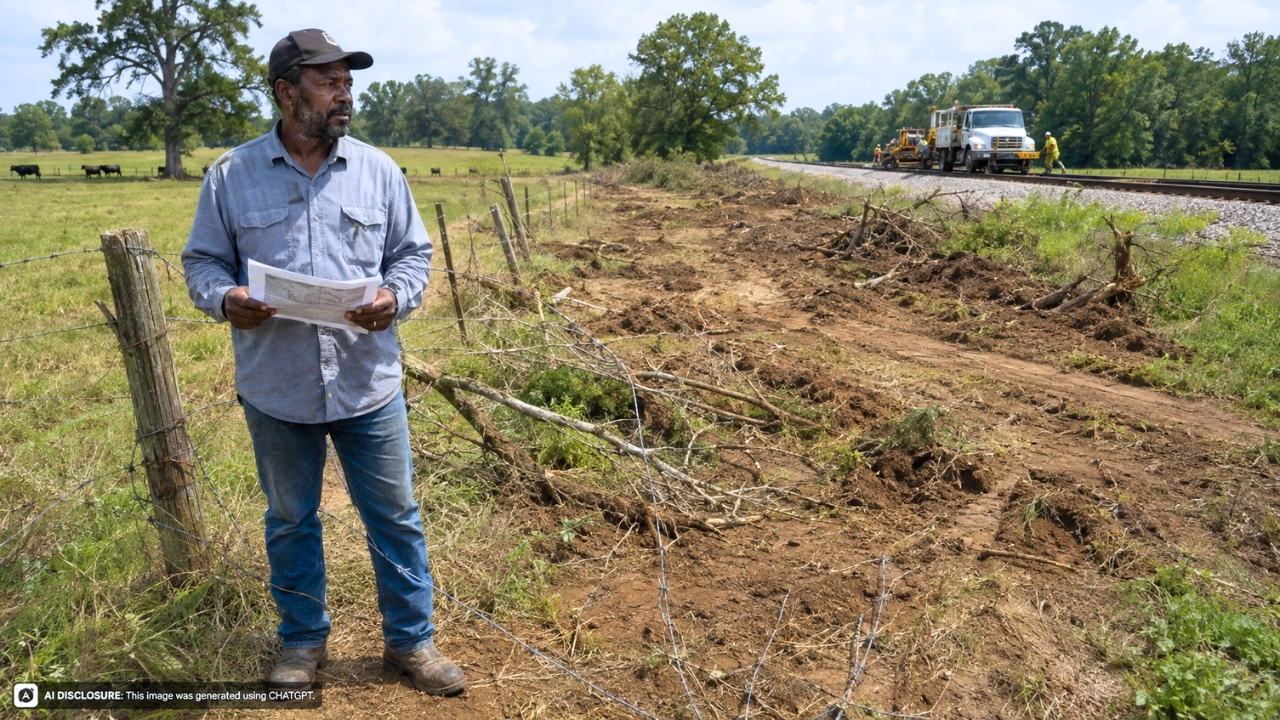
Alabama Rancher Finds a Railroad Crew Working Land His Family Has Held Since 1945 — Then 150 Feet of His Fence Is Bulldozed and Trees Uprooted
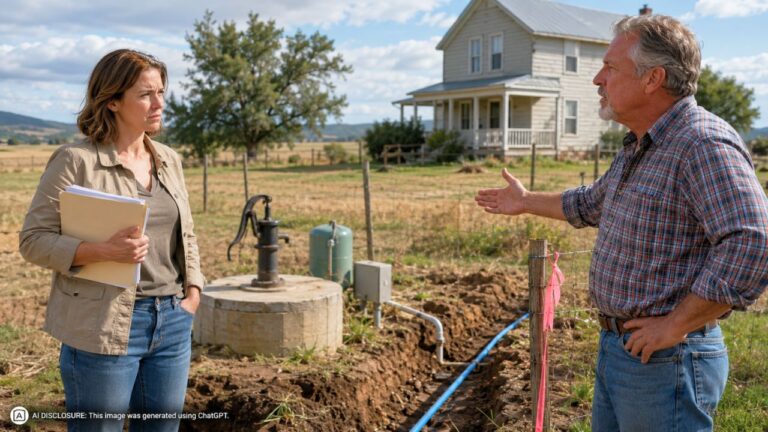
Photo credit: AI-generated image created using ChatGPT. Illustrative only.
Willie Palmer Jr. was doing what a lot of rural landowners do on a humid Alabama afternoon: gathering his cows under a tree, checking the plants, and walking the line of what he believes is his family’s 20 acres outside Selma. Then he noticed something that doesn’t belong in a quiet feeding routine—railroad work happening on or near his property, without anyone asking him first.
That moment kicked off months of late-night document digging, phone calls, and boundary questions that turned into a lawsuit with more than two dozen defendants. The details were reported in the original post, and they read like every landowner’s worst fear: you think you know where your property ends until someone with equipment starts acting like they know better.
A working farm, and a line in the dirt that suddenly mattered
Palmer, 50, says he inherited the land in 2017, and that his family has held it since 1945. He takes pride in the place—trees like pear, fig, and black walnut, the small details like a cactus plant, and the day-to-day rhythm of cattle on grass.
But for the last year, he’s been working overtime to protect what he says is his. By day he wrangles cattle and drives trucks for a living. At night he’s been reading deeds, studying case law, and making copies at the Selma Public Library, trying to pin down one basic thing: who, legally, has rights to the strip of land where railroad tracks cross near the northwest corner of his property.
The first sign was a crew doing maintenance
Palmer says his present-day fight started a few weeks before Christmas last year, when he discovered a CSX Transportation railroad worker doing maintenance on the tracks. In his complaint, he says the employee told him CSX was “taking back over the tracks” and refurbishing the short line.
Like most landowners would, Palmer says he started calling and emailing for answers. A CSX property manager shared a tax assessor map with him, and he says that map didn’t even show the tracks on his property. He put up “No Trespassing” signs and filed formal complaints to halt operations. He also says he has no written agreements, leases, or contracts with the railroad.
CSX declined to comment to Capital B. Palmer, meanwhile, took it personally and practically: if someone says they have rights on your land, you don’t argue it from the porch—you argue it with paper.
Paperwork got weird fast: patents, easements, and “less and except” language
Palmer says he has proof of ownership, including a title abstract, a federal land patent, and a May 2025 boundary survey. He also points to affidavits, probate court filings, surety bond records, and a 2025 tax assessor record listing the Palmers as co-owners.
CSX, through an assistant general counsel, stated in an email referenced in court filings that a railroad corridor was acquired through acts of the Alabama Legislature early in the last century, granting an exclusive easement of up to 50 feet on each side of the center line for railroad construction, occupation, and maintenance. The email said that if any portion of Palmer’s property falls within that corridor, it would be encumbered by the easement—even though tax maps didn’t appear to show that being the case.
Then Palmer’s research led him into a chain of deeds that, to a regular person, reads like a maze. He focused on a 1987 warranty deed where two brothers sold “all land east of the Cahaba River” to Galbraith McFadden Weaver III and Leah Perdue Weaver. Palmer believes this includes his land description (Northwest Quarter of Section 18, Township 16 North, Range 10 East). The Weavers’ attorney moved to dismiss Palmer’s claims against them, arguing the deeds Palmer cites don’t include his land.
A later sale, in 2005, is where the language starts sounding like the kind of clause that can save—or sink—a family. The Weavers sold three parcels to George Ballard and Rail Connection Inc., and the deed included a “less and except” clause that explicitly excluded Palmer’s property. An Alabama attorney told Capital B that “less and except” means the conveyed property does not include what comes after that phrase.
Palmer’s view is simple: if the deed explicitly excludes his land, how does anyone else get to treat it like it’s theirs?
Then came the part that feels personal: a neighbor, a path, and a wrecked fence line
The story didn’t stay on paper. Palmer says it escalated when he found his neighbor, William “Bill” Huffman III, entering an area Palmer claims is within his property using a pathway to go hunt. Huffman is an attorney and farmer, and he and his wife own 81 acres bordering the eastern and southern sides of Palmer’s land, plus more acreage around other sides.
Palmer called the Selma Police Department about suspected trespassing. An incident report says that while Palmer and an officer inspected the property, Huffman and a companion approached to discuss it. According to audio recordings shared with Capital B, Huffman disputed Palmer’s claim to the full property and said he’d take Palmer to court.
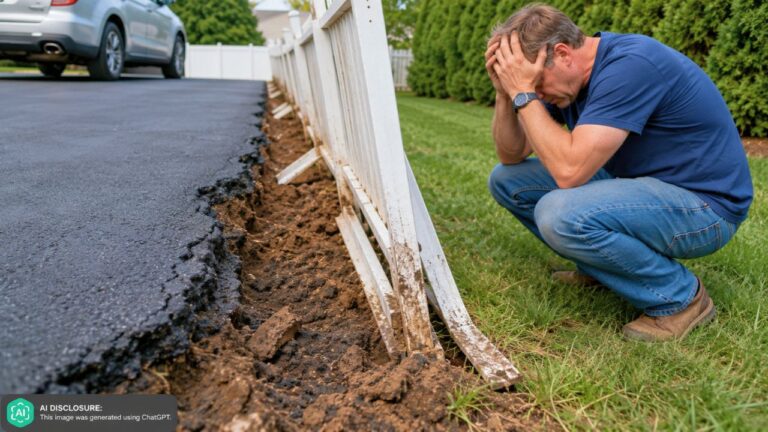
Then, on March 12, Palmer called police again while he was with a surveyor conducting a land survey. This time it wasn’t just someone walking through. Palmer says he found vandalism: barbed wire fence destroyed and trees uprooted.
He described seeing dirt piled and trees laid down in a way that didn’t match storm damage. He said someone had “150 feet worth of fence” torn up, and it looked like a bulldozer did it.
Palmer named Huffman as a potential suspect for criminal mischief and trespass in police reports. The municipal clerk told Capital B that a report exists in the system, but Palmer had not come in to press charges at that time.
What people latched onto: surveys, cameras, and the nightmare of “quiet” land grabs
No public comment thread was included in the source material, but you don’t need one to predict the practical reactions. In rural property disputes, people tend to split into two camps: those who think “the railroad always wins,” and those who say “paper beats muscle, but only if you stay organized.”
This is the kind of mess where homestead folks immediately think about documentation and prevention. Not because a camera magically fixes a boundary dispute, but because damage like uprooted trees and flattened fence lines is easier to argue about when it’s timestamped. Same with keeping copies of surveys, saving emails, and logging every date someone enters the property or moves equipment near a line.
And if you’ve ever replaced fencing, you already know why “150 feet” hits hard. That’s posts, wire, bracing, labor, and time—plus the headache of keeping cattle where they belong while the adults fight.
He’s suing, representing himself, and still feeding cows
Palmer ultimately filed a lawsuit in Dallas County Circuit Court on July 16, bringing claims including declaratory relief, quiet title, trespass, fraud, civil conspiracy, and professional misconduct. He’s suing banks, attorneys, and railroad companies, among others, and says there’s been a broader effort to assume ownership of his land through fraudulent deeds or misconduct.
Instead of starting a separate case, Palmer intervened in an existing property sale lawsuit involving Rail Connection Inc. and the Huffmans. A judge allowed him to intervene, and Palmer is representing himself. Huffman denied Palmer’s allegations in a court filing and demanded a jury trial on all issues. The case was still pending in the Dallas County Circuit Court as of mid-December, according to the reporting.
What makes it heavy isn’t just the legal tangle. Palmer says his family experienced racial violence on that same land years ago, including a story he heard about their house being burned down when the family was away. Now he’s trying to hold onto the same acreage with deeds, surveys, and long nights at the library.
And while the courts sort out whose lines count and whose easements reach where, he’s still out there doing the regular work—checking trees, watching cows, and staring at a fence line that used to be a fence line.
Like Fix It Homestead’s content? Be sure to follow us.