Family’s Texas Tract Has Been Landlocked Since 1914 — Then a Judge Is Asked to Declare Where the 1984 Access Easement Actually Runs, a Century Later
Photo credit: AI-generated image created using ChatGPT. Illustrative only.
In rural Texas, you can put up with a lot—dust, drought, washouts, and the occasional “that’s just how it’s always been.” But when the only road to your land starts ending at a locked gate, “always been” stops being a comfort and starts being a problem.
That’s what played out in San Saba County, where one branch of a family said they’d been using the same roadway to reach a landlocked tract for generations—until access got restricted and the lock got changed. The resulting court fight ended with a judge identifying the access as a true necessity that dated back to 1914 and later pinning down where the easement runs today, in a case laid out in the source opinion.
A landlocked tract is manageable—until someone controls the gate
The property at the heart of it traces back to a 1914 deed. On April 1 of that year, Mattie Turner deeded about 167 acres to her son, Joe Turner. The catch: the tract was landlocked.
On the map, it was boxed in by Mattie’s remaining land to the north and east, the San Saba River to the south, and separate ownership to the west. For Joe Turner’s descendants, access wasn’t a philosophical issue. It was a practical one: you get to your land the way your family always did, crossing family ground to reach what’s now known as County Road 202, also called China Creek Road.
For decades, the road wasn’t just a trail used on sunny weekends. Testimony described real working use—farming and ranching traffic, tractors, cattle, grain trucks, pecan equipment. This wasn’t a “nice-to-have” path; it was the route that made the tract usable.
The family tree changed, and the “shared” road stopped feeling shared
Time does what time does: property splits, inheritances, new deeds, new boundaries, and different people making different decisions with land their grandparents treated as one big working unit. By 1984, Joe Turner’s property had been divided again. One portion eventually became roughly 124 acres owned by the Cameron side of the family.
Other descendants, including Johnette Early, came to own neighboring property that the historic roadway crossed. That’s the part many rural folks recognize immediately: the road is “the road” until it’s also “my land.”
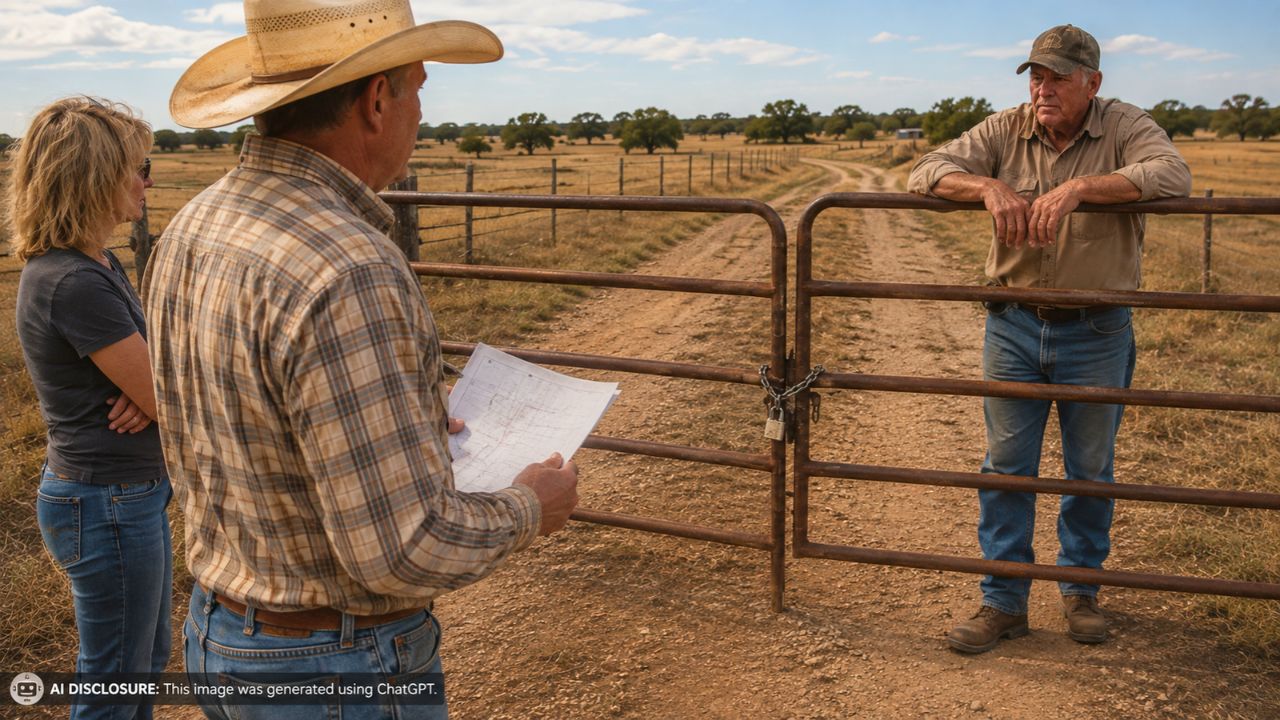
Then something changed around 2013. Early began restricting access. The detail that hits home for anyone who’s ever had a shared driveway or ranch gate dispute: the lock on the gate was changed.
Family members testified they’d used the road for decades without being told they couldn’t. Some said they’d previously been provided access through the locked gate. But once the lock changes, the old routine becomes a negotiation—and negotiations tend to harden fast when one side controls the only key.
When the argument isn’t “do we need access,” it’s “do you have another way in?”
In court, there wasn’t much disagreement that the Cameron tract was landlocked. The real fight was over whether the historic roadway across the neighboring properties was legally necessary, or whether other potential routes meant an easement wasn’t justified.
The opposing owners pointed to possibilities: occasional access through property to the west, and access from the south by coming across the San Saba River from property owned by a livestock company. If you’ve spent any time on rural land, you can already hear the problem hiding inside those options.
The evidence leaned into the reality of those “alternatives.” The western route was permissive—something allowed by a neighbor, not a guaranteed legal right. And the river route depended on conditions. The kind of “access” that works only when the river cooperates is not the kind you bet your ranch work on.
Witnesses testified that when conditions were bad, the roadway crossing the neighboring family property was the only practical legal route. In other words: it wasn’t just tradition; it was the only access that could be counted on as a right.
The judge didn’t just recognize an old right—she had to put it on the ground
The case wasn’t only about whether an easement existed. A century of use can still leave a modern problem: where, exactly, does it run?
After a bench trial, the judge found the family had an easement by necessity dating back to April 1, 1914—the moment Mattie Turner severed Joe’s land from her own. The court concluded that at severance, the only legal access was across Mattie’s remaining property to China Creek Road, and that necessity continued to the present.
But recognition on paper doesn’t move a cattle trailer. So the court established a surveyed easement—generally 30 feet wide, expanding to 38 feet near one section to accommodate trucks, trailers, and farm equipment. That detail matters in the real world. Thirty feet is the difference between “we can squeeze through” and “we can safely pass without tearing up fences, mirrors, or the shoulder after a rain.”
The ruling also tied the route to the existence of the public road itself. Historical documents supported that China Creek Road—or earlier versions referred to as Brownwood Road No. 2 and Brownwood Road via Beverage Crossing—existed as a public road before the 1914 split. That’s the kind of old paperwork that suddenly becomes priceless when a family road turns into an argument.
One side said the easement should’ve died in 1947—appeals court wasn’t buying it
The opposing owners raised another argument that comes up in long-running land histories: “pooling” or reunion of the tracts. They claimed a family arrangement in 1947 effectively reunited the properties and extinguished any earlier easement by necessity.
The appeals court rejected that. The evidence did not show a legal merger of the tracts. Joe Turner continued to own his tract separately both before and after the 1947 deeds, and it remained landlocked.
The Texas Third Court of Appeals upheld the easement by necessity, finding legally and factually sufficient evidence that the access right originated with the 1914 severance and stayed necessary more than a century later. In plain terms, the court treated the easement like what it was: a lifeline that never stopped being needed, even if the family relationships and parcel lines kept changing.
The only real reversal was about attorney fees—and that still stings
The appellate court mostly left the trial court’s judgment alone. But it did take a hard look at attorney fees, which is where these “it’s just a gate” fights get painfully real.
The trial court awarded $69,424.11 for fees already incurred, plus potentially another $165,000 for different stages of an appeal. The appeals court left the trial-level fees intact. But it ruled the evidence didn’t adequately support the projected appellate fees, and said any such award needed to be conditioned on success in the appeal.
So the easement ruling stood, and the rest of the judgment largely stayed in place. The attorney-fee issue—at least on appeal—went back to be recalculated. Even when you “win” access, you can still end up arguing over the bill for proving you had it.
On the ground in San Saba County, the takeaway isn’t abstract. A landlocked tract can sit quietly for generations—right up until the day a lock changes, someone gets told “no,” and the family history suddenly has to be translated into surveys, widths, road names from another era, and a court order that finally says: the road is here.
Like Fix It Homestead’s content? Be sure to follow us.