Homeowner Finds Three Bollards Blocking the Driveway to Her Adult Family Home — Then the City Manager Says He’s Never Seen Anyone Go That Far
Photo credit: AI-generated image created using ChatGPT. Illustrative only.
It started as a normal shared-driveway gripe: someone swears the pavement is getting beat up, someone else swears they have every right to drive on it. Then one Spokane Valley homeowner looked out and found three bollards planted in the strip of blacktop that functions as the only practical access to her home and adult family home business.
The details, including who installed the barriers and why it escalated into a lawsuit involving Spokane Transit Authority, are laid out in the original post. But the moment that sticks is how physical this got: not a note on the door, not a cone, not a “call me,” but infrastructure—installed to make sure larger vehicles couldn’t get through.
A shared driveway turns into a choke point
On this small block there are four houses, and Atalalech “Tutu” Aberra has lived at the end of the drive since 2013. She runs an adult family home out of her place, caring for up to four clients with disabilities at a time. Last year she also bought the next-door house—between her home and neighbor Cary Edwards—tightening the pressure on what’s basically the neighborhood’s one narrow funnel in and out.
City documents say Aberra has an easement over a paved strip crossing Edwards’ property, and that the people coming to her home for care and services can use it too. In real-life terms, that means the easement isn’t just “Aberra’s car” now and then. It’s caregivers, visitors, and sometimes paratransit vans that her residents rely on for work, appointments, and basic life errands.
Edwards says he watched the pavement and decided it was being damaged—specifically by Spokane Transit Authority paratransit vehicles that weigh about five tons. The blacktop is about 25 years old, and he pointed to visible depressions when it rains and cracks in the surface. His belief is simple: it’s on his property, it’s getting ruined, and he’s the one who will be stuck fixing it.
The “fix” was three bollards—and it didn’t just block traffic
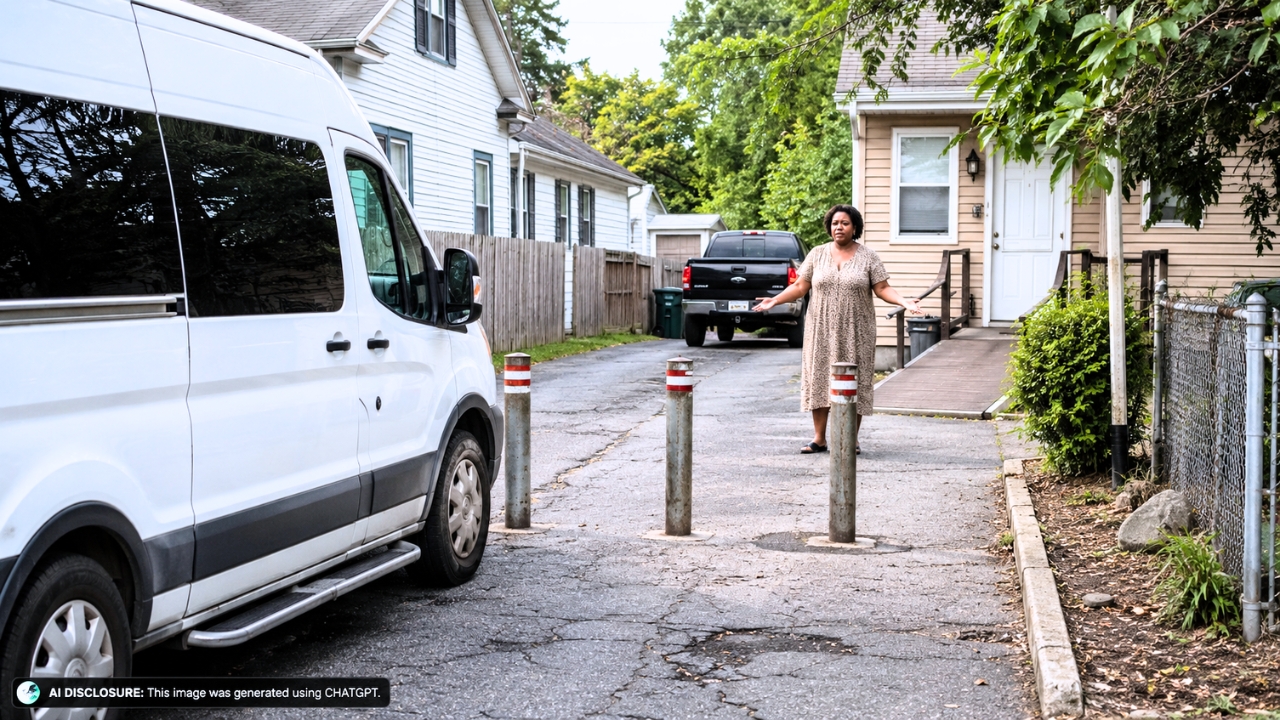
Edwards’ answer wasn’t an asphalt patch or a contractor quote. He installed three bollards, described as physical barriers meant to keep out large vehicles, right in the easement area Aberra uses to access her home. The effect was immediate: anything bigger than a minivan couldn’t make it through.
For an adult family home, that isn’t just inconvenience. STA’s paratransit vans sometimes need to reach the door to transport disabled clients, and the bollards turned that into a geometry problem the vans couldn’t solve.
The lawsuit later argued the center bollard wasn’t merely annoying—it narrowed the travel path and increased collision risk, reduced turning radius for larger vehicles, interfered with two-way flow, and could even impede emergency access. The kind of thing that feels like “a driveway dispute” until you picture a fire engine or ambulance trying to thread a needle next to someone’s residence.
Spokane Valley City Manager John Hohman ended up hearing from Edwards. His reaction was blunt: he’d never heard of someone going that far, referring to the bollards.
From tire marks and depressions to yelling matches
This wasn’t quiet. Edwards moved the office of his motorcycle parts business home last year, and he said that’s when he started paying closer attention to the pavement’s condition. As he blamed the depressions on paratransit traffic, he began parking a large truck along the easement—something Aberra said blocked access to her home and business.
Edwards told RANGE the truck wasn’t obstructing the easement. Aberra saw it differently, and the back-and-forth turned into tense interactions between families. Police were called more than once. Aberra also accused Edwards of mocking her for being single.
There’s video of one heated exchange in the road in front of Edwards’ house, recorded by Aberra. In that clip, she accused him of bringing “bad energy” and even offered to “buy your house for cash right now.” Edwards shot back with his own accusations, including a comment about Aberra being “from a communist country,” even though Ethiopia hasn’t been communist for decades.
Aberra, a Black Ethiopian-American woman, says Edwards is trying to make her work and life miserable because, in her words, he’s “racist.” Edwards denies that and scoffs at the claim, saying he has Black friends and a good relationship with another Black neighbor.
When the transit agency gets involved, it’s not neighborly anymore
On September 12, STA’s general counsel, Megan Clark, sent Edwards a cease and desist letter demanding he stop blocking the easement to STA vehicles. That’s a major turn in any “property line” dispute—once a public agency is documenting access problems, you’re not just arguing over whose guests can park where.
STA also reported multiple run-ins with Edwards, including one note that he “showed hostility towards an STA employee.” Another STA official contacted the Spokane County Sheriff to report that Edwards was harassing paratransit workers. Edwards denied harassment in his response filings.
Edwards’ core complaint stayed consistent: STA vans and other traffic are damaging blacktop on his property, and he believes he didn’t give the agency permission to access Aberra’s business. He also argued that the city “does not permit business-related traffic or commercial use,” while Aberra has a permit for her adult family home.
Meanwhile, city documents describe Aberra’s property as the “dominant property,” meaning it benefits from the easement for access between her home and the street. Hohman noted the city’s documentation “doesn’t contemplate group homes,” but the easement had historically been used for paratransit, and the documents give Aberra the right to enter and exit her property.
The lawsuit: remove the barriers, stop narrowing access
In February, after verbal standoffs, STA’s cease and desist, and the bollards going in, Aberra’s lawyer Douglas R. Dick sent Edwards a cease and desist letter demanding he remove the barriers. Edwards did not remove them.
On March 12, Aberra sued Edwards in Spokane Superior Court, asking a judge to order him not to “obstruct, gate, narrow, or otherwise interfere” with her easement rights. STA joined the litigation, asking the court to explicitly allow its vans access to Aberra’s adult family home.
Edwards countered in court documents by accusing Aberra of defamation for calling him racist. He also asked the court to ban STA from accessing Aberra’s property without his permission, framing the vans as trespassers and the wear-and-tear as an unfair cost he shouldn’t bear.
Then came the whiplash that anyone who’s lived through neighbor disputes will recognize. On April 1, Edwards texted RANGE that he hadn’t seen the vans in a long time and removed some bollards. On April 2, he texted again saying a van used the easement, so he reinstalled the bollards. “Bummer, oh well,” he wrote.
The homeowner reactions: “Document everything” meets “don’t block access”
Even without a comment section pasted in, this is the kind of driveway fight that tends to split homeowners into two practical camps: the ones who immediately think “wear-and-tear is real, get it documented,” and the ones who hear “bollards blocking paratransit and emergency access” and think, “That’s going to end badly.”
If you’ve ever dealt with shared access, the instinct is usually proof first, confrontation second—photos of cracking and depressions, dated notes, written requests to coordinate repairs, and real estimates for resurfacing. That’s the boring path, but it’s the path that doesn’t involve a physical barrier turning a civil disagreement into a safety issue.
Here, the expensive part isn’t just asphalt. It’s the uncertainty over who maintains it, what vehicles are allowed, and what happens when one neighbor tries to enforce their view of “property rights” with steel posts instead of paperwork.
The neighbors are due at a hearing in Spokane County Superior Court on April 24. Edwards told RANGE he’ll comply with whatever a judge orders, and Aberra said she just wants her clients to have the transportation access they need. Until someone with authority draws a hard line, the driveway remains what it’s become: not a path home, but a pressure point.
Like Fix It Homestead’s content? Be sure to follow us.