Landowner Is Told His Project Needs No Permit if New Concrete Stays Under 400 Square Feet — Then an Order Cites 2,122 Square Feet
Photo credit: AI-generated image created using ChatGPT. Illustrative only.
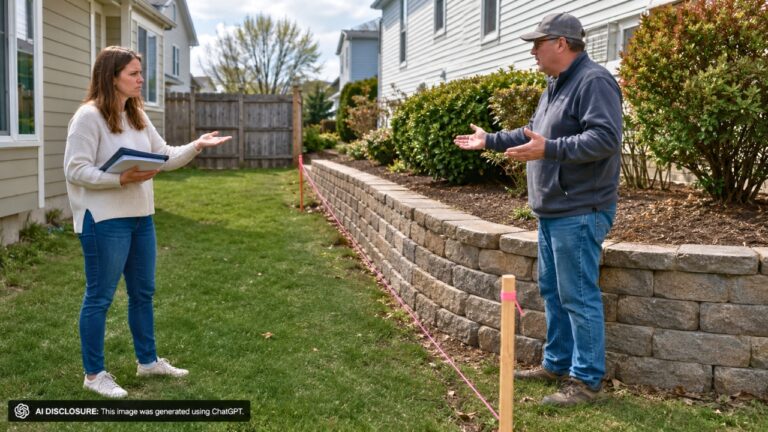
It started like a lot of lake-country projects do: a homeowner walking the yard with county staff, pointing at stakes in the ground, trying to figure out what can be built without triggering a long permit slog. The message Robert Audette says he heard during a June 2020 site visit was simple enough to remember: stay on existing fill, and keep any new concrete under 400 square feet.
Then came the kind of paperwork that makes your stomach drop. After a new concrete ramp was poured down to the water, a restoration order pegged the wetland impact at about 2,122 square feet—more than five times that “under 400” figure. The details are laid out in the source post involving Jennifer and Robert Audette and Lake of the Woods County in Minnesota.
A site visit, a green light (with strings), and then a very different build
The Audettes bought their Lake of the Woods shoreland home in 2019. In 2020, Robert met on-site with the county’s Land and Water Planning Director, Josh Strumland, and an environmental specialist to talk improvements, including a garage addition. According to the court record, he was told the addition wouldn’t need a permit as long as it stayed on existing wetland fill and new concrete stayed under 400 square feet.
They also talked about other upgrades: a driveway, a septic system, and even a concrete connection from the deck to the corner of the garage. Strumland also advised that septic placement should stay in filled areas to avoid wetland impacts and the need for wetland credits.
But the big thing that got built later—the 12-foot-wide concrete ramp running from the property down to the lake’s ordinary high-water mark—wasn’t what the county says was discussed. It went in without prior county approval, and it became the centerpiece of everything that followed.
The measurement that changed everything: 400 square feet vs. 2,122
In June 2021, a site inspection confirmed what the county described as “numerous violations” tied to the ramp. The next month, a conservationist with the Lake of the Woods Soil and Water Conservation District issued a restoration order identifying about 2,122 square feet of wetland impact attributed to the ramp.
That number matters because shoreland and wetland rules aren’t just about what looks nice from the deck. They’re about fill, runoff, erosion, nutrient impairment, and how much impervious surface you’re adding near water. A wide slab aimed at the lake isn’t treated like a little sidewalk patch job.
The county’s restoration order didn’t ask for tweaks. It directed the shoreline be restored to pre-altered conditions.
Riprap, a cost-share project, and the “one thing led to another” problem
There was another layer that a lot of property owners don’t think about until they’re already in trouble: previous shoreline work funded through programs that come with strings attached. The record says the SWCD chair told Robert that removing state-funded shoreline riprap and pouring the ramp violated a cost-share project—and that Robert knew the ramp dismantled that cost-share work when it was built.
When the Audettes tried to get approval after the fact, the explanations got messy. At a Planning Commission hearing in November 2021, Robert’s representative said the concrete was poured due to Jennifer’s health issues. Robert also described how he kept extending the concrete after a windstorm damaged trees—basically, the classic project-creep moment where you’re already mixing, already forming, and you convince yourself it’ll “make it look nice.”
Planning Commission members didn’t ignore the disability angle, but they focused on scale. One member said a normal-size sidewalk might have been acceptable, but a 12-foot ramp plus additional concrete wasn’t. Another member pointed out the water levels wouldn’t allow much more than a kayak, and Robert confirmed a boat launch was never his intention.
Even so, the Planning Commission recommended approval with conditions: remove some concrete, allow a 12-foot walkway to the lake, and replace riprap along the edges of the slab.
When it reached the County Board, the mood flipped
The County Board was the final decision-maker, and it didn’t follow the Planning Commission’s recommended path. Director Strumland told the Board that he’d been to the property before, but the ramp “was not what we discussed” and was never part of the original conversation.
Board members kept circling the same practical point homeowners hear in every zoning fight: you can ask first, or you can do it and hope forgiveness is cheaper than permission. One member asked if Robert could have come in originally and asked for a ramp. Strumland said yes—there would have been options.
There was also a credibility problem in the room. Approving a large, unpermitted, after-the-fact ramp was described as a “can of worms scenario,” the kind that tells everyone else they can pour first and negotiate later. Strumland acknowledged the ordinance typically allows things like a four-foot-wide boardwalk or sidewalk for residential structures, and openly questioned whether four feet is enough or eight feet is too much—but 12 feet was repeatedly described as very wide.
The Board voted to deny the after-the-fact conditional use permit. Its reasons included nutrient impairment concerns for the lake, the county’s interest in shoreline stabilization to reduce erosion and excess nutrients, the “egregious” violation of the zoning ordinance and process, and the existence of alternative, more environmentally friendly access solutions that would have preserved the riprap—options the Audettes didn’t seek before building.
The denial also came with a hard directive: restore the property to the original pre-project condition and restore the riprap to previous engineered standards by July 31, 2022. The record notes that neither Robert nor his attorney attended the County Board meeting even though they were informed of the time and location.
How the ADA argument collided with permitting reality
In their after-the-fact permit application, Robert described the slab as providing handicap accessibility to the lake for Jennifer, noting safety and access for the family. Later, in July 2022, the Audettes submitted a state Joint Application Form seeking approval of a wetland replacement plan under the Wetland Conservation Act, again arguing the concrete was crucial as an ADA-compliant accommodation.
The county Planning Office denied that request, finding the proposal did little to reduce overall wetland impacts and identified no alternatives. It also noted the ramp would still violate county zoning ordinances even if wetland replacement requirements were satisfied. The Audettes appealed to the Minnesota Board of Water and Soil Resources and lost.
By September 2023, the Minnesota Department of Natural Resources issued citations for failure to comply with the restoration order, because restoration work had not begun.
The Audettes then sued the county and officials in March 2024, alleging discrimination under Title II of the ADA for failing to reasonably accommodate Jennifer’s disability when the permit was denied. The federal district court granted summary judgment to the county, and in July 2026 the Eighth Circuit affirmed. A key theme in the appellate opinion: accommodation duties kick in when a public entity learns of the need, and the county’s ordinance already offered an accessible option (a walkway) that the Audettes never sought permission to build before pouring a much larger ramp.
The reactions you hear in real life: “Get it in writing” and “don’t pour first”
This is the kind of property drama that makes other homeowners immediately think about documentation. Not because anyone loves paperwork, but because verbal guidance—especially guidance tied to conditions like “as long as…”—turns into a memory contest once concrete is in the ground.
It also spotlights a second hard lesson of shoreland living: your shoreline isn’t just “your yard.” If there’s wetland fill, ordinary high-water marks, riprap tied to a cost-share project, or any kind of conservation overlay, the rules aren’t flexible just because the project feels practical in the moment.
And the third lesson is the one that stings: after-the-fact permits exist, but they’re not a guarantee. They’re a chance to propose something that could have been permitted in the first place. A 12-foot-wide slab to the water, tied to thousands of square feet of wetland impact, put the Audettes in a hole that got deeper every time another agency got involved.
At the end of the day, this wasn’t a small patio extension that accidentally crossed a property line by a foot. It was a major shoreline alteration—big enough that once the measurements were on paper, the whole “under 400 square feet” understanding didn’t just look wrong. It looked impossible to reconcile without tearing out concrete and starting over the slow way.
Like Fix It Homestead’s content? Be sure to follow us.