New Homeowner Finds a Neighbor’s Sprinklers Running Twice a Day Onto the Yard — Then the Watering Schedule Never Changes
Photo credit: AI-generated image created using ChatGPT. Illustrative only.
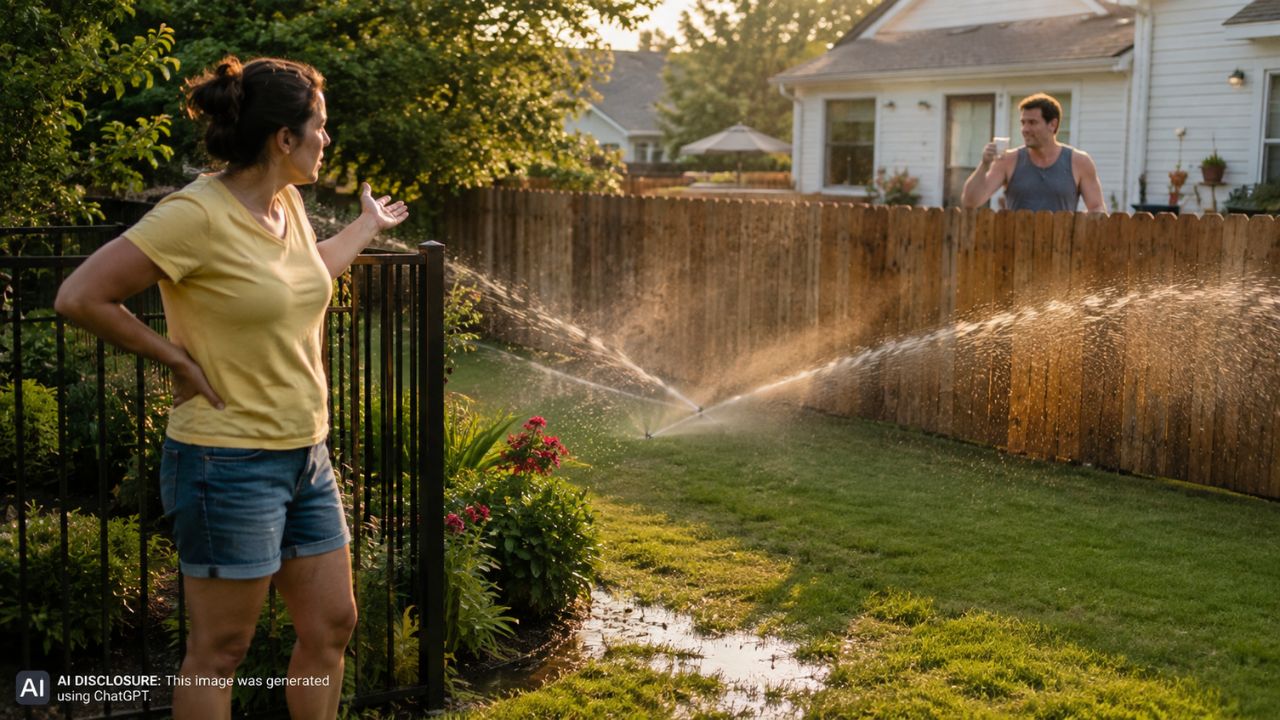
The new homeowner thought they were doing everything right: learning the quirks of the property, keeping up with the yard, and trying not to be “that neighbor.” Then they noticed something that didn’t make sense. Twice a day, every day, the sprinklers next door came on—and the water didn’t stay next door.
Along the shared fence line, the ground on the homeowner’s side turned into a muddy strip that was getting harder to mow, harder to walk, and harder to ignore. In the original post, the homeowner explained that the neighboring yard has a slight slope that appears to funnel runoff straight toward their property, leaving them with a soaked, messy border they never asked for.
The mud showed up where it always does: right along the fence
Drainage problems have a way of revealing themselves in the most predictable place—the low spot—and for this homeowner, that low spot was the fence line they share with their neighbors. The water wasn’t just overspray from a sprinkler head that’s aimed a little too far. It sounded more like regular saturation followed by runoff, the kind that turns soil into soup over time.
And the schedule was the part that made it feel relentless. Twice a day, every day is a lot of watering for one lawn, even in a hot state. When that much water hits a sloped yard, it doesn’t take a storm to create a mess downhill.
At first, homeowners tend to give these things a few days, assuming it’s a temporary routine—maybe new sod, maybe a repair, maybe a heat wave. But when the watering rhythm never changes, the consequences start to feel permanent.
A friendly conversation helped… but didn’t solve the underlying issue
To their credit, the homeowner didn’t start with accusations. They walked next door and talked to their neighbors in the morning, explaining what was happening along the fence. The neighbors were “super friendly,” and they agreed to cut the water off for now.
That kind of response is the best-case scenario in a neighborhood problem. Nobody wants a cold war over grass. But it also puts the homeowner in a weird spot: gratitude on one hand, and the nagging thought on the other that this will start up again once the immediate discomfort passes.
Because even if the neighbor turns the system back on and means well, a set-it-and-forget-it irrigation controller doesn’t care about property lines. If the heads are aimed wrong or the run times are too long, the water will keep taking the path of least resistance.
The real fear isn’t the puddles—it’s what constant saturation can do
A muddy strip sounds small until you live with it. It can kill grass, invite weeds, and make routine yard work miserable. It also changes how you use that side of your property. If you can’t walk it without sinking, you stop checking the fence regularly, which is exactly how small fence issues become big fence issues.
There’s also the question that pops into every new homeowner’s mind: what else is this affecting? Persistent wet soil can encourage pests, and it can turn a clean fence line into a rotting, algae-stained mess. If the fence posts are set where water collects, that wet-dry cycle is not doing the wood any favors.
The homeowner didn’t claim structural damage—just that the area had become “extremely muddy” and difficult to maintain. But the longer water is redirected onto one side of a boundary, the more it starts to feel like a property maintenance problem, not a minor inconvenience.
Trying to fix it without “drama” is its own kind of pressure
One detail that makes this feel familiar is how carefully the homeowner framed their question. They’re in Texas, they know irrigation is common, and they don’t want conflict. They asked if it’s reasonable to request a change in watering schedule or sprinkler aiming long-term.
That’s the tightrope: you can be completely justified and still dread the social fallout. A fence line is a daily reminder that you have to coexist. And as a first-time homeowner, it’s easy to worry you’ll be labeled difficult for bringing up something as mundane as sprinklers.
So the homeowner started thinking about what they could do on their side, even though the water is coming from someone else’s system. They floated possible fixes like drainage, gravel, or a French drain—solutions that cost time and money, but would reduce the dependence on the neighbor’s cooperation.
What people tend to suggest when sprinklers won’t stay in their own yard
The homeowner’s questions landed in a very practical place: is this a sprinkler adjustment issue, a scheduling issue, or a grading issue? They wondered whether the neighbors could adjust heads or install something to direct water away from the fence.
That’s usually where these problems live. If a sprinkler head is throwing water toward a boundary, it can often be re-aimed. If the run time is excessive, the soil can’t absorb it quickly enough and it becomes runoff. And if a yard is graded so that water naturally flows toward the fence, then even “normal” watering can turn into a slow-motion flood next door.
On the homeowner’s side, drainage ideas like gravel or a French drain can help manage water that arrives anyway. But those fixes can also feel unfair: paying to handle water you didn’t introduce. Still, for many homeowners, controlling your own soil conditions is more reliable than hoping a neighbor sticks to a new routine forever.
Why the schedule matters more than people think
Twice-daily watering doesn’t just add up—it compounds. When a lawn gets watered again before it has time to dry, the ground stays saturated. On a slope, saturation quickly becomes runoff, and runoff doesn’t politely stop at the fence.
That’s why the homeowner’s observation that the schedule “never changes” is such a red flag. It suggests automation, not someone standing at the window deciding the grass looks thirsty. Automated systems are great until the settings are wrong for the season, the soil type, or the layout of the property.
The neighbor turning it off “for now” is a pause button, not a reset. The homeowner’s bigger concern is what happens when the sprinklers come back on and the same pattern returns—mud, pooling, and another awkward knock on the door.
For the moment, the homeowner has something valuable: a neighbor who listened and a clear description of what’s happening along that fence line. The next step—whether it’s a simple sprinkler adjustment, a schedule change, or adding drainage on their side—will determine whether this becomes a one-time new-home headache or a recurring problem that shows up twice a day, every day, like clockwork.
Like Fix It Homestead’s content? Be sure to follow us.