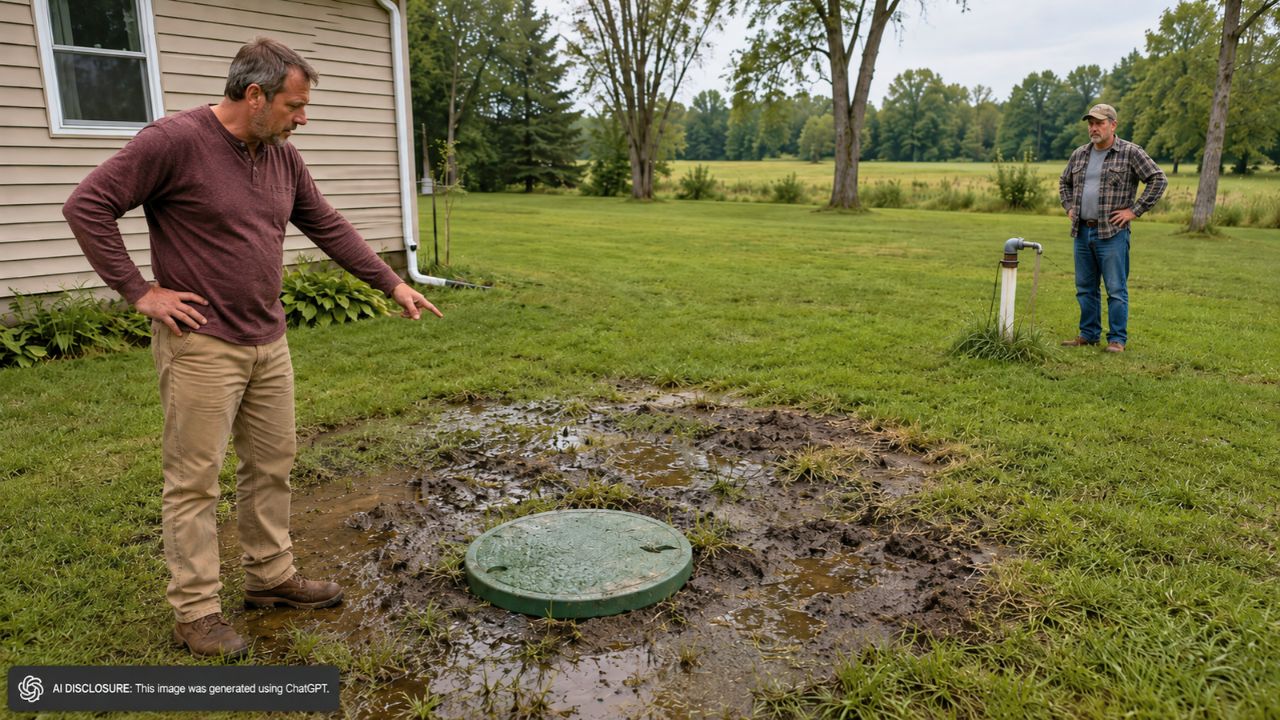
Homeowner Finds the Neighbor’s Well Sits 65 Feet From His Septic Field, Short of the County’s 100-Foot Rule — Then His Failing System Has Nowhere to Go
Photo credit: AI-generated image created using ChatGPT. Illustrative only.
Most homeowners don’t think much about distances measured in feet until a system fails and the county rulebook suddenly matters. One Pennsylvania homeowner found herself staring at that exact nightmare: a neighbor’s newer well sitting closer than the county’s required separation from her old septic drain field—right as her own septic system started giving up.
In the original post, the homeowner explains that her septic system’s drain field was installed in 1958, long before today’s tight-lot building pressure and modern health department setbacks. The neighboring lot was vacant for years, but when construction started next door, a well went in during 2021—and it landed in a spot that now boxes her in.
A small lot, an old septic field, and a new well next door
On paper, it sounds like a simple measurement problem. The homeowner says the neighbor’s well is within 65 feet of her drain field and about 85 feet from her distribution box. Her county board of health requires 100 feet between wells and existing septic systems.
That gap—35 feet in one direction, 15 in another—doesn’t just look bad on a diagram. It becomes a real-world constraint the moment anything needs to be replaced, expanded, or brought up to code. And on less than an acre, “just move it” isn’t a real option.
The homeowner’s property is 0.64 acres. That’s enough land to feel rural until you start drawing circles around wells, drain fields, replacement areas, property lines, and whatever else the local regulations demand. Suddenly the yard is all “no.”
When the septic starts failing, the math gets cruel
The timing is what makes this story sting. The homeowner isn’t raising a theoretical complaint; she says her septic system is failing and she needs a new system. Specifically, she says she requires a “sound mound,” a type of mound system used when soil conditions, groundwater, or space issues make a traditional setup difficult.
But mound systems don’t live in a vacuum. The new mound needs to be 100 feet from surrounding neighbors’ wells, she explains. That means the neighbor’s well placement doesn’t just violate a setback on paper—it actively blocks where her replacement system can go.
That’s the moment this stops being a neighbor gripe and turns into a property functionality crisis. A failing septic isn’t an “eventually” repair. It’s one of those household problems that dictates your schedule, your finances, and whether parts of your home remain usable.
The part nobody wants: the front-yard option
Once the homeowner started looking at potential locations for the replacement mound, the choices narrowed fast. With the neighbor’s well in the wrong spot (at least compared to the county’s 100-foot rule), she says she may only be able to put the sound mound in her front yard.
And that’s where the practical pressure shows up. A front-yard septic solution can come with its own limitations—setbacks, grading, access, aesthetics, and the simple reality of living with a prominent engineered mound where you’d normally have grass, landscaping, or a driveway approach.
The homeowner also notes that for a small lot, the front yard is “not acceptable.” Whether that’s a local code issue, a permitting standard, or a physical impracticality, it’s the kind of dead-end that makes homeowners feel trapped: the old system is failing, the replacement is blocked, and the remaining “option” may not be an option at all.
Neighbors don’t just share a fence line—they share consequences
Well placement and septic placement are the kind of things neighbors rarely discuss until someone’s forced to. A well isn’t like a shed you can slide over a few feet later. Once it’s drilled and established, it becomes a fixed point around which everyone else’s plans have to orbit.
From the homeowner’s perspective, the neighbor’s 2021 well created a new restriction that didn’t exist when her system was installed in 1958. What used to be her usable backyard (or side yard) becomes regulated space, and the replacement design has to respect the newer well even if the well didn’t respect the older septic offsets.
Meanwhile, the neighbor likely sees their well as part of building a home on their own lot—something they planned, paid for, and assumed was permitted. That’s what makes these standoffs so tense. Two families can be “right” in the everyday sense and still end up with a hard regulatory conflict that demands someone gives something up.
What people latched onto: rules are real, but paperwork is everything
The advice in the thread is short but blunt. A lawyer responding to the question didn’t offer a DIY fix or a friendly script for talking to the neighbor. The response was: retain a real estate attorney immediately, “if not sooner.”
That tone tells you what kind of problem this is. Not a handshake disagreement. Not a “let’s get a contractor to take a look.” It’s a boundary-and-permitting issue with potential health department implications, which tends to mean records, approvals, and enforcement—plus the very real possibility that the only path forward is through formal channels.
When homeowners talk about these disputes among themselves, the same themes usually repeat: get documentation, confirm the actual measured distances, find out what was approved, and don’t assume the county’s rule automatically translates into an easy remedy. But in this case, even the limited response points in one direction—professional help, and fast—because the homeowner’s own septic failure doesn’t pause while the neighbor issue gets sorted.
A failing system doesn’t wait for a neighbor dispute to cool off
The most stressful part of this homeowner’s problem is that it’s time-sensitive. If the septic is failing, it’s not just about property value or future plans. It can affect daily life in immediate, unpleasant ways, and it can force a decision under pressure: accept a compromised placement, fight for a remedy, or risk being stuck in permitting limbo.
And once you’re talking about a mound system on a 0.64-acre lot, every foot matters. The homeowner is left looking at a front yard she doesn’t want to use—and may not be able to use—while a neighbor’s well location sits like a permanent “no build” circle across the rest of her property.
This is the kind of homestead headache that doesn’t announce itself with a bang. It sneaks in with a measurement, a permit rule, and a failing system, and then suddenly the question isn’t “Who’s right?” It’s “Where does the replacement go?”
Like Fix It Homestead’s content? Be sure to follow us.