New Homeowner Finds an Eighty-Foot Junk Pile Spilling Five Feet Onto the Yard — Then Finds It’s Been Sitting There for Years
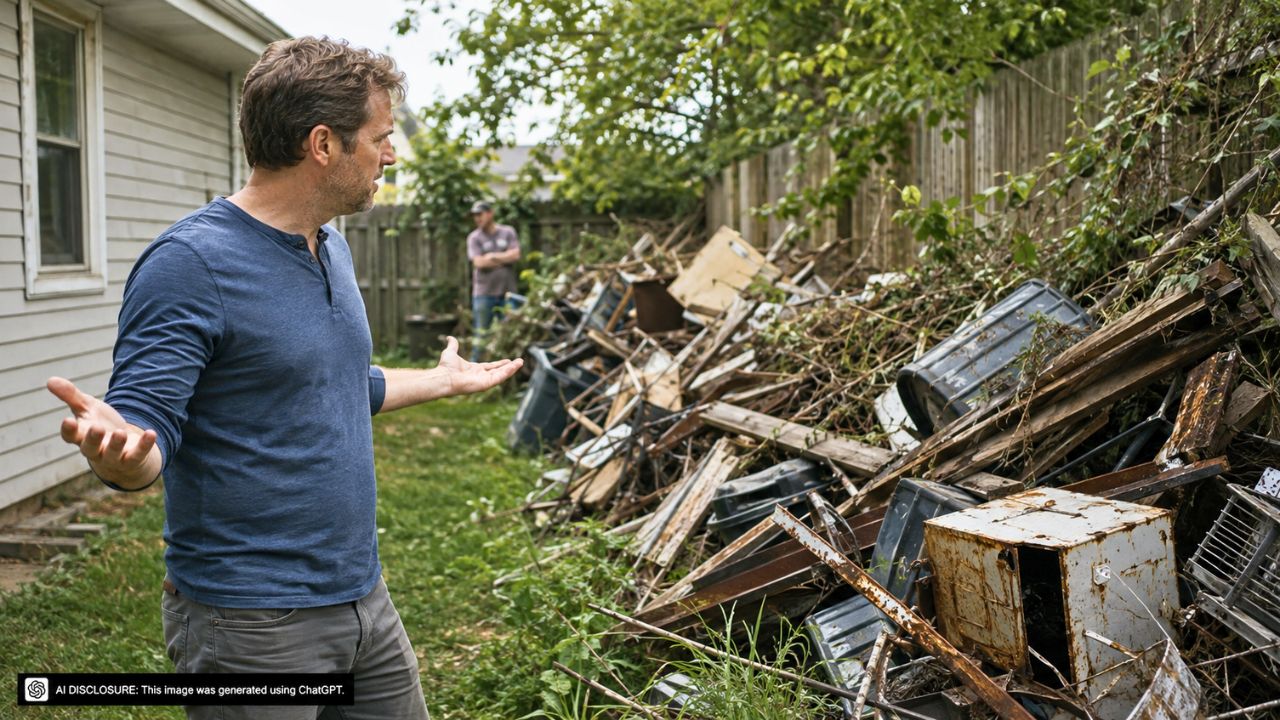
Photo credit: AI-generated image created using ChatGPT. Illustrative only.
When you buy a house, you expect the usual surprises: a sticky door, a weird slope in the yard, maybe a gutter that’s doing its own thing. You don’t expect to inherit a long, messy boundary problem that’s been quietly camping out on your land like it owns the place.
That’s what one Indiana homeowner described in the original post: a junk pile running about 80 feet alongside the property line—and spilling 5 to 6 feet onto their side. Not a little drift of debris, either. This was the kind of “pile” that changes how you use your yard, how you plan projects, and how tense it feels to look out your own window.
The fence plan that turned into a deadline
The homeowner bought the house a little over three years ago, and the pile was already there. They’d also heard from others that it predated their purchase, which matters because it means this wasn’t a one-time cleanup oversight. It was a pattern, and it had somehow become normal.
Early on, they did what a lot of people try first: talk it through. They told the neighbor they planned to put in a fence someday. The neighbor agreed, and even said he wanted a fence too. That’s the kind of friendly alignment that makes you think the whole thing will resolve itself once the project becomes real.
But “someday” doesn’t move junk. And when “someday” turns into “end of May,” you find out what kind of neighbor you actually have.
It wasn’t just along the line—it was over it
This isn’t a vague “I think it’s mine” argument. The homeowner described the pile as being clearly over the property line by several feet, and they even left survey stakes up for about eight months after moving in. That detail says a lot: they weren’t trying to play gotcha, and they weren’t hiding the ball. The boundary had been marked, visible, and sitting there while the junk stayed put.
Anyone who has dealt with property lines knows the emotional trap here. If you ignore it, you feel taken advantage of. If you push too hard, you risk turning a daily neighbor relationship into a cold war. And the longer it sits, the more it starts to feel “set,” even if it’s not legally set.
Now the fence is coming, and the pile has gone from eyesore to obstacle.
Spring arrived, and so did the fear of a last-minute standoff
In late fall of last year, the homeowner reached out again with a clear timeline: fence in the spring, close to the line. They told the neighbor the pile would need to be moved, and even offered to haul all of it away. That’s not a small offer. It’s time, effort, dump runs, and the willingness to touch someone else’s mess just to get your own project moving.
The neighbor’s response was reassuring on paper: he said he’d get it, no problem.
Fast forward to now. The homeowner texted again: the fence would be built at the end of May, with an eight-day window from start to finish. And with that message came the dread that will feel familiar to anyone who has ever coordinated with a procrastinator: the sense that nothing will happen until the minute the equipment shows up, and then suddenly it becomes a confrontation.
Because at that point, it’s not just about junk. It’s about access, timing, money, and the fact that fencing crews don’t usually want to stand around waiting for two neighbors to negotiate.
The moment it turns from “neighborly” to “what are my rights?”
The homeowner’s question wasn’t framed like a threat, but you can hear the frustration underneath it. They asked whether they’d have the right to scrap all the stuff that sits on their side of the line—or whether the only safe move would be to physically shove it back over using a skid steer.
That’s the mental fork in the road people hit when patience runs out. One path is “I’m cleaning my property.” The other is “I’m avoiding the accusation that I stole or destroyed something.” And both paths feel risky when the other person has already shown they can ignore a problem for years.
It also hints at what the pile might be: enough bulk and weight that a skid steer seems like a realistic tool. Not just a few boards you can drag by hand, but a long run of stuff that will take real labor to move.
Even if the homeowner never touches a single piece, the fence job is now tied to someone else’s clutter—and that’s a recipe for delays and finger-pointing.
People zeroed in on documentation and keeping the fence project from derailing
While the post itself is mainly the homeowner laying out the timeline and asking what they can do, the typical reactions in these property-line messes tend to cluster around the same pressure points: proof, written communication, and minimizing the chance of retaliation.
The homeowner already has a strong breadcrumb trail: they notified the neighbor when they moved in, they discussed a fence, they provided advance notice in late fall, they offered to haul it away, and they set a firm build window in writing via text. They also had survey stakes out for months. Those are the kinds of facts that matter when someone later claims they “didn’t know” or says the line “wasn’t clear.”
In situations like this, neighbors often encourage each other to keep everything in writing, take photos of the pile and the stakes/markers, and avoid doing anything that could be interpreted as destroying property—especially if the other person might respond by calling authorities or escalating the dispute. The point isn’t to be dramatic. It’s to keep a fence project from turning into a months-long mess of accusations.
And there’s another practical angle: once fence installers show up, they need a clear work zone. If the homeowner’s timeline is tight, the risk isn’t just an argument—it’s paying for rescheduling or losing a contractor’s slot during a busy season.
Eight days isn’t much time when someone’s been ignoring it for years
The hardest part of this story is how ordinary it starts. Two neighbors agree a fence is a good idea. One neighbor gives multiple reminders. A survey is visible. An offer to haul the junk away is on the table. And still, the homeowner is standing there, weeks away from a build date, trying to guess whether the neighbor will suddenly act—or dig in.
That’s the reality of long-running yard clutter: it becomes background noise to the person who owns it, but it never stops being an active problem for the person living next to it. Add a property line, and it’s no longer just an eyesore. It’s an encroachment that can stall improvements and poison day-to-day peace.
For now, the homeowner is in the tense in-between stage: enough notice has been given that it feels unreasonable for the neighbor to act surprised, but not enough certainty exists to know whether the end of May will bring a cleared boundary—or a junk pile staring down the fence crew. And when you’re trying to build something permanent on your own land, that’s a stressful way to count down the days.
Like Fix It Homestead’s content? Be sure to follow us.