Rural Mountain Homeowner Sets Up a Trail Camera on Their Own Property to Catch Coyotes on the Road — Then the Neighbor Threatens to Shoot It Down
Photo credit: AI-generated image created using ChatGPT. Illustrative only.
Living in the mountains has a way of turning a quiet stretch of road into part wildlife corridor, part neighborhood commons. One rural homeowner thought they were doing something harmless: placing a small trail camera on their own property, set low and aimed down the public road, hoping to catch footage of two large coyotes that had been “playing in the road.”
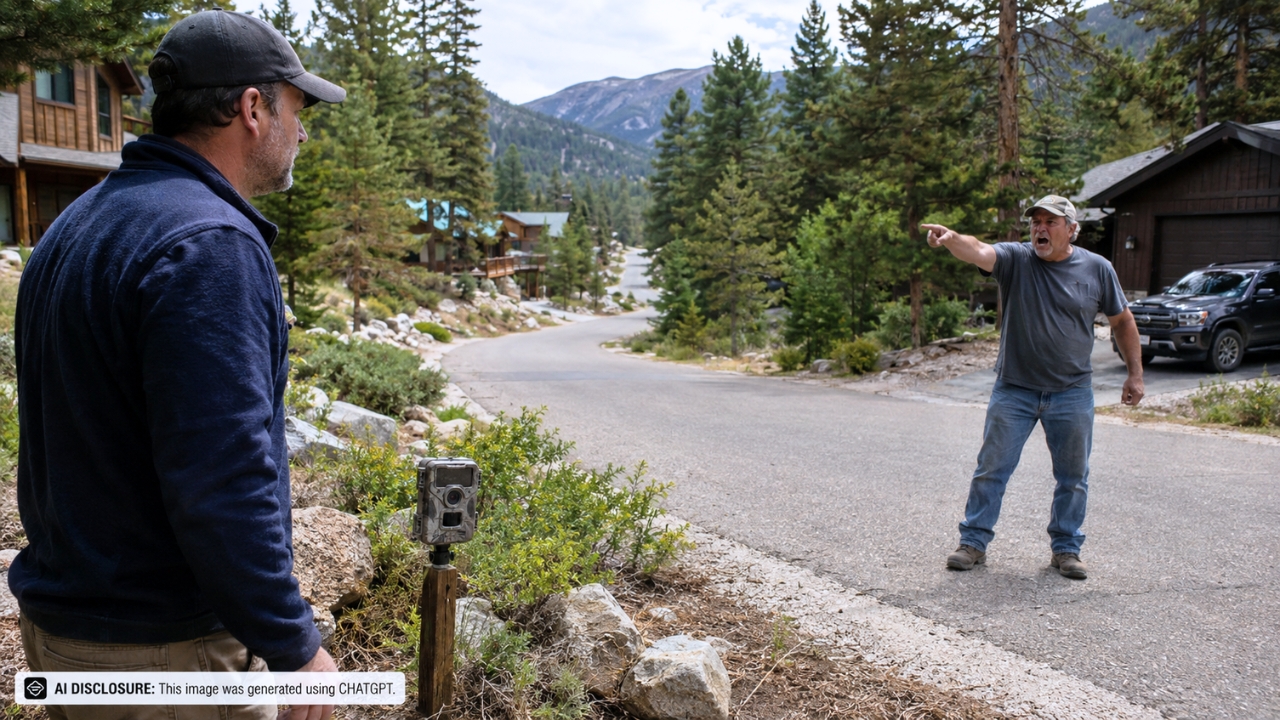
But the moment the neighbor across the street saw the camera going up, the mood flipped fast. In the original post, the homeowner describes an immediate demand to remove it, followed by threats to call police—or shoot the camera—despite assurances it wasn’t pointed into the neighbor’s house.
A simple wildlife camera turned into a front-yard showdown
The camera wasn’t hidden deep in the woods or strapped high on a tree line. It was on a prop, “very low,” and oriented down the roadway to capture animal activity. That detail matters, because it signals the homeowner wasn’t trying to look into windows or over fences—just record the kind of roadside movement rural residents see all the time.
The neighbor didn’t interpret it that way. According to the homeowner, he “lost his mind,” ordering the camera taken down immediately and escalating when told it was for coyotes, not surveillance. The homeowner describes his tone as “incredibly aggressive,” the kind that makes your stomach drop because you can tell this is headed somewhere ugly.
For a lot of people, the breaking point wasn’t even the demand. It was the threat: call the cops or shoot it. Out where response times can be long and people are protective of their space, a threat like that doesn’t feel theoretical.
Why road-facing cameras make people nervous, even in camera-heavy neighborhoods
What makes this blowup especially tense is the homeowner’s last detail: the angry neighbor has multiple cameras of his own, and “everyone on the street has ring cameras.” In other words, this isn’t a camera-free, privacy-purist community. It’s already a place where doorbells record deliveries, headlights, and anybody walking up a driveway.
But a trail camera feels different to some neighbors. It’s often camouflaged, runs quietly, and can be placed in unexpected spots. Even when it’s not aimed at a house, people worry about what it might catch: who comes and goes, which cars stop, which visitors park, what time lights turn on.
Pointed down a public road, the camera also potentially captures more than coyotes. It can pick up anyone driving by, pedestrians, and whatever happens in the right-of-way. That’s where the “it’s on your land” argument smashes into the “it’s filming my life” fear, and the conversation can get heated quickly.
The threat to shoot it changed the calculation
The homeowner ultimately took the camera down, and the reason reads like pure self-preservation. When someone is already talking about shooting property, you’re not really debating trail-cam etiquette anymore. You’re deciding how much you want to gamble on a confrontation that could escalate.
There’s also a practical angle: even if the homeowner is completely within their rights to place a camera on their property, replacing a damaged camera costs money. And if a neighbor is willing to destroy it once, the homeowner has to assume they’ll do it again—maybe the next time it’s up, or maybe to something else that shows up near the road.
In rural areas, disputes can get sticky because distance and terrain make it easier for people to act first and argue later. A camera shot off a post becomes “your word against mine,” especially if the very device that could document the act is now destroyed.
The real homestead problem: living across from someone who escalates
At its heart, this wasn’t about coyotes. It was about the reality of sharing a road with someone whose first response is aggression. When you’re living on mountain property, you can’t just “avoid them” the way you might in a city apartment. You’ll see them at the mailbox, during snow and storm events, when trees come down, when the road washes out, when a loose dog turns up.
That’s the part that can keep a homeowner up at night: not the camera itself, but the reminder that the neighbor is watching, reactive, and ready to make threats over something small. If he’s willing to go from zero to “take it down immediately” over a low trail cam, what happens when the issue is louder—like chain saws, target practice, a new gate, a delivery truck blocking the lane, or a controlled burn?
And while the homeowner was trying to document coyotes, coyotes already bring their own set of worries: pets, livestock, and the uneasy feeling of hearing them close at night. The camera was supposed to be a tool for awareness. Instead, it became a spark for conflict.
What people urged: document everything and avoid a roadside argument
Even without a full comment thread included, the homeowner’s question—“what would you do?”—is the kind that typically pulls practical, self-protective advice from other property owners. When a neighbor threatens to call police or shoot a device, most seasoned homeowners don’t recommend a shouting match in the road.
The common-sense approach in disputes like this is to stop handling it as a personal disagreement and start treating it like a documentation problem. Write down what was said, when it happened, and where the camera was placed. Save any relevant photos of the camera’s position and direction, especially if it was clearly aimed down the roadway and not at the neighbor’s windows.
People also tend to suggest stepping away from face-to-face confrontation once threats come out. Not because you’re “backing down,” but because the goal changes. It’s no longer about convincing the neighbor; it’s about reducing risk and keeping yourself from being pulled into an incident that could spiral.
A quiet road, an unfinished argument
The homeowner’s choice to remove the camera bought short-term peace, but it didn’t answer the question that will linger: how do you live next to someone who thinks threats are a normal way to negotiate? The coyotes will still pass through, the road will still be shared, and the neighbor will still be watching for what he considers a provocation.
Out on a mountain road, people rely on each other more than they like to admit. That’s what makes moments like this so unsettling. A tiny camera meant for wildlife turned into a warning sign about the human animal across the street—and the homeowner is left weighing whether getting proof of coyotes is worth inviting another blowup in broad daylight.
Like Fix It Homestead’s content? Be sure to follow us.