Homeowner Solves a Years-Long Mystery of Dryer Lint in the Crawl Space — Then Finds the Neighbor’s Sewer Line Backs Up Into It Every Time They Do Laundry
Photo credit: AI-generated image created using ChatGPT. Illustrative only.
For years, it was just one of those gross little house mysteries: dryer lint showing up where it had no business being. Not in the lint trap. Not behind the machine. In the crawl space—like the house was somehow shedding sweater fuzz underground.
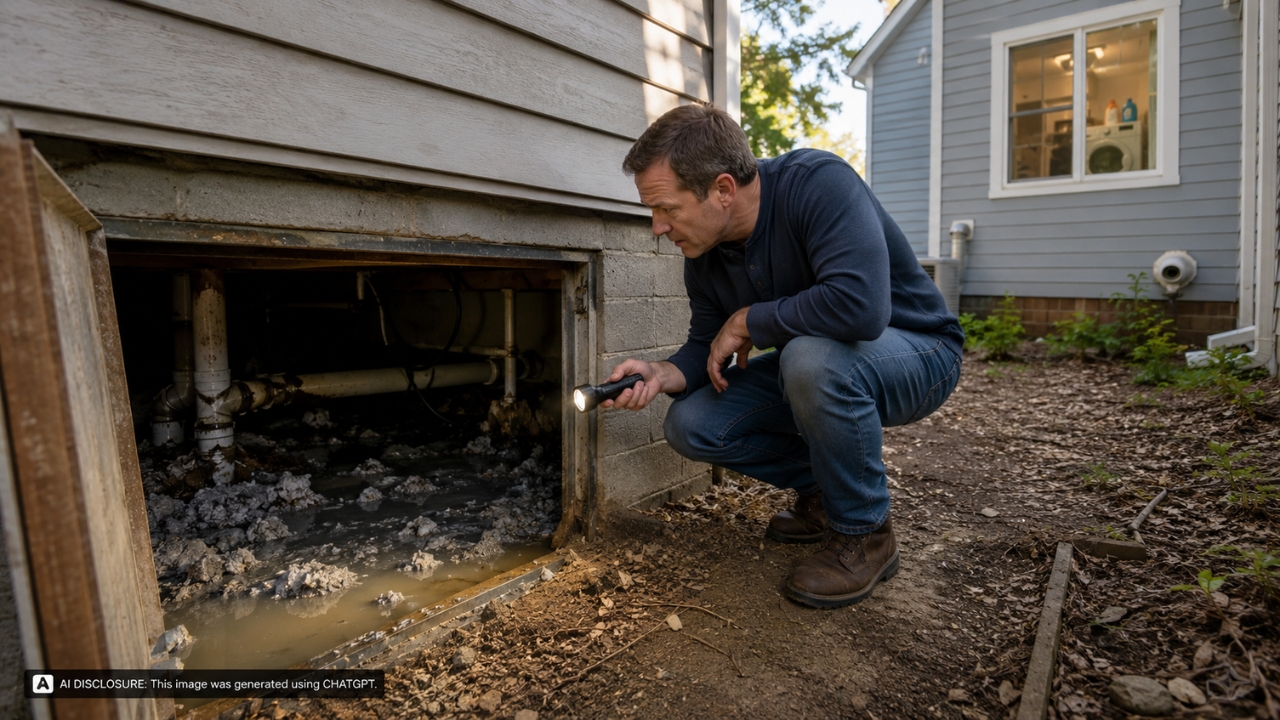
Then the homeowner finally connected the dots and realized the lint wasn’t random at all. In the original post, they describe discovering that when the neighbor to the right does laundry, a sewer backup drains into their crawl space—carrying water and lint along with it. And the timing could not be worse: they’re scheduled to have a vapor barrier and sump pump installed in two weeks, and they can’t have wastewater coming in on top of brand-new work.
The first clue was the lint that didn’t make sense
Lint is annoying, but it’s usually a known annoyance. It stays near the dryer vent, clings to the laundry room baseboards, and shows up in the occasional forgotten pocket. It doesn’t typically appear under the house unless something is very wrong—or unless something is actively delivering it there.
That’s what made this so maddening. The homeowner says they’d been wondering for years where the lint was coming from. Years of seeing it, assuming it was just another unpleasant crawl-space feature, and not having a clear source to chase down.
It wasn’t until they traced the problem far enough to see a pattern—laundry happening next door, then wetness and debris showing up under their own home—that the “mystery lint” stopped being quirky and started looking like evidence.
When the neighbor’s laundry became your crawl-space problem
The turning point here isn’t just that water is getting into the crawl space. It’s the kind of water, and the trigger. The homeowner believes the neighbor’s sewer line backs up when they do laundry, and instead of staying on the neighbor’s property, it ends up draining into the homeowner’s crawl space.
That detail matters because laundry days aren’t rare events. They’re routine. Which means this isn’t a one-off puddle from a freak storm—it’s a repeatable, predictable intrusion tied to normal life next door.
And the lint is what makes it feel especially surreal. Lint suggests washing machine discharge, dryer vent discharge, or some shared pathway that’s collecting household waste and depositing it where it doesn’t belong. Whatever the plumbing layout is, the homeowner is seeing the result under their floors.
Even without getting into every technical possibility, the homeowner’s core fear is simple: if this keeps happening, it can undermine repairs and create bigger problems in a space that already struggles with moisture, odors, and access.
Two weeks before major crawl-space work, everything got urgent
This would be stressful at any time. But the homeowner is on a countdown because they’re about to install two big-ticket crawl-space upgrades: a vapor barrier and a sump pump. Those aren’t cosmetic. They’re meant to manage moisture, protect the structure, and keep the underside of the house stable.
If wastewater is flowing in now, it can complicate everything. A vapor barrier is supposed to create a clean, controlled layer. If water—especially sewage-tainted water—comes in on top of it, you don’t just have a wet crawl space. You have trapped contamination, smells, and a mess that’s harder to clean because it’s now sitting on a new surface.
The sump pump adds another layer of concern. A pump moves water out, but it doesn’t solve the “why is this happening” question. If the neighbor’s backup continues, a pump might become the thing that keeps the homeowner’s crawl space from flooding—while also masking the severity of the neighbor’s problem.
In other words, the homeowner is staring at a scenario where they pay to protect their home, only to have someone else’s plumbing repeatedly test that protection.
The stakes under the house are bigger than a little water
Crawl spaces don’t forgive repeated wetting. Even clean groundwater can lead to humidity spikes, odors, insulation issues, and wood staying damp longer than it should. Add the possibility of sewer backup, and the stakes climb fast—sanitation, air quality, and the risk of lingering contamination become part of the equation.
And because the problem seems tied to a neighbor’s line, the homeowner can’t just “fix their side” and be done. If a line is failing, misrouted, broken, or overwhelmed next door, the long-term fix likely requires cooperation—at least enough to get the right professionals looking at the right pipe.
That’s what makes this kind of property drama so exhausting. It’s not like a leaky faucet where you shut off the valve and call a plumber. This is buried infrastructure, possibly crossing near property lines, and showing itself in the one place most people avoid until they have to: the crawl space.
What the homeowner is really asking: how do you make it stop?
The question in the post is blunt: “What can I do?” It’s a homeowner who feels cornered by timing and by the fact that the source appears to be outside their home.
They’re not asking how to clean lint. They’re asking how to stop a neighbor’s backup from becoming their own recurring damage. They’re trying to protect upcoming work and avoid paying twice—once for the install, and again to remediate whatever comes in afterward.
Even the way they frame it shows how urgent it feels: they “can’t have water coming in on top of the vapor barrier.” That’s not a theoretical concern. It’s a practical one. If the installer shows up and the crawl space is actively receiving water and debris, it can delay work, complicate warranties, or force decisions that aren’t ideal.
It’s also the kind of discovery that forces an uncomfortable next step: bringing the neighbor into a problem the neighbor may not even realize is spilling over—or may not want to deal with if it’s going to involve excavation or serious plumbing work.
The reactions: people tend to push documentation and fast proof
Even without a long comment thread included in the source material, this kind of scenario reliably triggers the same practical instinct from experienced homeowners: don’t rely on a hunch when it’s time to talk to someone next door. Get proof.
When water intrusion is tied to a neighbor’s routine, the best conversations often start with specifics: what happened, when it happened, what it looked like, and whether it can be observed again. The homeowner already has one compelling “receipt” built into the story—the lint that’s been showing up for years.
People who’ve been through boundary-line headaches usually focus on avoiding escalation while still creating a paper trail. That doesn’t mean going nuclear. It means being ready for the moment the neighbor says, “That can’t be coming from my place,” or the moment a contractor needs something more concrete than a description.
At minimum, this is the kind of problem where the homeowner’s next move needs to match the seriousness of what’s coming into the crawl space—because once the vapor barrier goes in, every new intrusion becomes harder to ignore and harder to clean.
The homeowner solved the mystery of the lint, but that was the easy part. Now they’re stuck with the harder reality: their home is being treated like an overflow area for a plumbing system that isn’t theirs, and the clock is ticking toward a major crawl-space install that needs a dry, controlled space to work the way it’s supposed to.
Like Fix It Homestead’s content? Be sure to follow us.