New Homeowner’s Survey Confirms a Two-Foot Strip of Lawn Is Entirely Hers — Then the Older Neighbor Keeps Mowing That Exact Strip Every Single Week Without a Word
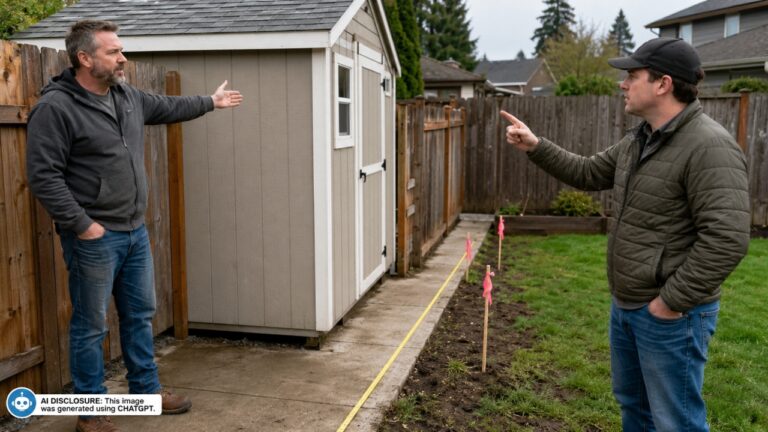
Photo credit: AI-generated image created using ChatGPT. Illustrative only.
Six months into owning a first home, you expect surprises like a sticky window or a mystery light switch. You don’t expect your neighbor to silently maintain a small piece of your yard like it’s part of his weekly routine.
That’s exactly what one new homeowner described in the original post: every time the older neighbor mows, he makes one deliberate pass two feet into the new owner’s lawn. No wave. No comment. No “Hey, I’ve always done it this way.” Just the same precise strip, week after week.
The first sign was easy to brush off
At first, it almost read as neighborly. An older guy, friendly in every other interaction, maybe just trying to help the new person settle in. The homeowner noticed the mower crossing over, but it didn’t look like an accidental drift over an invisible line. It looked intentional—clean, consistent, and repeated.
And because it was only two feet, it didn’t immediately register as a threat. There wasn’t damage, there wasn’t shouting, and there wasn’t an obvious reason to make it weird by bringing it up. In a lot of neighborhoods, people do tiny favors like that—grab a package, nudge a trash can back from the curb, clip a little extra grass at the edge.
But favors usually come with some kind of acknowledgment. This one came with silence and a hard stop at the exact same “invisible line” every time.
Then the survey made it feel less harmless
The turning point wasn’t a new act from the neighbor—it was the homeowner going back to the paperwork. They checked the survey from the home purchase and confirmed the strip is “100 percent” on their property. Not shared. No easement. Nothing that would make the neighbor’s routine automatically normal.
That’s when the mowing started to feel less like a friendly gesture and more like a quiet statement. The consistency is what gets in your head. If someone crosses onto your lawn randomly, you assume it’s careless. If they do it the same way every week, down to the exact two-foot width, it feels like a habit built over time.
And habits around property lines can get sticky, even when nobody is trying to be hostile. People get used to a certain edge of “their” yard, especially if the prior owner never corrected it, never mowed that strip, or didn’t care.
It’s not the grass—it’s the claim underneath it
The homeowner was clear that the mowing itself wasn’t a big problem. In fact, the reaction from friends captured the split many homeowners feel: “free mowing, shut up” versus “he’s claiming your land, say something before he expands.”
This is the part that makes small boundary issues feel big. A two-foot strip isn’t worth a feud, but it’s also the kind of thing that can turn into a story later: years from now, a fence goes up, a shed gets planned, a drainage project needs a clean line, or the house gets sold. Suddenly someone insists, “That’s always been mine. I’ve maintained it forever.”
Even when the law is on paper and the survey is clear, neighbor conflicts rarely stay purely technical. They become emotional fast—especially when one person feels corrected, embarrassed, or accused. And when the other person feels like they’re being pushed around in their own yard.
The quiet part that makes new homeowners hesitate
Brand-new homeowners often avoid rocking the boat because everything is still settling. You’re still learning which switches control what, which trees drop sap on the car, and whether the basement smell is seasonal or a problem. Starting a tense conversation with the person living ten feet away can feel like lighting a match in a room you just moved into.
It doesn’t help that the neighbor is described as “super friendly otherwise.” That detail makes the behavior harder to interpret. If he were openly rude, the next step would be obvious. But when someone is pleasant in person and quietly assertive with boundaries, you second-guess yourself.
That’s why this kind of thing lingers. It’s not a crisis. It’s a weekly reminder that someone is making decisions on your property without asking.
Homeowners’ gut reactions: document first, talk second
Even without a long comment thread included in the source material, the homeowner’s own circle already captured the two classic camps. One camp treats it as a harmless perk. The other treats it as the first inch in an inches-to-feet problem.
In real neighborhoods, the most common practical approach lands in the middle: don’t panic, but don’t ignore patterns that could become “history” later. That usually means keeping the survey handy and choosing a calm moment to clarify the boundary while the interaction is still small enough to stay polite.
It’s also why people tend to handle this with soft language rather than accusations. Not “Stop taking my land,” but something closer to “Hey, I noticed you mow a strip over here—just wanted to make sure you knew the line is actually here, so I’ll take it from now on.”
The homeowner’s hesitation makes sense. Confrontation can turn a quiet street into a long-term stressor. But silence can also turn a simple correction into a bigger correction later.
A two-foot strip can snowball into real-world complications
Grass is easy to dismiss until you need the boundary for something that costs money. A fence installation needs clear agreement on placement. Landscaping projects depend on where the line actually is, not where somebody has been mowing. Even routine maintenance—like edging, reseeding, or treating weeds—gets awkward when two people assume they’re “in charge” of the same narrow area.
And there’s another layer: access. If the neighbor is pushing a mower onto the homeowner’s side every week, it means the neighbor is physically entering the property regularly. Most of the time that’s no big deal, until it is. A slip, a tossed rock that cracks a window, a gouge to a sprinkler line—small accidents can turn friendly routines into sharp arguments when nobody agreed on the arrangement in the first place.
That’s what makes this particular detail—the neighbor never says anything—so important. Without a quick, normal conversation, there’s no shared understanding of why it’s happening, or whether it’s welcome.
The homeowner isn’t dealing with a screaming match or a lawsuit. They’re dealing with something subtler: a neighbor who acts like that strip is part of his weekly territory, and a new owner who has the paperwork to prove it isn’t. The grass will keep growing either way. The question is whether the silence around that two-foot line keeps growing with it.
Like Fix It Homestead’s content? Be sure to follow us.