Rural North Carolina Homeowner Watches New Farm Neighbors Move Cows and Goats Onto Condemned Land Next Door — Then Finds the Animals Repeatedly Escaping to Eat Up the Yard
Photo credit: AI-generated image created using ChatGPT. Illustrative only.
When you build your “forever home” out in the country, you expect the noise to be crickets and the biggest yard problem to be weeds. One rural North Carolina homeowner says their quiet six-acre dream turned into a constant cleanup once livestock from the property next door started treating their lawn like an open buffet.
In the original post, the homeowner lays out how quickly “country charm” can turn into a fence-and-lawyer problem: goats first, then cows, and finally a middle-of-the-night escape that left deep hoof holes across the yard and manure scattered everywhere.
They built close to the line for a reason
The homeowner and their wife bought a six-acre lot in 2019, sold their suburban house, and built a new place meant for privacy and peace. Because of the land’s slope and where their septic system could be installed, they had to place the home along the edge of their parcel—closer to the neighboring property than they would have preferred.
They weren’t worried at the time. The adjoining land had been condemned and, in their understanding, wasn’t suitable for a septic system, which made it feel like a “no one will ever live there” buffer zone. Next door also had two old pole barns used for farm equipment, and the homeowner says they didn’t mind the look of them.
In fact, the previous owner of that land even asked if they wanted to buy it. The couple couldn’t afford the expansion right after building, and they assumed condemned land wouldn’t be attractive to anyone else at full price.
New buyers arrived—and brought animals
Then the surprise: the neighboring property sold anyway. The homeowner says it wasn’t listed publicly, so they didn’t know it was being shopped around after they’d asked for time to come up with funds.
The new owners planned a small farm—cows, chickens, goats. The homeowner didn’t object. Both spouses grew up around farms, and the idea of occasional barn activity sounded like part of rural life.
The problem wasn’t the animals existing. It was the animals not staying put.
The first sign was easy to brush off
At first, it was goats. They allegedly got out “pretty regularly,” wandering into the homeowner’s yard to eat grass and flowers. Because the couple hadn’t done major landscaping yet, the early damage felt annoying but manageable.
They tried speaking with the neighbors, but communication went nowhere. The homeowner says the neighbors don’t speak English and “seem to have no interest in being friendly neighbors.” So instead of a quick “hey, your fence is down,” it became a recurring mystery: the animals would appear, eat, and eventually be moved back—until the next time.
Meanwhile, the visual impact of the adjoining property was changing, too. The homeowner says the barns became “junked up” over time, including one that was closed in to house junked cars being worked on at all hours. The area is zoned Rural Agricultural, and they say that meant there wasn’t much the county could do about aesthetics.
The county did issue “a couple violations” related to the junk cars, but the homeowner claims they were told the fines were minimal and there was little real penalty if the neighbor didn’t pay.
Then the cows started doing real yard damage
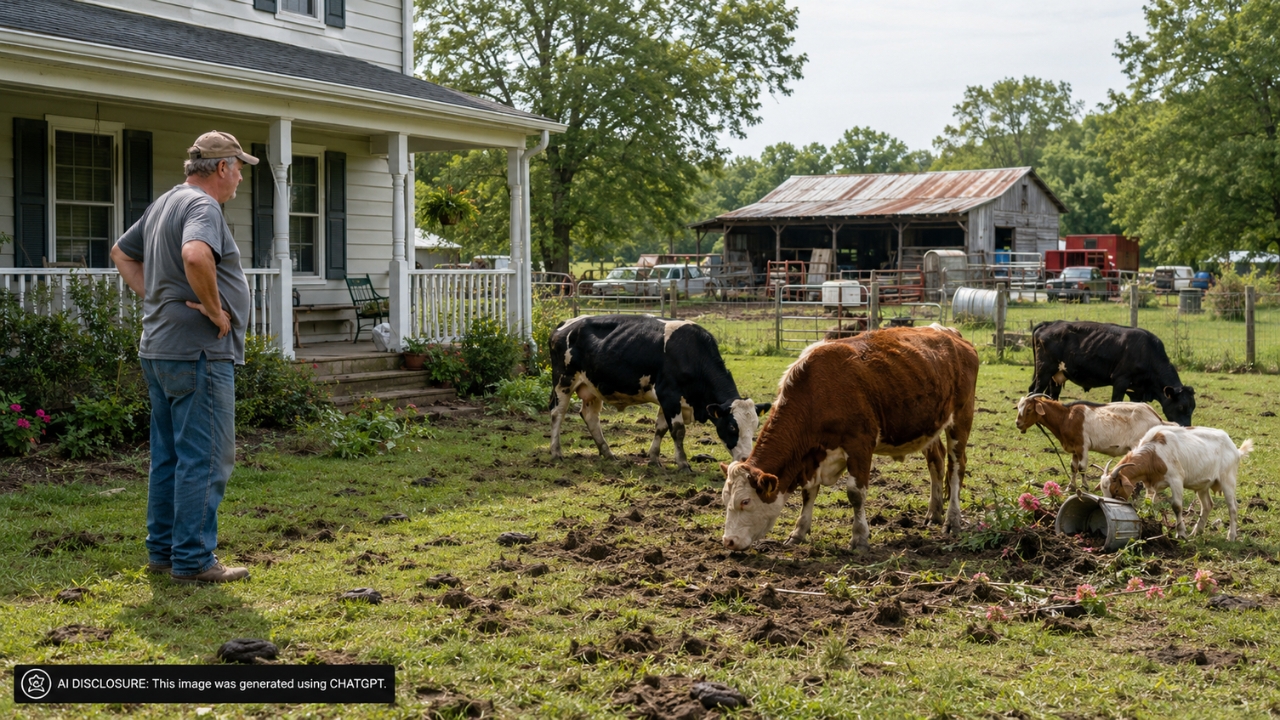
The breaking point came when cows began escaping regularly, not just goats. And one weekend, during a heavy rainstorm, the homeowner says the entire herd got out overnight.
Soft ground and cattle hooves are a brutal combination. The homeowner describes “4–6 inch holes punched into the ground,” deep enough to twist an ankle if someone stepped wrong. Add manure across the lawn, and it wasn’t just ugly—it was a safety and usability issue in the area around their home.
They gathered two separate repair quotes and averaged the damage at about $5,000. To make things worse, they say their homeowners insurance doesn’t cover damage done by animals.
At that point, they hired an attorney to pursue repair costs and to push for proper fencing so it stops happening. But even with a lawyer involved, they were still staring at a hard question rural homeowners ask all the time: when your neighbor’s animals become your problem, what actually forces change?
The stress wasn’t only the money—it was the fear of what comes next
The homeowner’s post isn’t just about torn-up grass. It’s about the feeling of losing control over the property they worked toward for years. Their home sits near the border because that’s where the site allowed it, and now the animals are repeatedly ending up close to the house and yard.
They’re also worried about their children being outside if cows—or a bull—get loose again. Even calm cattle can be unpredictable, and a big animal in a suburban-style yard is not the kind of “rural” anyone is daydreaming about during the home-building process.
They also raise the issue of resale. The homeowner believes the neighboring barns and junked vehicles have made their property harder to sell at fair market value because buyers might not want to live next to what they describe as a noisy, cluttered landscape.
That’s a uniquely frustrating kind of damage: not a broken window you can replace, but a long-term loss of enjoyment and potentially diminished value tied to what’s happening next door.
What people pushed them to do: document, estimate, and stop negotiating in the driveway
In the way these neighbor-property disputes usually go, the most practical voices tend to focus on proof. When animals repeatedly escape, the story can turn into a finger-pointing match about when it happened, how bad it was, and whether it’s “normal.”
The homeowner already took one step that signals they’re thinking along those lines: getting multiple quotes to quantify the damage. They also moved from informal conversations to formal action by hiring an attorney.
They asked whether they’re going about it the right way, whether there’s an angle related to diminished value or loss of enjoyment, and whether anyone else might be liable. Specifically, they noted the neighbors are buying the land through seller financing, and the seller requires insurance—but they say the buyers don’t have it. The homeowner asked if the lien holder could be liable in any way.
Even without a final answer baked into the story, the tension is clear: they aren’t looking to “win” a feud. They want a fence that works, repairs paid for, and a yard where kids can run without stepping into hoof holes after the next storm.
For now, the dream home is still standing. But the peace and privacy that drew them to the country is being tested by something as old as farming itself—animals wandering where they shouldn’t—and the modern reality that not every neighbor can be persuaded to fix it just because it’s the right thing to do.
Like Fix It Homestead’s content? Be sure to follow us.