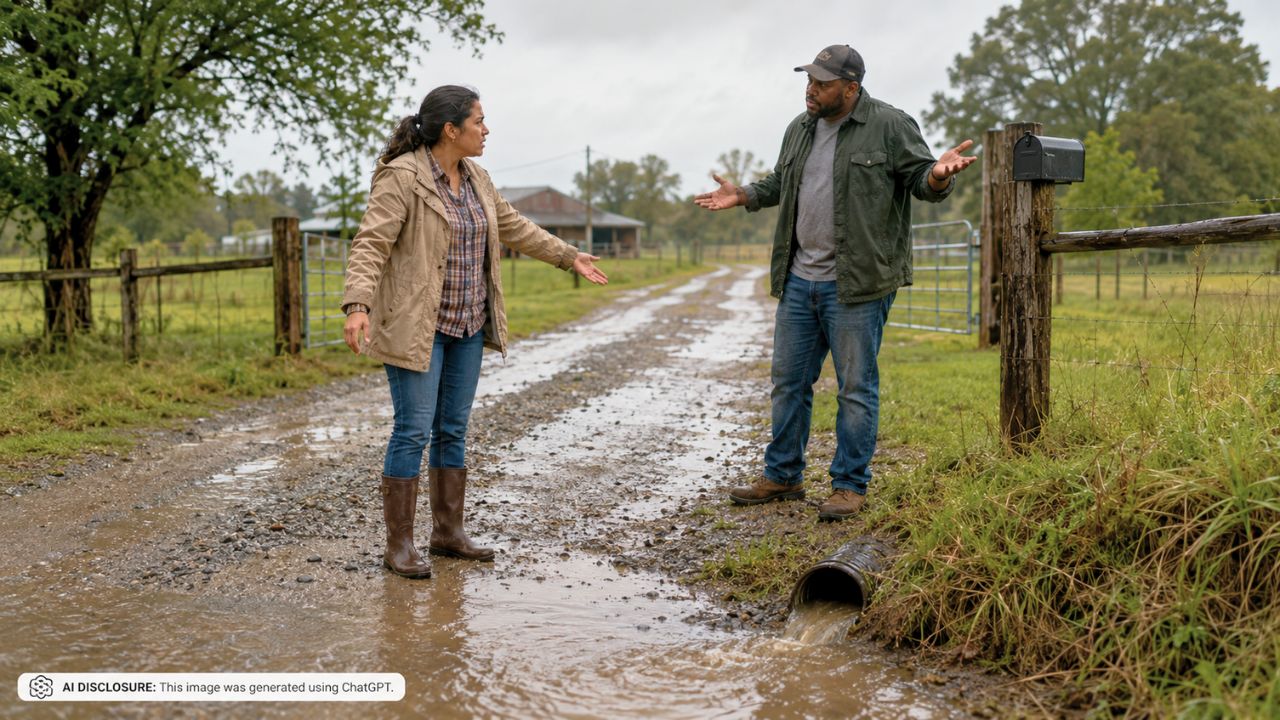
Rural Property Owner Finds a Four-Inch Stormwater Pipe Flooding the Driveway After Every Storm — Then the Neighbor Says the Pipe Was There “Before You Bought the Place”
Photo credit: AI-generated image created using ChatGPT. Illustrative only.
It started the way a lot of drainage problems start: a driveway that turns into a small river every time the weather rolls through. A new homeowner in Auckland thought they were just dealing with normal runoff—until they noticed something more specific and a lot more frustrating.
After a closer look, they found a stormwater pipe dumping rainwater straight onto their driveway. They laid out the details in the original post, asking where to find the relevant rules and whether calling the council was the right move. Their plumber had already weighed in, telling them the setup was illegal.
The driveway wasn’t just wet — it had a source
Owning a place on a downhill slope comes with a certain amount of reality: gravity wins, and the lower property ends up seeing everyone’s water. The homeowner even acknowledged that up front, saying their drains “have to deal with his water.”
But this wasn’t just “water comes downhill.” This was a pipe—directed, deliberate, and concentrated—sending stormwater onto a surface that’s supposed to stay passable. When it’s your driveway, it’s not an abstract nuisance. It’s access to your own home.
In rural and semi-rural living, the driveway is often the lifeline: where deliveries come, where you park, where kids walk, where you’re hauling tools and supplies. And when it floods after every storm, it stops being a minor annoyance and starts feeling like a design flaw you didn’t sign up for.
A plumber’s comment turned it into a “now what?” moment
The turning point wasn’t just noticing the pipe—it was hearing a professional call it illegal. That changes the temperature fast. A homeowner can tolerate inconvenience for a while, but “illegal” suggests liability, required repairs, and a bigger headache if you ignore it.
Once that idea is on the table, you start thinking about what else could be happening. Is the driveway base being washed out? Is water getting pushed toward the garage? Is it undermining edging, retaining walls, or the path people use to get to the front door?
Even if none of that damage is visible yet, the question becomes: how long has this been going on, and what will it cost to undo it? And because this is stormwater, the worst days are the ones you can’t predict—when a big downpour turns a manageable stream into a forceful discharge.
The neighbor acknowledged it — then tried to shrug it off
What makes this kind of dispute tricky is that it’s happening between people who still have to live near each other. The homeowner said they were on good terms with the neighbor, and their first move was casual: ask if he knew about the drain.
He did. He acknowledged it. That’s both helpful and infuriating—helpful because it confirms this isn’t a mystery pipe from the 1970s no one can explain, and infuriating because it means somebody has lived with this as “normal” while the lower property takes the hit.
Then came the part that tends to escalate things: the neighbor’s attitude when pressed. After a phone call that evening, the homeowner reported his stance as: “it was put there before I bought the property, not much I can do about it.”
That line shows up in property disputes everywhere, and it rarely lands well. From the downhill owner’s perspective, it sounds like: not my problem, even though it’s my water. From the uphill owner’s perspective, it can be a defensive reflex—an attempt to avoid blame, cost, and conflict. Either way, the pipe is still there, and the driveway still floods.
Why a pipe onto a driveway feels different than “normal runoff”
People accept that rain flows across land. But piping stormwater is different because it concentrates volume and speed. Instead of diffuse sheet flow, you get a directed discharge that can carve channels, move gravel, and keep a driveway slick long after the rain stops.
Driveways take a beating already. Add regular flooding and you can end up with potholes, soft spots, and washouts that come back no matter how many times you top them up. If the drive is concrete or asphalt, you’re looking at premature cracking and erosion at joints and edges.
And there’s the day-to-day hassle. A flooded driveway isn’t just inconvenient—it can become a safety issue. Slippery surfaces, unexpected pooling, and muddy edges are exactly how people twist ankles, get stuck, or track mess into the house. If you’re hauling feed, firewood, or tools, it turns into a recurring problem you can’t ignore.
For a new homeowner, it’s also an unwelcome surprise: one more hidden “feature” that didn’t stand out during viewings, especially if the weather was dry at the time. Drainage problems love to hide until the first real storm test.
The next step they circled was the council — and that’s where things get real
The homeowner’s instinct was to research first, not storm over and start a feud. They asked where to find the legislation and whether contacting the council would be better. That’s a practical fork in the road.
On one hand, going official can bring clarity fast—what’s allowed, what’s not, what permits exist, and what enforcement looks like. On the other hand, once you bring in outside authority, the neighborly tone can shift overnight. Even a simple inquiry can feel like an accusation when the other person realizes the pipe might need to be removed or redirected.
What makes it extra tense is the homeowner’s location: Auckland. In many places, stormwater rules can be strict and tied to specific property infrastructure. If the uphill property has an unapproved discharge, it could become a compliance issue, not just a private disagreement.
And if the downhill owner ends up needing repairs—driveway resurfacing, drainage improvements, or restoration—then the question of responsibility stops being theoretical. Someone pays, and nobody wants it to be them.
The practical advice people tend to push: document first, then talk
Even without a full comment thread included, this kind of dispute usually pulls the same practical instincts out of readers: get proof, get it in writing, and avoid turning a neighbor-to-neighbor problem into a shouting match.
In real life, that often means taking photos and videos during heavy rain, noting dates and times, and keeping records of what tradespeople say. It also means communicating calmly and clearly—because if the issue ends up going through council channels, emails and texts can matter more than someone’s memory of a driveway conversation.
There’s also a reason people recommend checking property files and drainage plans when possible. A pipe that “was there before” might still be unauthorized. Or it might have been part of an older setup that no longer meets current standards. Either way, knowing what’s officially recorded can keep you from guessing—and keep you from being spun around by shrug-and-deflect explanations.
For now, the homeowner is stuck in the worst middle space: new to ownership, trying to stay civil, but staring at a pipe that turns every storm into a mess. The neighbor’s “not much I can do” might be the end of the conversation on his side, but it’s only the beginning for the person who has to drive through it.
Like Fix It Homestead’s content? Be sure to follow us.
- Man Says He Found Out the Fence He Paid For Wasn’t Actually on His Property
- Woman Says Her Neighbor Started Taking Mulch From Her Delivery Pile Before She Could Even Spread It
- I made Joanna Gaines’s Friendsgiving casserole and here is what I would keep
- What Caliber Works Best for Groundhogs, Armadillos, and Other Digging Pests?