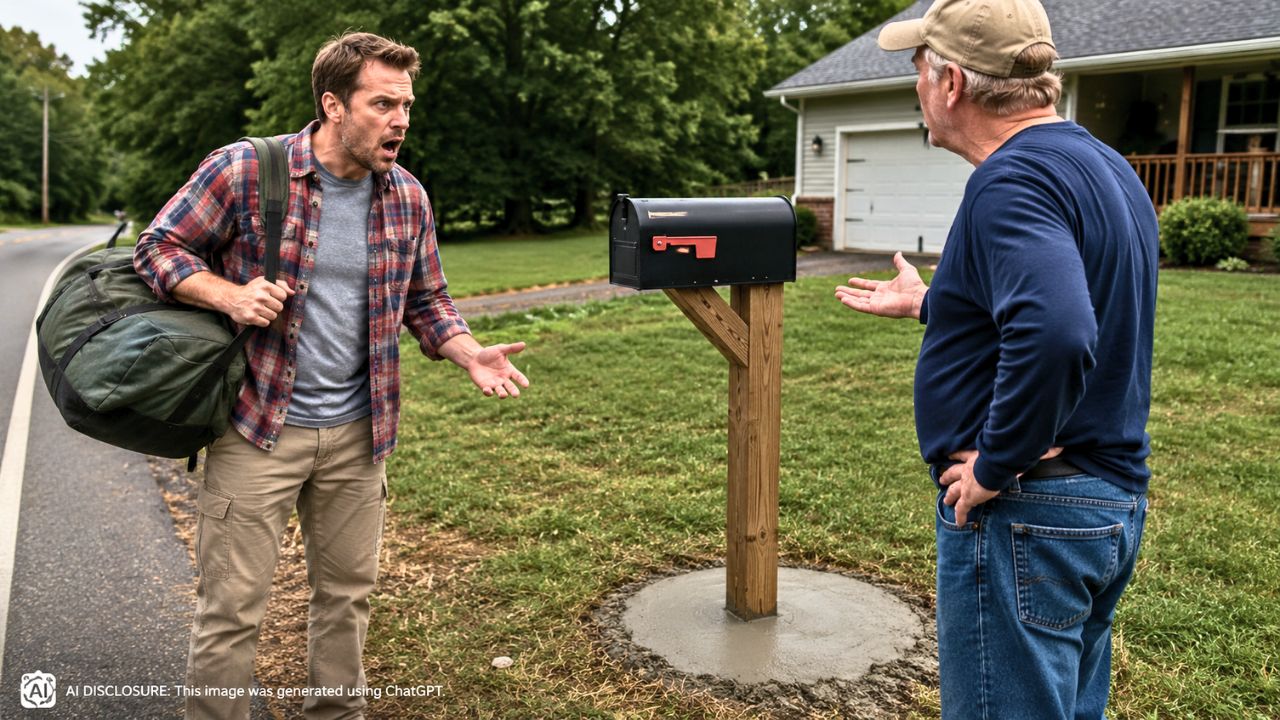
Homeowner Returns From a Camping Trip to Find the Neighbor Poured Concrete and Planted Their Own Mailbox on His Land — Then Learns He Only Asked the Mail Carrier for Permission, Not the Owner
Photo credit: AI-generated image created using ChatGPT. Illustrative only.
Nothing snaps you out of vacation mode like pulling into your driveway and realizing the front edge of your property has been “rearranged” while you were gone. That’s what happened to one homeowner who returned from a couple weeks of camping to find their mailbox knocked over—and their neighbor’s mailbox suddenly installed on their land in fresh concrete.
In the original post, the homeowner explains they weren’t home for any of it. They just came back to a changed curb line: their own mailbox “dinked” and down, and a neighbor’s box set up where it didn’t belong, like someone decided the property line was optional.
The first sign was a smashed mailbox and a contractor’s bad timing
The homeowner’s mailbox didn’t fall over on its own. A contractor truck reportedly backed into it because the driver “really needed to use the port-a-potty nearby.” It’s the kind of small-but-expensive nuisance that can happen when vehicles are swinging wide near the street—especially around construction traffic and temporary toilets.
Normally, that would be the entire story: replace the post, set the box again, maybe reinforce it so it survives the next bump. But that damaged mailbox became an opening for something stranger, because while the homeowner’s box was down, the neighbor apparently saw an opportunity to solve their own mailbox problem.
While the owner was away, the neighbor dug, poured, and claimed space
With the homeowner gone and their mailbox already on the ground, the neighbor “comes over, digs a hole, pours some concrete, and moves their mailbox onto my yard.” No heads-up. No note. No “hey, I’m thinking of shifting this a foot or two while things are already torn up.” Just a new installation planted into someone else’s property.
That’s what turns this from a normal curbside repair into a boundary problem. Concrete is a commitment. It’s not like someone stuck a temporary sign in the grass; they set a post like it was meant to stay.
And now there are two problems at once. The homeowner still has to redo their own mailbox and pole. Plus, there’s an uninvited mailbox anchored on their side, creating a weird shared-zone right at the street—the very place where property lines are most likely to be assumed, argued over, or “fixed” by whoever acts first.
The neighbor didn’t ask the owner—only the mail carrier
The homeowner didn’t guess or speculate about how it happened. They went to the person who would know whether any permission had been granted: the mail carrier.
The mail carrier said the neighbor asked if they could move their box, and the carrier said he “didn’t have a problem with it.” But the carrier also seemed surprised the neighbor never asked the property owner. That detail lands like a thud, because it shows how this kind of mess happens in real life: someone gets a casual “sure, I guess” from the wrong person and treats it like a green light to dig.
It also leaves the homeowner stuck in an awkward spot. The neighbor can tell themselves they “checked” with somebody. Meanwhile, the actual owner is left staring at a concrete-set post on their property that they never approved.
The fix was simple—until concrete made it personal
The homeowner wasn’t even opposed to a shared solution. They said they would have suggested going “halfsies on a thicker post” and mounting both mailboxes together, since they had to rebuild theirs anyway. That’s the kind of practical compromise that prevents exactly this type of slow-burning neighbor resentment.
Instead, the neighbor skipped the conversation and went straight to installation. And that changes the whole tone. When someone asks first, you can talk about placement, alignment with the road, distance from the curb, and how to make it sturdy. When someone pours concrete first, the next conversation feels like a confrontation—even if you start calm.
The homeowner summed up the emotional math pretty cleanly: they’re “mostly upset because they didn’t bother asking.” And now, if they get mad, what’s the point? The post is already set, and the homeowner still has their own repair to handle.
Where the real cost shows up: time, tools, and neighbor fallout
A mailbox post sounds minor until you’re the one dealing with it. Replacing a knocked-over box means digging out the old post, dealing with broken wood or bent hardware, and getting the height and setback right so delivery stays consistent. If the original post had concrete at the base, it’s more than a quick yank-and-replace.
Now add a second post—one that isn’t yours—sitting in your yard. Even if you’re confident about the property line, removing someone else’s mailbox is the kind of thing that can escalate fast. Leave it there and you risk normalizing the encroachment. Move it and you risk a neighbor claiming you interfered with their mail service.
And there’s a practical complication hiding underneath the annoyance: once a mailbox is established in a spot, it can become “the way it’s always been” in neighborhood memory. That matters when people sell homes, when survey stakes go missing, or when someone later insists the line “must be” where the mailbox sits. A small concrete pour can turn into a long-term reference point that never should have existed.
Readers leaned toward documentation and a calm, firm reset
Even from this one homeowner’s summary, the instinct many property-minded readers tend to have is predictable: document everything before you touch anything. Photos of the current placement. Photos of where the original mailbox was. Notes about dates away camping and what was found on return. Not because every mailbox disagreement becomes a legal battle, but because memory gets fuzzy the moment a neighbor starts telling a different story.
Another common practical reaction in these scenarios is to avoid a shouting match and go straight for clarity: a measured conversation that separates the mail carrier’s “no problem” from the homeowner’s actual permission. The homeowner’s own suggestion—splitting a stronger shared post—also shows there was room for a friendly fix if the neighbor is willing to back up and redo it properly.
But there’s no getting around the core issue: it’s harder to negotiate when one side already poured concrete. A “reset” now means someone has to dig and undo work, and that’s where people get defensive.
The homeowner came back expecting to unpack camping gear and settle in. Instead, they walked into a curbside power move that left them with a repair bill, a new eyesore, and a conversation they shouldn’t have to initiate. The mailbox can be rebuilt. The tricky part is rebuilding the neighborly trust that got cracked the moment someone decided asking the mail carrier was the same as asking the owner.
Like Fix It Homestead’s content? Be sure to follow us.