Homeowner Offers to Split the Cost of a Fence Toppled by the Neighbor’s Collapsed Retaining Wall — Then He Refuses to Rebuild It Unless She Pays for His Wall Too
Photo credit: AI-generated image created using ChatGPT. Illustrative only.
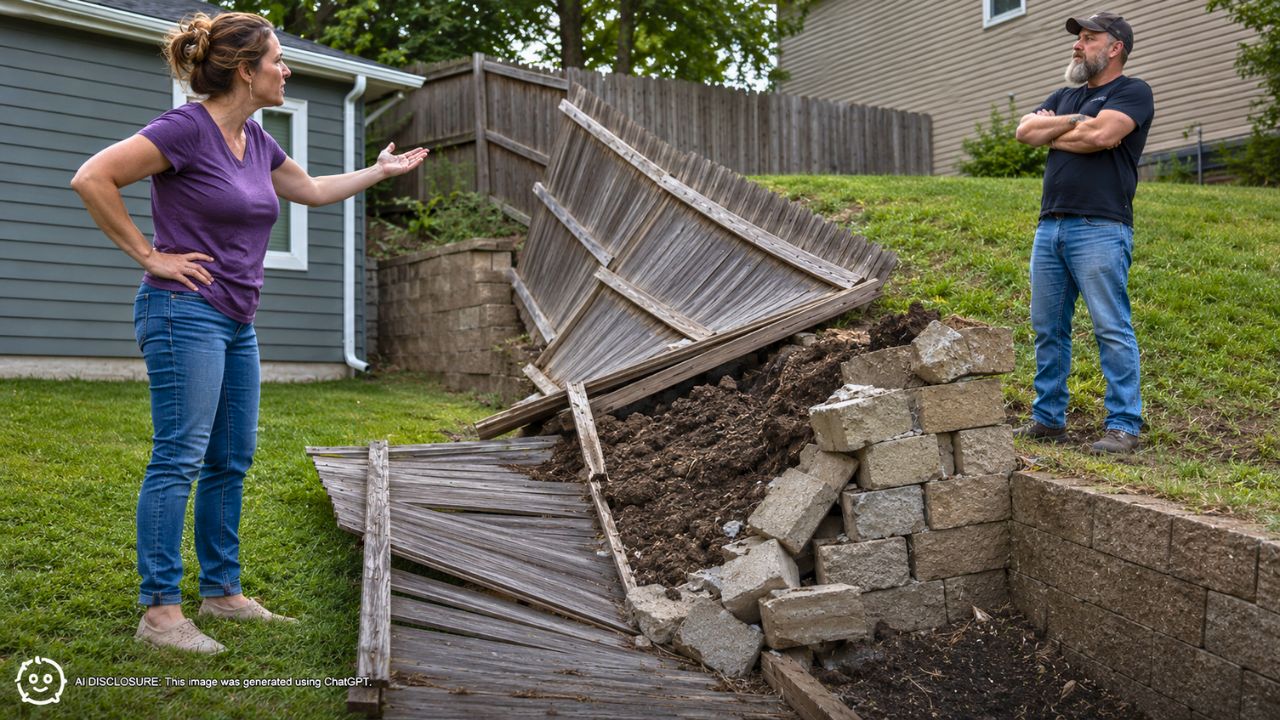
The fence didn’t just lean or lose a board. It was taken out in one violent move when the neighbor’s retaining wall gave way—dragging the shared boundary down with it and leaving one backyard wide open to the other.
In the original post, the homeowner explains that the south side of their yard sits uphill from the neighbor’s property, with an estimated 5–7 foot drop between the two backyards. When the downhill neighbor’s retaining wall collapsed, it didn’t stop at dirt and blocks. It pulled down the fence that used to divide the properties, and suddenly the homeowner’s immediate worry wasn’t aesthetics—it was their dogs.
A fence problem turned into a “who pays for what” fight
At first, the homeowner tried to be reasonable. They offered to split the cost of rebuilding the fence, even though the fence went down because the neighbor’s wall failed. That kind of offer is common when people want to keep the peace and get a boundary restored quickly.
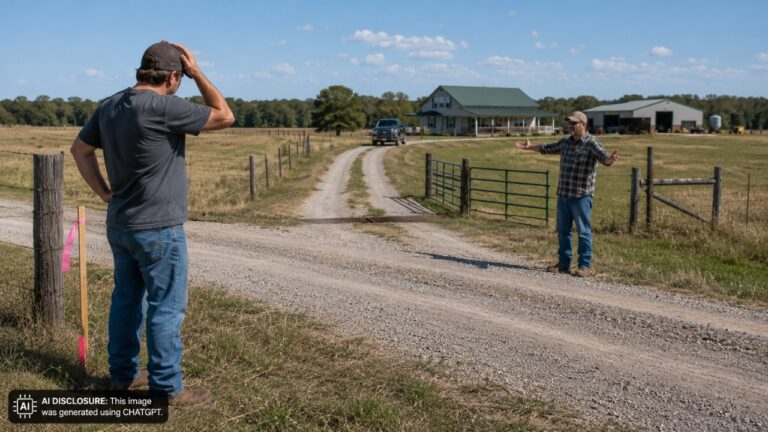
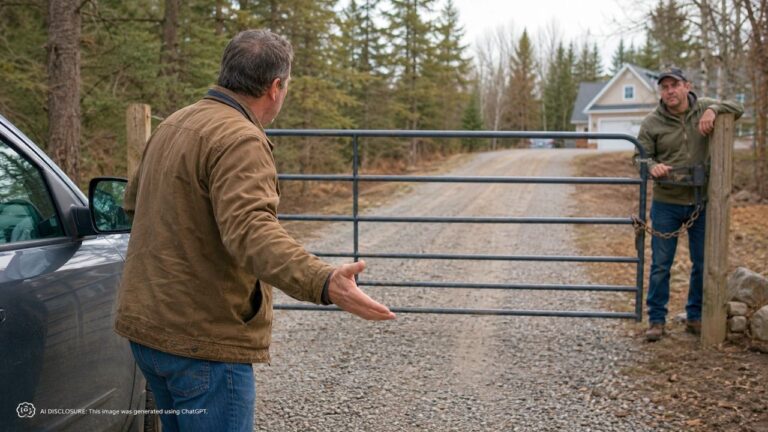
But the neighbor countered with a condition: he wouldn’t help get the fence back up unless the homeowner also agreed to split the cost of rebuilding his retaining wall. The fence wasn’t being treated like its own repair anymore. It became leverage.
That’s how small repair agreements blow up. Once one side ties your urgent need—privacy, security, containing pets—to their bigger bill, it stops being a straightforward “shared fence” issue and starts feeling like a ransom note written in concrete and rebar.
The drop between yards is what makes it messy
The detail that keeps sticking out is the grade difference: the neighbor is downhill by several feet. Retaining walls exist for a reason in setups like that. They’re not decorative; they’re holding back soil and controlling how the landscape behaves after rain, irrigation, and time.
When one fails, it doesn’t just change the look of the yard. It can shift soil, expose roots, mess with drainage patterns, and destabilize anything that was built near the edge—including posts and fence panels that used to feel solid.
And once that edge is compromised, the “easy” fix—throw up a new fence—may not stay fixed. If the slope is still unstable, the next heavy rain could tilt new posts, heave sections, or bury the bottom of the fence in slumped dirt. That’s part of why the neighbor is pushing the retaining wall issue: he likely knows the fence can’t be truly rebuilt like before without addressing what it was attached to or supported by.
The homeowner’s urgency isn’t cosmetic—it’s dogs and liability
The homeowner doesn’t frame this as a design dispute. They frame it as a daily-living problem: they don’t want their dogs jumping into the neighbor’s backyard now that there’s no barrier.
That’s the pressure point. When you have pets, an open property line isn’t just awkward—it creates risk. Dogs get out, dogs get blamed, dogs get hurt, and suddenly a neighbor dispute turns into vet bills or animal control calls or a bite accusation depending on how tense things already are.
Even if both neighbors are reasonable people, a missing fence changes behavior. It changes how you let pets out, how you use your yard, and how safe you feel. It also puts time pressure on a repair that might otherwise be scheduled “whenever contractors are available.”
Now the fence is being used as bargaining power
The homeowner’s core question is simple: are they obligated to help pay for the retaining wall?
But the lived reality is less simple. The neighbor has effectively tied two separate projects together: the fence everyone can see, and the wall that failed. He’s refusing to participate in restoring the fence unless the homeowner helps fund his wall rebuild too.
That refusal matters because it turns cooperation into a stalemate. The homeowner wants the fence back for immediate containment and peace of mind. The neighbor may see an opportunity to reduce a major expense by framing it as shared responsibility, especially since the two features are physically connected in the same area of the property line.
It also hints at a bigger issue: if the retaining wall was on the neighbor’s side and built to support the grade of his yard, he may view it as “protecting both properties.” But the homeowner likely views it as “his structure that failed and took our fence with it.” That’s how both can feel right, and still end up in a cold war over invoices.
What people pushed in response: document first, rebuild second
Even from this short description, the practical-minded reaction is predictable: before anyone agrees to “split” anything, they want documentation. When a wall collapses and takes down a fence, the key questions become whose structure it was, where exactly it sits relative to the property line, and what condition it was in before it failed.
In real-life neighbor repairs, people tend to urge a paper trail early—photos of the collapse, wide shots showing the yard levels, and close-ups showing how the fence was pulled down. Not because everyone is itching for a fight, but because memories get selective once estimates arrive.
They also tend to push homeowners to separate the immediate need (a temporary barrier so pets can’t cross) from the permanent fix (a properly rebuilt fence and whatever must be done to stabilize the grade). If the neighbor is refusing to cooperate, a temporary solution on the homeowner’s own property line can at least stop the dog problem while the bigger money argument plays out.
And when the dispute centers on a retaining wall, people often point out that it isn’t a casual DIY feature. Rebuilding one can involve engineering, drainage, and permitting depending on where you live—details that can change who is allowed to build it, how it must be built, and whether it can be rebuilt in the same footprint. That’s another reason neighbors push “slow down and document,” because rushing into an agreement can mean paying into a project that later gets redesigned or re-priced.
Until the wall question is settled, the backyard won’t feel normal
There’s a particular kind of stress that comes from losing a fence overnight. It’s not like an interior repair where you can close a door and ignore it. Every time the homeowner looks outside or lets the dogs out, they’re reminded: the boundary is gone, and the neighbor relationship is now part of their daily routine.
The homeowner tried the neighborly approach first—splitting the fence rebuild—only to find the ask expanding into a much larger bill. Now they’re left weighing two bad options: pay into a retaining wall they don’t believe is their responsibility, or risk weeks (or months) of an open yard while the neighbor digs in.
For now, the only thing that’s clear is the fence didn’t fall on its own. Something underneath it failed, and with it went the simple assumption that a shared boundary is easy to restore once it’s knocked down.
Like Fix It Homestead’s content? Be sure to follow us.