Downhill Homeowner Watches a Shared Retaining Wall Lean Onto Her Property — Then the Uphill Neighbor Insists She Pay for Repairs Even Though His Gutters Feed the Wall
Photo credit: AI-generated image created using ChatGPT. Illustrative only.
The homeowner knew exactly where the trouble was coming from: the strip of earth between two houses, where one yard sits a little higher and a retaining wall tries to keep gravity from winning. Except the wall wasn’t holding steady anymore. It was leaning—toward the downhill property—like a slow-motion shove that gets harder to ignore every time you look at it.
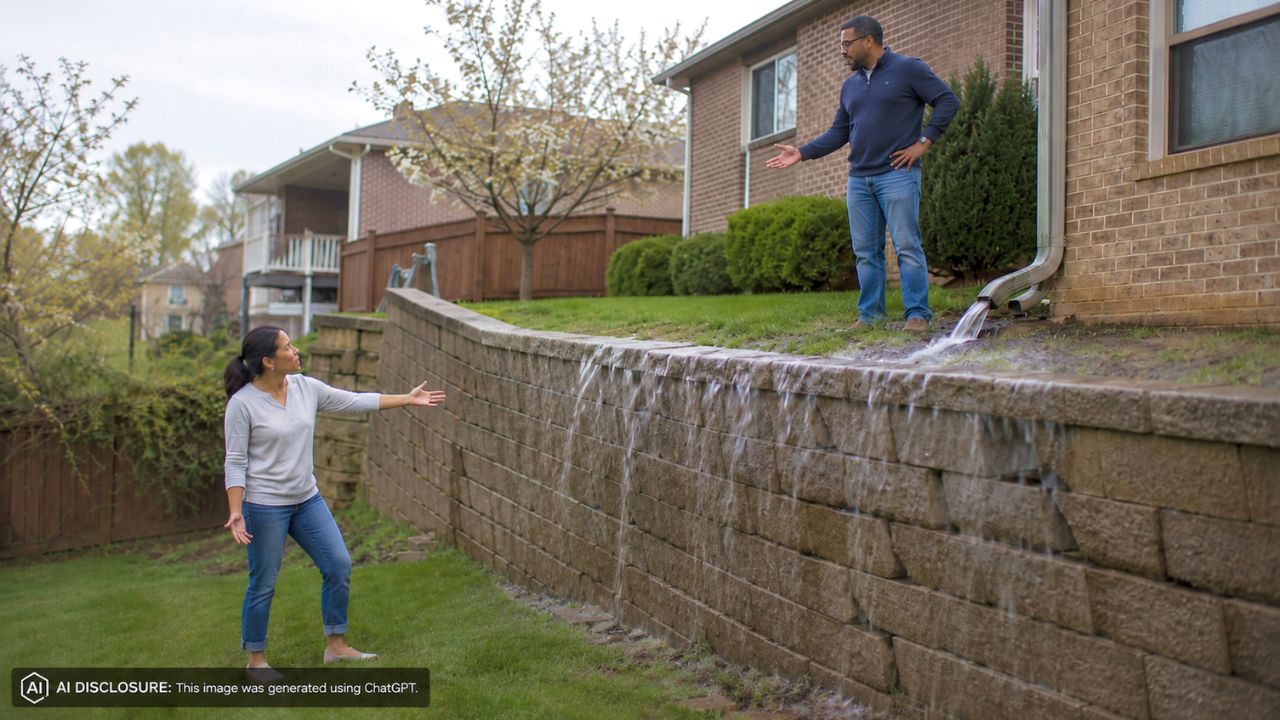
In the original post, the homeowner explained that the property line runs right through the middle of the retaining wall, meaning it physically sits on both properties. The uphill neighbor believes the downhill homeowner should pay to repair it. But the downhill homeowner sees it differently: the wall was built to hold up the uphill neighbor’s land, and the neighbor’s gutters appear to dump water straight into the wall and toward the downhill foundation.
A wall that doesn’t “belong” to just one person
This isn’t the clean, simple kind of property problem where something is clearly on one side of the line. The homeowner described a shared structure: the boundary runs through the center of the retaining wall itself. That detail turns a normal repair into a neighbor standoff, because “shared” can mean anything from “split the bill” to “split the blame,” depending on who you ask.
To the uphill neighbor, the leaning wall reads like a shared expense that the downhill owner should handle, maybe because the failure is most visible—and most threatening—on the downhill side. To the downhill homeowner, it reads like a wall that exists primarily for the uphill lot’s benefit. If it was built to hold back the uphill soil, then why should the downhill owner shoulder the cost alone?
The lean is pointing downhill, but the pressure is coming from above
Retaining walls don’t usually fail out of nowhere. They fail because they’re being asked to handle more load than they were designed for, or because water is getting into places it shouldn’t. In this case, the homeowner isn’t just watching the wall tilt; they’re also watching water move.
The homeowner believes part of the wall’s failure is tied to the uphill neighbor’s gutter drainage. Instead of being routed away, the water “flows right into the wall,” then continues onto the downhill property and “under my foundation.” That’s not just annoying runoff. That’s the kind of detail that changes the entire emotional temperature of the dispute—because now the argument isn’t only about a wall. It’s about potential structural damage to a home.
And that’s where the pressure spikes. A leaning retaining wall can be a future repair bill. Water under a foundation can be a present one.
The part nobody wants to say out loud: collapse doesn’t respect property lines
Even when neighbors disagree about who should pay, gravity doesn’t care. If the wall fails, the consequences won’t stop at the surveyed boundary. Soil can shift. Fence lines can move. Drainage patterns can change overnight. And the downhill homeowner is the one staring at the direction the wall is leaning.
That’s what makes this kind of shared-boundary problem so tense. The “fair” solution and the “safe” solution aren’t always the same timeline. A neighbor can argue for weeks. A wall can pick a rainy season and decide it’s done.
The homeowner’s post reads like someone trying to prevent the worst outcome—collapse—while also trying not to get stuck paying for a fix that primarily protects the uphill property. It’s the classic homeownership trap: you don’t want to pay, but you also don’t want to wait.
Gutters, runoff, and the quiet ways neighbors damage each other’s homes
The gutter piece is where this stops being a simple “split the repair” conversation. Water management is one of those hidden neighborhood battlegrounds that most people don’t notice until something starts rotting, cracking, or sliding.
If a gutter system is dumping water toward a retaining wall, that wall is absorbing the punishment. Saturated soil gets heavier. Hydrostatic pressure builds behind the wall. Freeze-thaw cycles can widen tiny cracks. Even a well-built wall can start to bow if drainage is wrong long enough.
Then there’s the downhill homeowner’s bigger fear: that the water isn’t just stressing the wall, it’s reaching the home’s foundation. That turns this into a two-front problem—one visible (the leaning wall), one potentially expensive and invisible (water where it doesn’t belong).
How readers typically react when a “shared” structure starts failing
Posts like this tend to pull practical, boots-on-the-ground reactions from other homeowners—because plenty of people have learned the hard way that neighbor disputes get messy fast once contractors, surveys, and water intrusion enter the picture.
The common instinct in these shared-line problems is to focus on proof before emotion: where the legal boundary truly is, what the wall was designed to do, and whether water is being directed improperly. When someone believes drainage from another property is contributing to damage, the advice usually leans toward documenting everything—photos of the lean, photos or video of gutter discharge during rain, and notes on when water shows up on the downhill side.
Another typical reaction is that the “who pays” question often depends on local rules and what’s actually on the deeds or plats, not just what feels fair. A wall built to retain one property’s soil can still become a shared maintenance problem if it straddles the line. On the flip side, drainage that’s actively causing damage can shift responsibility in practice, even if the wall itself is shared.
Underneath all of that is a blunt reality homeowners recognize: if you let a leaning wall go too long, you may lose the chance to repair it and end up having to replace it—at a much higher price—while also dealing with neighbor fallout.
The standoff: fix the wall, fix the water, or both?
The uphill neighbor’s demand—downhill homeowner pays—doesn’t address the runoff allegation at all. And from the downhill homeowner’s perspective, that’s the core of the problem: if the gutters are feeding water into the wall, repairing the wall without fixing drainage is like patching drywall while a roof leak continues.
That’s also why this kind of dispute escalates so quickly. One homeowner sees a leaning wall and a bill to split. The other sees an upstream cause and downstream damage, and hears “you should pay” as a refusal to take responsibility for what’s coming off the roof.
For now, the homeowner is left balancing two risks at the same time: the physical risk of a failing retaining wall, and the financial risk of becoming the default payer simply because the wall is leaning onto their side and threatening their house first.
In neighborhoods built on slopes, shared structures like this can turn neighbors into reluctant business partners overnight. The wall doesn’t care who’s right. It just keeps leaning, one wet season at a time, until someone decides the cost of action is finally lower than the cost of waiting.
Like Fix It Homestead’s content? Be sure to follow us.
- Man Says He Found Out the Fence He Paid For Wasn’t Actually on His Property
- Woman Says Her Neighbor Started Taking Mulch From Her Delivery Pile Before She Could Even Spread It
- I made Joanna Gaines’s Friendsgiving casserole and here is what I would keep
- What Caliber Works Best for Groundhogs, Armadillos, and Other Digging Pests?