Pennsylvania Buyer Explores an Acre of Forested Land Behind the New House — Then Finds a Neighbor’s Shed That’s Apparently Been Sitting on It for Years
Photo credit: AI-generated image created using ChatGPT. Illustrative only.
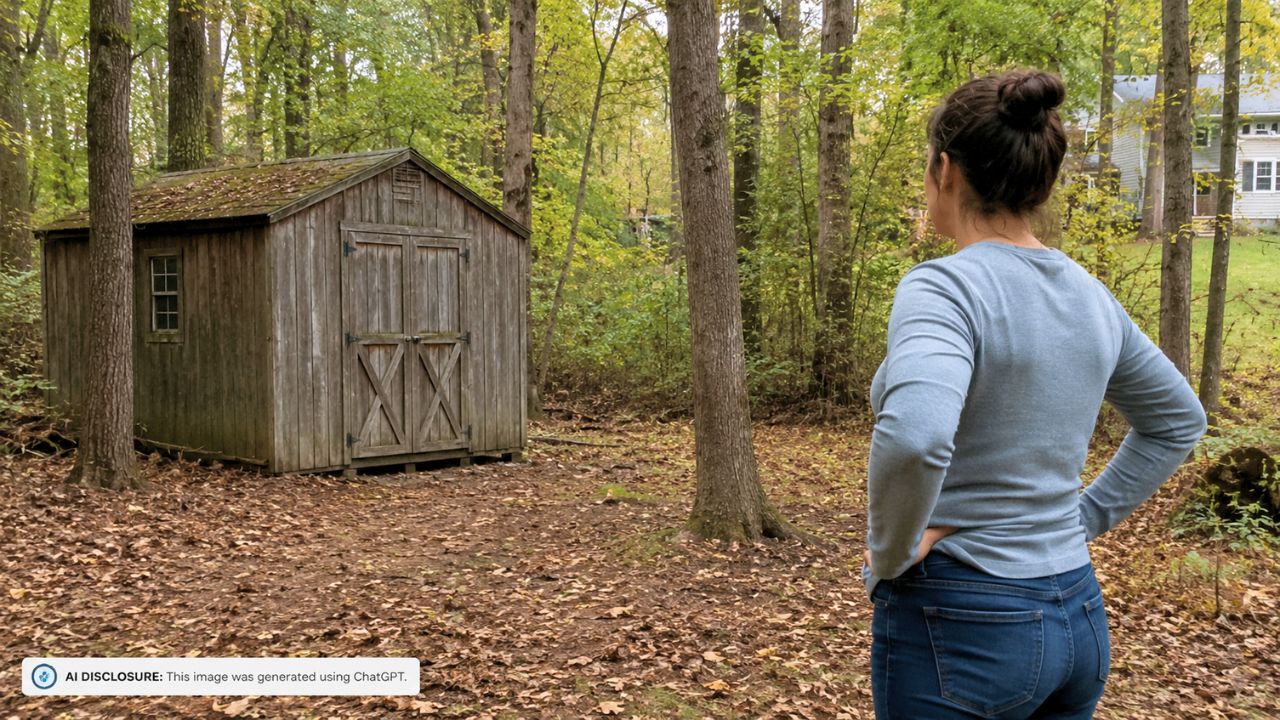
The back acre was supposed to be the quiet bonus: a strip of Pennsylvania woods behind a new backyard, the kind of space you explore slowly after closing—just to learn what you actually bought. But when the new owners finally walked the treeline, they didn’t just find fallen branches and old deer paths. They found a shed that appeared to belong to the neighbor behind them, sitting at least partly on their land.
In the original post, the homeowner explained that they’d bought the house just a few months earlier. The shed wasn’t something they noticed from the patio. It was tucked back in the wooded portion—about an acre of forested land—far enough away that it could easily escape attention during the early rush of moving in.
A back-lot surprise you don’t see during a walkthrough
This is the kind of discovery that feels almost unreal at first, mostly because it’s so ordinary. A shed is small enough to seem harmless, and in the woods it can look like it has “always been there,” even if it hasn’t. But it also screams one thing: property lines are not where someone thought they were.
The owners described it plainly: a neighbor “in the back” has a shed on their land, right along the line. That wording matters, because the shed might not be entirely over the line—it might just clip it. Or it might be deeper than it looks. Either way, it turns a pleasant back-acre into a question mark.
And questions multiply fast when the structure doesn’t belong to you.
The plan starts with proof: a survey before a conversation
The couple’s first move wasn’t to storm over or start hauling boards. It was to line up a survey. That’s a very homeowner response: before you say a word, you want to know what’s real and what’s “I think.”
Property lines in wooded areas can be especially tricky. Old pins get buried, fences wander, and informal landmarks—“that big oak,” “the rock pile,” “the edge of the brush”—shift over time. If the neighbor put the shed up years ago, they may have done it based on a guess, an old map, or someone else’s handshake version of the boundary.
Once the survey is done, the couple said they’d “probably have a friendly chat.” That’s also telling. They’re not looking to start a feud. They’re trying to figure out how to live next to someone while also protecting what they just bought.
The fear isn’t just the shed—it’s what comes with it
A shed sitting over a line isn’t just a cosmetic annoyance. It’s an access issue, a future sale issue, and sometimes an insurance headache. The homeowners’ concerns were immediate and practical: could the neighbor claim possession of any of the land, and if someone got hurt in the part of the shed that’s on their land, could the homeowners be held liable?
That’s the part that keeps people up at night. A structure on your land can blur responsibility in a way that feels unfair. If a tree falls on it, do you get blamed? If the neighbor is on “your” side doing repairs, are they trespassing—or is it now “their” area because the shed has been there? If a kid climbs it and falls, whose problem is that?
The homeowner also noted they don’t know how long the shed has been there, “presumably years at least.” That single line hints at the bigger worry: time. The longer something sits, the more entrenched it feels, and the harder it can be to untangle without emotions getting involved.
When “it’s been there forever” becomes a weapon
Even without anyone yelling yet, this kind of discovery carries a predictable script. The neighbor may say they didn’t realize. Or they may say the previous owner told them it was fine. Or they may insist the shed is exactly where it’s always been, and therefore it must be right.
For a new buyer, that’s a nasty spot to be in. You didn’t make the original mistake—if it is a mistake—but you inherited it. You’re the new face that suddenly “cares,” even though you just paid for the property and are trying to understand what you actually own.
And because it’s a shed, not a house, it can feel petty to push hard. But it’s also land, and land is what people fight over when everything else is going fine. Especially when the shed is in the woods, where nobody was looking closely until now.
Commenters zeroed in on documentation and the order of operations
While the original post focused on the couple’s immediate next step—getting a survey—the broader homeowner community response in situations like this typically centers on doing things in the right order. Proof first, then a calm conversation. If it really is over the line, put everything in writing before any memories “change.”
People in these threads also tend to emphasize not relying on assumptions. A lot of boundary fights start with, “Well, the old fence is the line,” or “Everyone’s always used it like that.” A survey is the cleanest way to stop arguing about vibes and start talking about measurements.
And then there’s the long-game advice: if the shed is on your property, don’t ignore it. Not because you need to go nuclear, but because ignoring it can create a pattern—access, maintenance, casual use—that’s hard to unwind later when you refinance, build a fence, or try to sell.
The next conversation is where it either gets solved or gets personal
Once the survey comes back, the shed stops being a vague discovery and becomes a clear request. If it’s over the line, the neighbor may need to move it, remove it, or come to some agreement. Each option carries costs, and nobody likes surprise costs—especially for a structure they thought was safely theirs.
That’s where tone matters. A “friendly chat” can stay friendly if it starts with the facts: “We had the lot surveyed, and it looks like the shed crosses onto our property.” Not an accusation. Just a shared problem with a proposed solution.
But even friendly conversations can go sideways if the neighbor feels cornered, or if they’ve treated that patch of woods as theirs for a long time. Some people get defensive fast when they hear words like “survey” and “property line,” because it sounds like the first step toward lawyers, even if it isn’t.
For the new homeowners, the tension is real but familiar to anyone who’s bought property with trees and invisible borders: you can’t fix what you don’t confirm, and you can’t live next door to resentment forever. A shed in the woods seems small—until it’s the only thing you can think about when you look at the back of your lot.
Like Fix It Homestead’s content? Be sure to follow us.