Rural Oklahoma Families Rely on One Dirt Road to Reach Their Homes — Then the Neighbor Who Owns It Blocks the Road With Cement Rocks
Photo credit: AI-generated image created using ChatGPT. Illustrative only.
It’s one thing to deal with a rutted dirt road in the country. It’s another thing to come home after dark and find the only way to your house intentionally blocked.
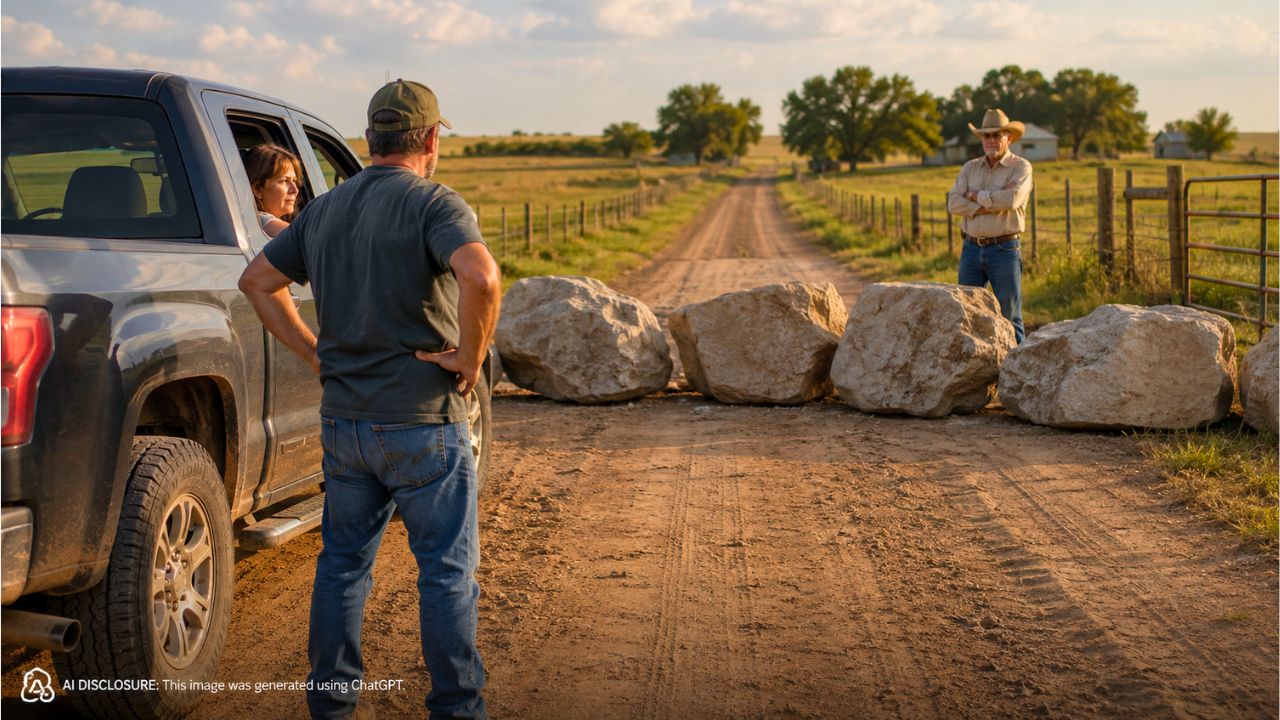
That’s what one rural Oklahoma family described in the original post: a dirt road used daily by about six families—trash pickup, deliveries, everyone—suddenly had large cement rocks dragged across it by a neighbor who can see the road from his house. The neighbor doesn’t use the road, but the poster says he claims people “drive too fast down it.”
A road everyone uses, owned by the one person who doesn’t
The setup is the kind that’s common outside town limits: one narrow dirt road, multiple homes tucked down it, and no alternate route. People rely on it for basic life—work commutes, medical appointments, groceries, and the steady stream of trucks that keep a household running.
But the twist here is ownership. The poster says the road is legally owned by the neighbor who put the barriers up. At the same time, the families living down it have been there for generations, and the poster’s mother says the road has been used publicly as the only way in and out for more than 50 years.
That combination—longstanding use, multiple households, and one owner—creates the kind of pressure point that doesn’t show up until someone decides to test how much control they really have.
The nighttime block that turned a bad neighbor mood into an emergency problem
According to the post, the neighbor placed the cement rocks after dark. That detail matters, because it changes the vibe from “grumpy complaint” to “this could trap people.” It also meant the first people to find it were just trying to get home.
The poster and their mother discovered the obstruction when they pulled in at night. They got out, moved the rocks, and drove through—then put the rocks back. Not because they agreed with the roadblock, but because they expected the neighbor would escalate once daylight came.
The immediate problem wasn’t a property-line argument. It was access. When the only road is blocked, everything gets urgent fast: can an ambulance reach an elderly resident, can a fire truck get down there, can a disabled neighbor even get to a vehicle without climbing out to move heavy chunks of concrete?
Why it hit harder than “people drive too fast”
The complaint itself is familiar: speeding on a shared lane, dust clouds, shaking windows, pets spooked by trucks. But the poster’s read is that it’s not the residents tearing through—it’s the unavoidable service vehicles. Trash trucks don’t exactly creep along when they’re on a route, and delivery drivers aren’t going to inch forward if they don’t know what the road surface is like.
Still, the response here wasn’t a phone call, a sign, or a chat with neighbors. It was a physical blockade. And the people who paid the price weren’t the “speeders” in the story—they were everyone else, including residents who may not be able to hop out and heave concrete off a road every time they need food or prescriptions.
That’s the thing about rural access: it’s not just convenience. It’s safety. You can’t “just take another way” when there is no other way.
Calls to authorities, but no appetite for a pricey legal fight
After the initial discovery, the family tried to pull the situation out of the neighbor-to-neighbor arena and into the public-safety lane. The poster says they called the police department and the fire marshal, and both said they would come out and look.
That move makes sense in a place where a private road can function like a public lifeline. If emergency access is compromised, the argument stops being about hurt feelings and starts being about whether someone is creating a hazard for multiple households.
But there’s another reality in the post: money. The family said they want to do things “the easy way first” before spending funds they don’t have on a lawyer. That’s an honest snapshot of how these disputes often unfold. People living on inherited land or in long-established rural pockets may not have the bandwidth to jump straight to court, even when the stakes are high.
In the meantime, the poster also took matters into their own hands—moving most of the rocks aside while walking down to check the mail. It’s not a long-term fix, but it’s the kind of day-to-day workaround people resort to when access gets threatened.
Proof, paper trails, and the quiet question of “rights”
Even without digging into legal jargon, you can feel the tension underneath the facts the poster shared. If a road has been used openly as the only access for decades, multiple households may assume it’s effectively a shared road—even if a deed says otherwise.
That gap between “what everyone’s always done” and “what the paperwork says” is where rural property disputes get ugly. A neighbor who suddenly asserts ownership can change life overnight, and the people affected are left scrambling to figure out what protections they have—especially when the land use predates anyone’s current memory.
The post also hints at something else: the value of documentation. When the only access is being interfered with, the details matter. When it happened (after dark), what was used (large cement rocks), and who it affects (about six families, including elderly and disabled residents). Those specifics are the kind of facts that can be clearly communicated to officials when you’re trying to get someone to take it seriously.
Then the rocks were stacked off to the side—by someone else
The most interesting development in the updates is that the rocks didn’t just disappear from the road. They ended up placed to the side in stacks. The poster says they did not stack them; when they moved rocks earlier, they tossed them off into the grass.
That detail opens up a few possibilities without confirming any of them. Maybe an official visit prompted the neighbor to clear the road. Maybe another resident got tired of the blockade and made it passable. Maybe the neighbor moved them to make the point without fully blocking access.
Whatever the reason, the road was no longer obstructed in the same way when the poster checked again. The tension, though, doesn’t vanish just because the rocks moved. Once someone has shown they’re willing to block the only route in and out, every drive home comes with the question: will it be there again tonight, and will it be heavier next time?
For now, the families down that dirt road are watching, waiting, and hoping the next “solution” doesn’t come in the form of another midnight barricade.
Like Fix It Homestead’s content? Be sure to follow us.