Rural Landowner Finds Former In-Laws Still Living Next Door on Forty Acres — Then an Old Easement Twenty Feet From the Patio Becomes a Fight
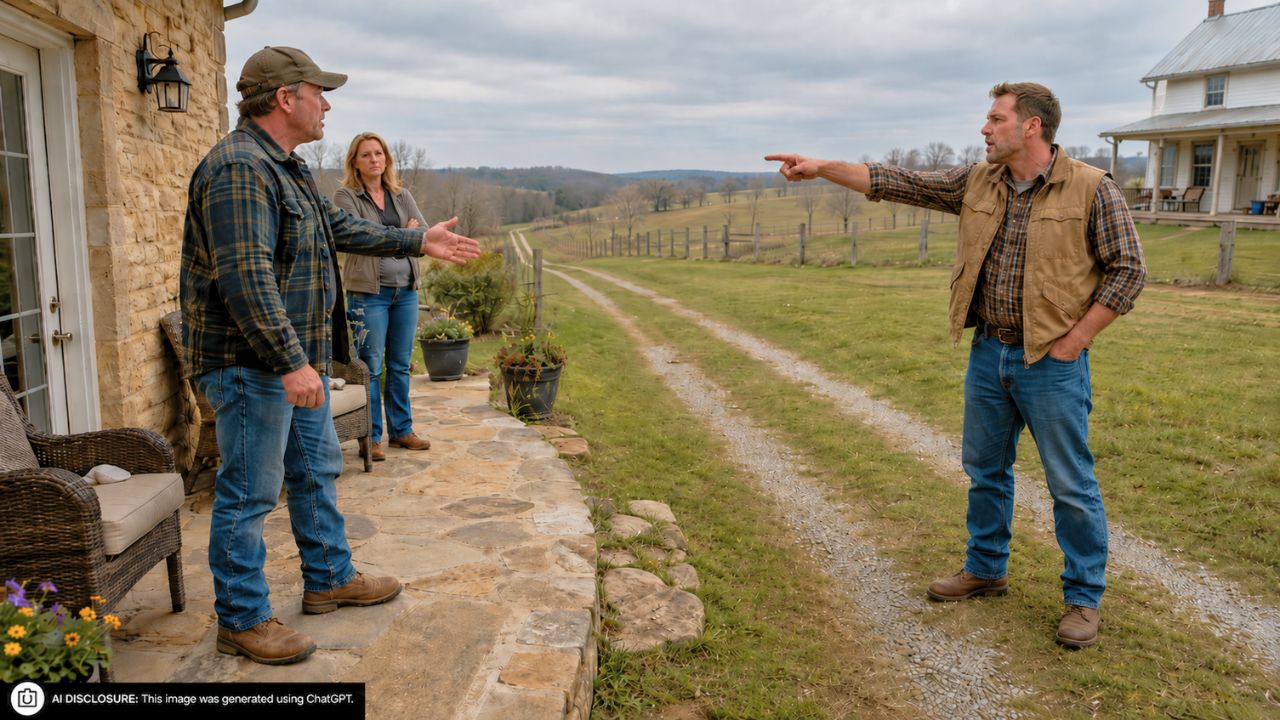
Photo credit: AI-generated image created using ChatGPT. Illustrative only.
When you buy a rural house out of foreclosure, you expect some cleanup. Maybe a few half-finished projects, maybe some awkward neighbor vibes. What one Michigan family didn’t expect was to inherit a backyard that effectively wasn’t theirs—because a long-standing easement cuts through it just about 20 feet from their back patio.
The details came out in the original post, where the homeowner described how “keeping the peace” with the neighbors slowly turned into a daily safety worry, a construction-zone headache, and a property-line standoff that didn’t start with fences at all. It started with cars and trucks flying through what should have been a place for kids to play.
A foreclosure sale with old family ties still attached
The backstory reads like the kind of small-town chain reaction that never really ends. An elderly neighbor owned about 40 acres for more than 50 years. In 2006, she split it, giving half to her son and daughter-in-law so they could build a home.
But the family’s finances unraveled. According to the homeowner, the son took out a balloon mortgage and later left. In 2016, the daughter-in-law couldn’t cover the lump sum when the loan term ended, and the house went into foreclosure. She then moved in next door with her former mother-in-law—meaning the new buyers weren’t just purchasing a home, they were moving next door to people who still felt emotionally tied to it.
The homeowner said they tried to stay on “good(ish) terms,” but the bitterness never fully went away. The neighbors still acted like the property was partly theirs, and over time that attitude began showing up as tire tracks and “normal” use of the yard.
The backyard that turned into a drive-through
The pressure point is an easement that runs straight through the back of the property, leaving the family with 20 acres but “no backyard.” The easement sits close enough to the house that it’s not an abstract map problem—it’s right there off the patio.
With young children at home, the homeowner said the neighbors regularly drive through at 25+ miles an hour. It’s hard to relax when the space behind your house functions like a private road for someone else. It also changes how you use your own land: no safe play area, no sense of separation, and no real way to tell guests where the “yard” ends.
Then there’s the invisible issue. The easement runs over the septic drain line, and heavy vehicles can compact soil, crush pipe, or damage the field over time. The homeowner also described months of construction traffic, including “numerous concrete trucks,” grinding over that strip and beating it up.
At that point, the homeowners didn’t just want less inconvenience—they wanted less risk. Their idea was to relocate the easement to the front of the property, even offering to do it at their own expense. But moving an easement typically requires agreement, and the neighbors didn’t just say no. They came with a price.
“Move it… if you give us 10 acres”
Instead of negotiating over the route, the neighbors proposed a trade: they’d only agree to move the easement if the homeowners gave them 10 of the 20 acres. The homeowner wasn’t interested, and the demand changed the tone from neighborly friction to boundary war.
Until then, the homeowners admitted they’d been “relatively lax” about boundaries. They allowed a mowed trail through their land. They let neighbors store construction scrap on their property. The kind of informal permission that feels friendly in the moment can start looking like a mistake once lawyers and surveys enter the picture.
So they did the one thing that turns rural assumptions into hard lines: they ordered a survey.
The survey didn’t just confirm lines—it found a propane tank and a new driveway over them
The survey results brought the kind of surprise that makes your stomach drop. The homeowners learned that when the property was split back in 2006, the neighbors’ propane tank ended up on the buyers’ side—by almost 30 feet.
That’s not a minor “the grass grew over the stake” problem. A propane tank is a physical object tied to safety, liability, and access. If it’s on your land and something happens, you don’t want to be in the middle of a blame game about whose tank it was, who maintained it, or who had the right to be there.
Worse, the survey also showed fresh encroachment: the neighbors had put in a new garage and a new driveway that the homeowners said crossed onto their property by 26 feet. Unlike the old tank placement, this wasn’t a decades-old artifact of a family split. It was new construction.
When the homeowners raised those encroachments, the response wasn’t cooperation. They got a text saying their state-certified surveyor was wrong, and that the neighbor “never would have split the property like that.” In other words, the neighbors weren’t just disputing a line—they were disputing reality, even with certified measurements in hand.
Practical consequences: safety, damage, and the fear of being stuck with someone else’s hazard
This is where rural property drama stops being theoretical and starts costing money and peace of mind. The homeowners aren’t only worried about a few feet of land. They’re worried about vehicles cutting through close to the house, about the septic system quietly getting damaged, and about whether they’ll be stuck accommodating equipment and traffic indefinitely.
They also want to protect themselves long-term. If the propane tank stays on their land, they don’t want to be responsible if it’s damaged, or if someone claims they interfered with it. And if a driveway was built over the line, that can turn into an entrenched “this is how we’ve always done it” claim fast—especially if nobody stops it early.
At the same time, the homeowners know they can’t simply pick up the easement and move it without the neighbors’ permission. That’s what makes the standoff so tense: their best solution depends on someone who’s already demanding a huge concession.
How readers reacted: document everything, and don’t let “informal” become permanent
Even without a full comment thread included, the homeowner’s questions point to the kind of advice property-law veterans tend to give in these moments: don’t argue from memory, argue from documents. A survey is a start, but people in similar disputes often push homeowners to keep everything in writing, stop granting casual use that looks like permission, and treat encroachments like time-sensitive problems—especially when new construction is involved.
Just as important, there’s a common warning that shows up in almost every boundary fight: the longer an encroachment sits uncontested, the harder it can be to unwind—emotionally, practically, and sometimes legally. That doesn’t mean the homeowners automatically lose, but it does mean letting it slide rarely makes it easier later.
For this Michigan family, the immediate question is leverage: can they use the propane tank and the driveway encroachment to push for an easement move without giving up half their land? What they’ve already learned the hard way is that rural space doesn’t guarantee rural peace. Sometimes, the biggest fight on 20 acres is over a strip of ground only wide enough for a truck—especially when it runs twenty feet from your back door.
Like Fix It Homestead’s content? Be sure to follow us.