New Jersey Homeowner Catches the Neighbor Tending a Garden Built Directly on the Property Line Marker — Then She’s Caught Gardening From His Side, Insisting She’s “Not Touching” Anything
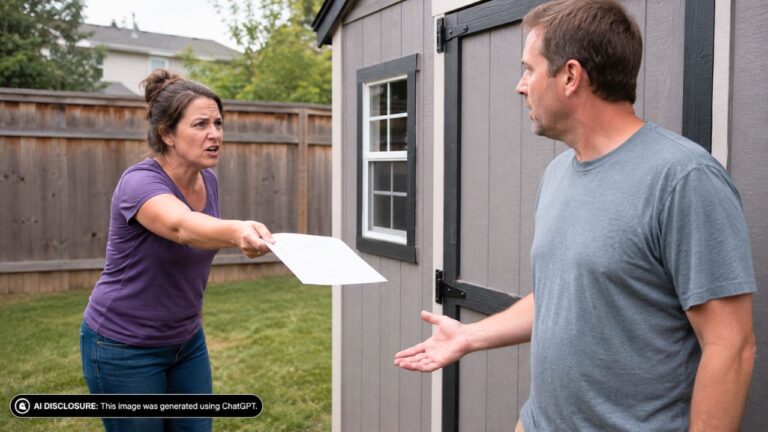
Photo credit: AI-generated image created using ChatGPT. Illustrative only.
It started with a garden—stones set tight to the boundary, plants tucked right up against the property line marker like a dare. A New Jersey homeowner says his neighbor didn’t just build a new bed near the line, she built it on the line, turning a strip of dirt into the latest chapter of an ongoing feud.
In the original post, the homeowner describes the kind of neighbor tension that never fully goes away. It quiets down for a while, then comes back in a new form. This time, it’s landscaping—pretty on the surface, but loaded with implications about access, boundaries, and who gets to claim an extra few inches.
The first battles were about smoke, not soil
The homeowner says the history goes back a couple of years, to an earlier argument involving a swing hanging from the neighbor’s tree. The branch extended over his property, and he didn’t mind—until the neighbor started complaining about a fire pit.
According to the homeowner, the fire pit is on his property and came with the house. But he says the neighbor objected to it, claiming the smoke went into her home and that it was damaging her swing because she placed it near the pit.
He alleges she called the police whenever they used it, accusing them of burning garbage. He says that wasn’t true, explaining they burned fallen branches and leaves, and used cardboard only as tinder underneath. Even after things cooled down for a couple of years, he says the dynamic stayed the same: she pushes, he tries not to react.
The garden bed shows up right on the line
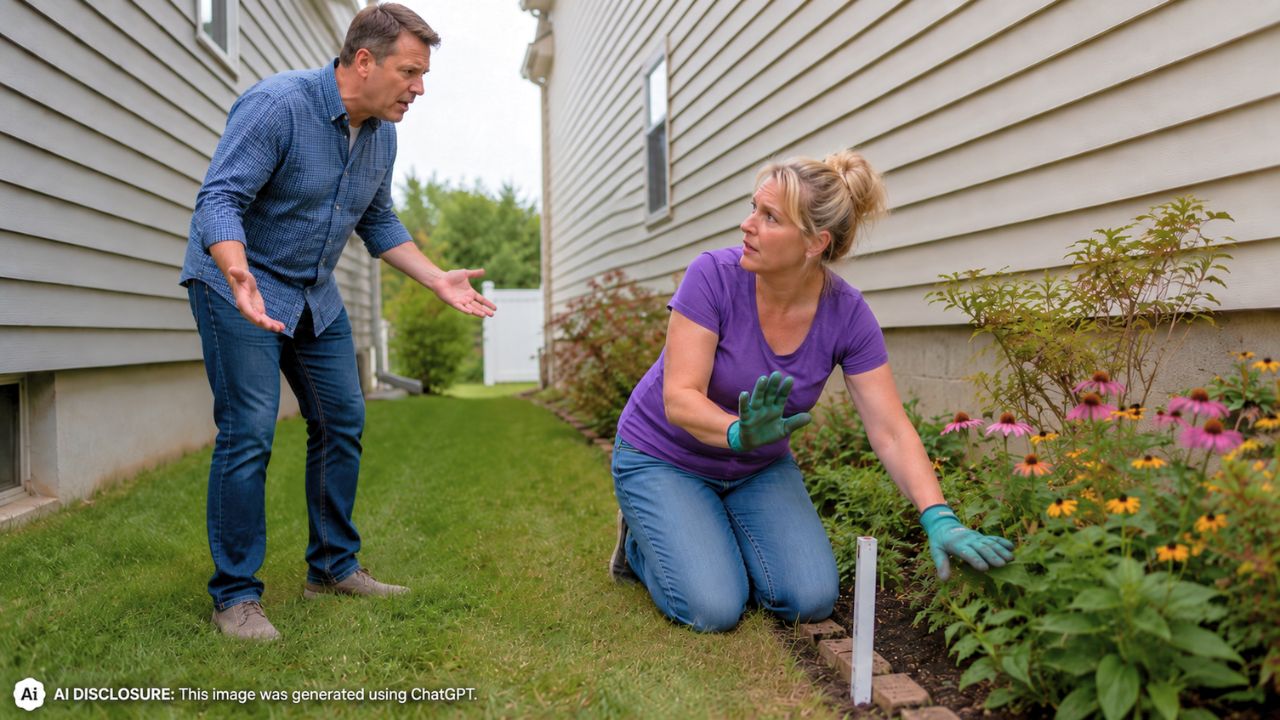
Last week, he says, the neighbor built a garden on her side and directly on the property line, including around the property line marker. It wasn’t just “near” the boundary—he describes it as placed to straddle the exact divider, the kind of choice that feels less like gardening and more like posturing.
That’s where the homeowner’s worry turns practical. A bed built on the line isn’t just an eyesore or an annoyance. It can become an argument about whose job it is to maintain it, who can access it, and whether it quietly shifts how the boundary is treated over time.
He also says he’s been told nothing can be built or planted on the property line unless both neighbors agree. He’d heard that many places require an offset—he mentions “at least 3–5 feet” on each side in typical cases—though he’s not presenting that as a confirmed local rule so much as what he believes applies in general.
Then she’s caught tending it from his side
The part that made it feel deliberate wasn’t just where the garden sat. The homeowner says he caught her on his property tending the garden from his side—standing on his side of the line to do the work.
He describes it as a kind of petty boundary game: the adult version of “I’m not touching you,” with the neighbor insisting she’s “not touching” anything even while she’s physically occupying space she doesn’t own. It’s the kind of move that can be hard to challenge in the moment without escalating into a shouting match.
And he’s trying not to be pulled into that. He says he doesn’t speak to her, doesn’t address her, and doesn’t bother her—partly because he doesn’t want to lose his temper and become “that hood girl anymore,” as he puts it. The restraint is intentional, but it comes with a cost: the longer it goes on, the more normalized her behavior can become.
Paperwork says one thing, real life says “prove it”
When he went to the Sparta Police Department, he says they told him it was a civil matter. That’s a common wall homeowners hit in property-line disputes: law enforcement may respond to keep the peace, but they rarely adjudicate boundary questions.
Still, he says he was told he could remove stones from the property line and from around the property line post marker. He was also told he may need to have a survey done, even though he says he has paperwork from when he bought the house that clearly shows the line.
This is where homeowners get trapped between “I know where the line is” and “Will that hold up when a neighbor keeps testing it?” Closing costs paperwork and old diagrams can be helpful, but if a neighbor decides to fight, the clean answer is often an updated survey—time, money, and one more thing to schedule, all because someone decided to plant flowers in the wrong place.
The yard-sign line didn’t hold, either
The homeowner includes another detail that shows how long this has been simmering. At one point, after the neighbor nastily told him to “keep your f$#€ing kid off my property,” he tried to mark the line with yarn and yard signs to make sure his child stayed off her side.
He says she mowed it all down.
That’s not just petty. It’s the kind of act that turns a boundary into a moving target. When one neighbor tries to be cautious and the other wipes out the markers, it sends a clear message: “I get to decide where the line is.” And once someone starts gardening right on top of a property marker, it’s hard not to see it as part of the same pattern.
Reactions centered on proof, not shouting matches
The homeowner asked for advice, and the practical tone of the responses—at least from what the post itself points toward—leans toward documentation and de-escalation. When a neighbor dispute has a history, people tend to focus on what can be proven instead of what can be argued.
The first step many homeowners in this kind of standoff consider is getting the boundary professionally confirmed, even if it feels redundant. The second is keeping the conflict from becoming a daily face-to-face fight: photos of the garden’s placement, notes on dates and behavior, and keeping interactions minimal.
Because once it turns into two people yelling over a garden bed, the story gets muddy fast. But if it stays about measurable facts—where the marker is, where the stones are, who is stepping over the line—it’s harder for the issue to be waved away as “just neighbors not getting along.”
For now, the homeowner is left with an awkward choice: remove stones he says he was told he could remove and risk provoking the next retaliation, or let the garden sit there and watch the boundary be tested day after day. The problem isn’t the flowers. It’s the message behind them—and the way a few inches of dirt can turn into a long, expensive war of attrition.
Like Fix It Homestead’s content? Be sure to follow us.