Homeowner Traces a Flooded Crawl Space to Five Garden Hoses Running From the Neighbor’s Yard — Then He Admits to Pumping 12 Million Gallons Onto Her Property
Photo credit: AI-generated image created using ChatGPT. Illustrative only.
It started like one of those ugly, slow home problems that never feels like an emergency—until it does. After a heavy winter of snowfall, one homeowner watched the water table climb and his crawl space begin taking on water, the kind of damp creep that makes you worry about mold, rot, and what’s happening under the floors when you can’t see it.
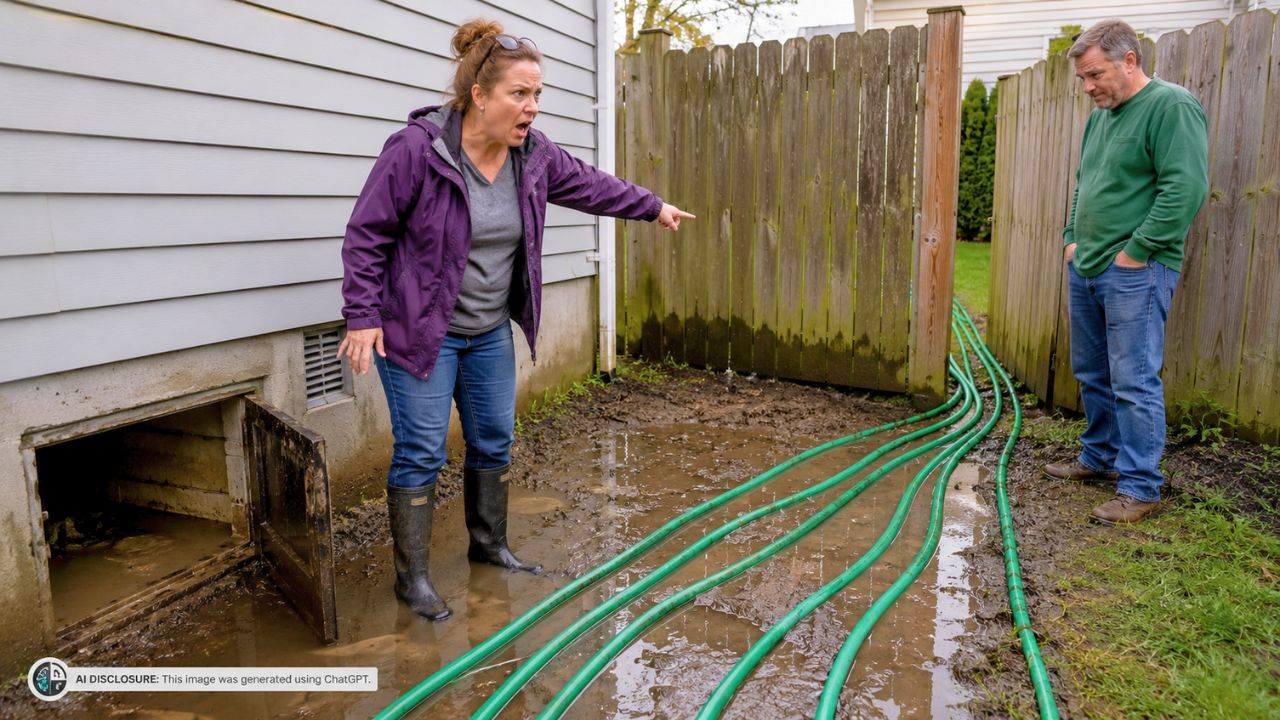
He and his wife tried to get ahead of it with a sump pump, and for a while it sounded like they were managing. But by summer, with not much sun and the ground still saturated, the yard wouldn’t stay dry. When he finally walked the property to figure out why the flooding kept returning, he says he found the real culprit: five garden hoses running from the neighbor’s crawl space into a backyard that sloped straight toward his own home, as described in the original post.
The first “it’s just the water table” phase
The homeowner’s timeline will sound familiar to anyone who’s battled groundwater. A snowy winter pushed local conditions past normal, and the crawl space began filling. A sump pump helped, but it wasn’t a “set it and forget it” fix—he said it ran frequently, more like a constant defensive move than a permanent solution.
Then summer arrived without much relief. With continued wet weather and lingering high groundwater, the yard started holding standing water. They even tossed a sump pump into the low area outside to drain it faster, and it helped… briefly. The frustrating part was that the yard never seemed to stay drained for long, and the flooding would return in less than a day.
That pattern—temporary improvement followed by quick re-flooding—often makes homeowners suspect something upstream. Water doesn’t keep showing up in volume without a source, and the “source” isn’t always Mother Nature.
A walk around the yard revealed five hoses and a downhill problem
The turning point was simple: he went for a walk to see if the issue was bigger than seasonal groundwater. That’s when he noticed the neighbor had routed five garden hoses from his crawl space, discharging into his own backyard.
The problem wasn’t just that water was being pumped out. It was where it was going. The neighbor’s yard sloped directly down into the homeowner’s yard, turning that hose discharge into a steady, directed flow toward the already-soggy property.
In other words, it wasn’t merely runoff from rain or snowmelt. It was dewatering from one crawl space being offloaded into another homeowner’s drainage problem, using gravity like a conveyor belt.
The neighbor didn’t deny it—he just didn’t want it to be his problem
When confronted, the neighbor didn’t argue about the hoses. The homeowner asked if they could be redirected away from his house. The response he got was blunt: moving the hoses would “just flood” the neighbor’s yard.
During that conversation, the homeowner learned something that made the whole situation feel less like a misunderstanding and more like an ongoing decision. The neighbor admitted he had pumped “12 MILLION gallons” into the homeowner’s yard.
The homeowner also understood the technicality that complicates these disputes: the hoses weren’t physically lying across his property line. They were still on the neighbor’s side. But the impact—the flooding—wasn’t staying contained. The discharge was effectively being aimed downhill into someone else’s yard, and the neighbor was openly saying he wasn’t planning to change it.
Why this kind of crawl space flooding can turn into expensive hidden damage
A wet crawl space isn’t just an annoyance. It can be a slow demolition. Persistent moisture can warp wood, feed mold, and invite pests that thrive in damp conditions. Even when a sump pump “handles it,” a constantly running pump usually means the house is living on borrowed time—and one power outage, pump failure, or clogged line can turn “managed” into “disaster” fast.
Outside, a yard that can’t dry out can start affecting grading and soil stability. Standing water near a foundation is the nightmare scenario: it finds cracks, it pressures walls, and it keeps humidity high under the home. The homeowner had already taken steps—installing a sump pump, trying to drain standing water—but now he was facing a new reality: he might be trying to out-pump another person’s pumping.
The cruel part is that the neighbor may also be dealing with a real groundwater issue. But pumping a crawl space and dumping that water where it runs straight into someone else’s low spot turns two homes’ problems into one person’s bill.
HOA on paper, muddy yard in real life
The homeowner said he has an HOA—$100 a year—and planned to contact them. That detail says a lot. This isn’t a high-control neighborhood with an office staff and a stack of enforcement letters ready to go. It sounds like a light-touch association, the kind that might cover minimal common needs and not wade into disputes unless there’s a clear rule being broken.
Still, the HOA was the first “official” channel he could think of. When a neighbor won’t cooperate, homeowners often go looking for any structure with authority: HOA covenants, municipal drainage rules, building codes, or a local agency that handles property standards. Even if the HOA can’t fix the drainage, a written complaint creates a record that the issue was reported and not just handled with one heated conversation over a fence.
And that’s where this gets tense: the homeowner isn’t simply dealing with water. He’s dealing with a neighbor who has already justified the damage as necessary—because the alternative is damage to his own yard.
What people urged: document first, because water fights get ugly fast
In homeowner disputes like this, the practical advice tends to converge quickly: prove what’s happening before you escalate. With water, emotions run high and memories get fuzzy. A soggy lawn can be blamed on weather. A wet crawl space can be blamed on “old house problems.” Hoses running from a crawl space toward a downhill property are harder to explain away if they’re documented.
Homeowners in similar conflicts often push for basics: photos and videos of the hoses, the discharge point, and the pooling water; a dated log of when flooding occurs; and records of sump pump run time if available. It’s not about being dramatic. It’s about being able to show patterns—especially if the neighbor later moves the hoses or claims they were never there.
Just as importantly, people tend to recommend keeping communication in writing after the first conversation. If the neighbor is openly stating he won’t redirect the water because it would flood his own yard, that’s a major detail to preserve accurately.
For now, the homeowner is stuck in the worst phase of these property problems: he knows where the water is coming from, he knows it’s not going to stop on its own, and he’s staring at a fix that may require more than a pump. It may require someone with authority telling the neighbor that “not my yard” isn’t a drainage plan.
Like Fix It Homestead’s content? Be sure to follow us.